3.2 Short-Run Production Costs
Short-run production costs for AP Microeconomics: fixed and variable cost, marginal and average costs, why MC slopes up, and what shifts the curves.
Part 1 of 3 Fixed and Variable Costs
Total cost is fixed cost plus variable cost. Fixed cost stays the same at every level of output, including zero. Variable cost changes as output changes.
Hollin Farm is a fictional potato farm that sells into a market with hundreds of farms selling identical potatoes. The farm pays $600 a week for its land lease and equipment loan, whether it harvests 0 tons or 7. Fuel, seed and workers' wages are variable costs.
| Tons | Total cost | Variable cost | Marginal cost | AVC | ATC |
|---|---|---|---|---|---|
| 0 | $600 | $0 | |||
| 1 | $900 | $300 | $300 | $300 | $900 |
| 2 | $1,100 | $500 | $200 | $250 | $550 |
| 3 | $1,260 | $660 | $160 | $220 | $420 |
| 4 | $1,440 | $840 | $180 | $210 | $360 |
| 5 | $1,700 | $1,100 | $260 | $220 | $340 |
| 6 | $2,040 | $1,440 | $340 | $240 | $340 |
| 7 | $2,450 | $1,850 | $410 | $264.29 | $350 |
Read the table from left to right. Total cost at 0 tons is $600, which is all fixed cost. Each row adds the variable cost of a larger harvest. At 4 tons, variable cost is $840, so total cost is $600 + $840 = $1,440.
Part 2 of 3 Marginal and Average Costs
| Measure | How to calculate it | Hollin Farm at 4 tons |
|---|---|---|
| Marginal cost (MC) | Change in total cost divided by change in output | $1,440 - $1,260 = $180 for the 4th ton |
| Average fixed cost (AFC) | Fixed cost divided by output | $600 / 4 = $150 |
| Average variable cost (AVC) | Variable cost divided by output | $840 / 4 = $210 |
| Average total cost (ATC) | Total cost divided by output, or AFC + AVC | $1,440 / 4 = $360 |
Marginal cost, all three average costs, total cost and variable cost all change as output changes. Fixed cost does not. Average fixed cost keeps falling, because the same $600 is spread over more tons.
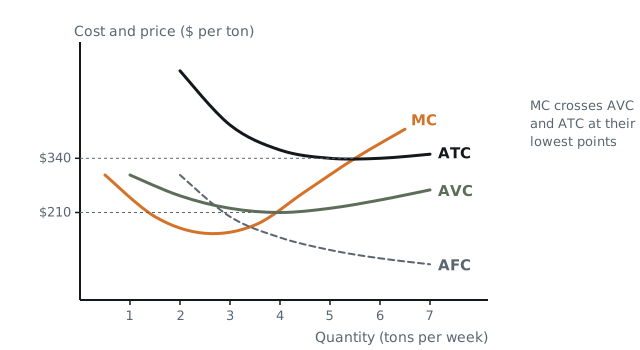
Marginal cost crosses average variable cost and average total cost at their lowest points. When the next ton costs less than the average, the average falls. When it costs more, the average rises.
Part 3 of 3 Why Marginal Cost Rises
A production function with diminishing marginal returns gives an upward-sloping marginal cost curve. Each new worker adds less output, so each extra ton needs more labor and costs more. At low output, marginal cost falls first. Specialization and the division of labor let workers split tasks, which lowers marginal cost for the first few tons.
Cost curves also shift when input prices or productivity change. A change in fixed cost moves only the curves that include fixed cost. A change in a variable input's price moves every curve that includes variable cost.
| Change | Curves that shift up | Curves that stay put |
|---|---|---|
| Fixed cost rises (a higher land lease) | AFC and ATC | MC and AVC |
| Variable input cost rises (higher wages) | MC, AVC and ATC | AFC |
| Productivity rises (a faster harvester) | None: MC, AVC and ATC shift down | AFC |
Key Terms
Practice Questions
6 questions. Nothing here is recorded or scored.
- Question 1PRD-1.A.4, PRD-1.A.5
Tallis Print Shop
Tallis Print Shop pays $200 a day for rent and its press lease, whatever it prints. The table shows its total cost for different numbers of print jobs per day.
Jobs per day | Total cost 0 | $200 1 | $260 2 | $300 3 | $360 4 | $440 5 | $550 What is the average variable cost of 4 print jobs?
- A.$110
- B.$60
- C.$80
- D.$50
Check answerHide answer
Answer: B
- A.
- This is average total cost, $440 divided by 4. Average variable cost leaves out the $200 fixed cost.
- B.
- Correct. Variable cost at 4 jobs is total cost minus fixed cost: $440 - $200 = $240. Average variable cost is $240 divided by 4, or $60.
- C.
- Eighty dollars is the marginal cost of the 4th job, $440 - $360.
- D.
- Fifty dollars is average fixed cost, $200 divided by 4.
- Question 2PRD-1.A.5
Jobs per day | Total cost 0 | $200 1 | $260 2 | $300 3 | $360 4 | $440 5 | $550 What is the marginal cost of the 5th print job?
- A.$550
- B.$350
- C.$70
- D.$110
Check answerHide answer
Answer: D
- A.
- This is total cost at 5 jobs. Marginal cost is the change in total cost from 4 jobs to 5.
- B.
- This is variable cost at 5 jobs, $550 - $200.
- C.
- This is average variable cost at 5 jobs, $350 divided by 5.
- D.
- Correct. Marginal cost is the change in total cost: $550 - $440 = $110. Average total cost at 5 jobs is also $110, which shows marginal cost crossing ATC near its lowest point.
- Question 3PRD-1.A.8
Jobs per day | Total cost 0 | $200 1 | $260 2 | $300 3 | $360 4 | $440 5 | $550 If the shop's rent rises by $50 a day, which of the following will happen?
- A.Marginal cost rises by $50 at every quantity.
- B.Average variable cost rises, and average total cost does not change.
- C.Average total cost rises, and marginal cost does not change.
- D.All of the shop's cost curves shift up.
Check answerHide answer
Answer: C
- A.
- Rent does not change with the number of jobs, so it does not change the cost of one more job.
- B.
- Rent is fixed, so it affects AFC and ATC, and AVC stays the same.
- C.
- Correct. Rent is a fixed cost. A higher fixed cost raises AFC and ATC at every output, but it adds nothing to the cost of one more job, so MC and AVC stay the same.
- D.
- MC and AVC depend only on variable costs, so they do not move.
- Question 4PRD-1.A.5
Which of the following is true of a firm's total fixed cost in the short run?
- A.It is the same at every level of output, including zero.
- B.It rises as output rises.
- C.It is zero when the firm produces nothing.
- D.It falls as output rises, because it is spread over more units.
Check answerHide answer
Answer: A
- A.
- Correct. Fixed cost does not change with output. A firm that produces nothing still pays it.
- B.
- That describes variable cost.
- C.
- Fixed cost must be paid even at zero output in the short run.
- D.
- Average fixed cost falls as output rises. Total fixed cost stays the same.
- Question 5PRD-1.A.6, PRD-1.A.7
Which of the following best explains why a firm's marginal cost curve eventually slopes upward?
- A.Fixed costs rise as output rises.
- B.Specialization lowers the cost of each additional unit.
- C.Diminishing marginal returns: each extra unit needs more labor.
- D.Average fixed cost falls as output rises.
Check answerHide answer
Answer: C
- A.
- Fixed costs do not change with output.
- B.
- Specialization lowers marginal cost at low output, the falling part of the curve.
- C.
- Correct. When marginal product falls, each extra unit of output takes more labor, so it costs more. Diminishing marginal returns give an upward-sloping marginal cost curve.
- D.
- Falling AFC lowers average total cost. It has no effect on marginal cost.
- Question 6PRD-1.A.5
A firm's marginal cost is below its average total cost at the current output. If the firm produces one more unit, what happens to average total cost?
- A.It rises.
- B.It stays the same.
- C.It becomes equal to marginal cost.
- D.It falls.
Check answerHide answer
Answer: D
- A.
- The average rises only when the next unit costs more than the average.
- B.
- The average stays the same only when marginal cost equals average total cost.
- C.
- One more unit moves the average toward marginal cost but does not make them equal.
- D.
- Correct. When the next unit costs less than the current average, adding it pulls the average down. That is why MC crosses ATC at the lowest point of ATC.
Practice every topic in Unit 3
CED Codes
PRD-1.A.4 · PRD-1.A.5 · PRD-1.A.6 · PRD-1.A.7 · PRD-1.A.8