3.3 Long-Run Production Costs
Long-run production costs for AP Microeconomics: all costs become variable, returns to scale, the LRATC curve, and minimum efficient scale.
Part 1 of 3 When Every Cost Is Variable
In the long run, a firm can adjust all of its inputs. The firm can build a bigger plant, buy more land or close a factory. For that reason, all costs become variable in the long run.
Imagine a firm choosing how big a potato-chip plant to build. In the short run, it is stuck with the plant it has. In the long run, it can pick the plant size with the lowest average cost for the output it plans to make.
Part 2 of 3 Returns to Scale
Returns to scale describe what happens to output when a firm increases all of its inputs by the same percentage.
| Inputs double, and output | Name | Long-run average total cost |
|---|---|---|
| More than doubles | Increasing returns to scale | Falls: economies of scale |
| Exactly doubles | Constant returns to scale | Stays the same |
| Less than doubles | Decreasing returns to scale | Rises: diseconomies of scale |
Economies of scale often come from specialization and from equipment that only pays off at large volume. A large chip plant can run a slicing machine all day. Diseconomies of scale often come from the difficulty of coordinating a very large organization.
Part 3 of 3 The Long-Run Average Total Cost Curve
The long-run average total cost (LRATC) curve shows the lowest average cost of producing each level of output when every input can change. Each point on it belongs to the best plant size for that output.
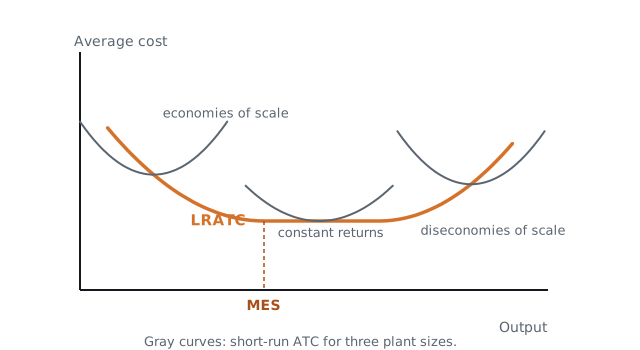
Minimum efficient scale (MES) is the smallest output at which long-run average total cost reaches its lowest level. Minimum efficient scale plays a role in how many firms a market can hold. When MES is small compared with market demand, many firms can each produce at the lowest cost, as on potato farms. When MES is large compared with market demand, only a few firms can reach the lowest cost, as in airplane manufacturing.
In the long run, every cost is variable, and plant size decides where a firm sits on the LRATC curve.
Key Terms
Practice Questions
6 questions. Nothing here is recorded or scored.
- Question 1PRD-1.A.10, PRD-1.A.11
Scaling a Bicycle Factory
A bicycle maker studies its long-run costs. When it doubles all inputs from a small plant to a medium plant, output rises from 1,000 to 2,500 bicycles a month. When it doubles all inputs again to a large plant, output rises from 2,500 to 5,000. When it doubles them a third time, output rises from 5,000 to 8,000.
When the firm moves from the small plant to the medium plant, it experiences which of the following?
- A.Increasing returns to scale, so long-run average total cost falls
- B.Decreasing returns to scale, so long-run average total cost rises
- C.Constant returns to scale, so long-run average total cost stays the same
- D.Diminishing marginal returns, because one input is fixed
Check answerHide answer
Answer: A
- A.
- Correct. Doubling inputs more than doubles output, from 1,000 to 2,500. That is increasing returns to scale, which means economies of scale and falling long-run average cost.
- B.
- Output more than doubled, which is increasing returns.
- C.
- Constant returns would mean output exactly doubles to 2,000.
- D.
- All inputs change here, so this is a long-run question about returns to scale.
- Question 2PRD-1.A.11
Moving from the large plant to the next size up, the firm experiences which of the following?
- A.Economies of scale
- B.Diseconomies of scale
- C.Constant returns to scale
- D.Minimum efficient scale
Check answerHide answer
Answer: B
- A.
- Economies of scale would need output to more than double.
- B.
- Correct. Doubling inputs raises output from 5,000 to 8,000, less than double. Decreasing returns to scale mean long-run average total cost rises, which is diseconomies of scale.
- C.
- Constant returns would need output to rise to exactly 10,000.
- D.
- Minimum efficient scale is where LRATC first reaches its lowest level, before costs start rising.
- Question 3PRD-1.A.9
Which of the following is true of the firm's costs when it chooses among these plant sizes?
- A.Its plant cost is fixed, and only labor cost is variable.
- B.All of its costs are fixed, because plants are expensive.
- C.All of its costs are variable, because it can change every input.
- D.It has no costs until it chooses a plant.
Check answerHide answer
Answer: C
- A.
- That is the short run, when the plant size cannot change.
- B.
- How expensive an input is does not make it fixed. In the long run nothing is fixed.
- C.
- Correct. Choosing a plant size is a long-run decision. In the long run every input can change, so every cost is variable.
- D.
- Every plant size has costs. In the long run, they are all variable.
- Question 4PRD-1.A.12
In an industry, minimum efficient scale is very large compared with total market demand. Which of the following is most likely?
- A.The market will likely hold many small firms.
- B.Firms face diseconomies of scale at every output.
- C.Long-run average total cost is the same at every output.
- D.The market will likely hold only a few firms.
Check answerHide answer
Answer: D
- A.
- That happens when minimum efficient scale is small compared with market demand.
- B.
- A large minimum efficient scale means economies of scale continue over a wide range of output.
- C.
- A minimum efficient scale implies LRATC falls before reaching its lowest level.
- D.
- Correct. If one firm must produce a large share of market demand to reach minimum efficient scale, the market can support only a few low-cost firms.
- Question 5PRD-1.A.12
Which of the following is the best description of minimum efficient scale?
- A.The lowest output at which LRATC reaches its minimum
- B.The output at which marginal cost is lowest
- C.The output at which a firm stops making a profit
- D.The smallest plant a firm can legally build
Check answerHide answer
Answer: A
- A.
- Correct. Minimum efficient scale is where economies of scale end and the LRATC curve first reaches its lowest level.
- B.
- Minimum efficient scale is about long-run average total cost.
- C.
- Profit depends on price as well as cost. Minimum efficient scale is a cost concept.
- D.
- Minimum efficient scale is defined by long-run costs. Laws play no part in it.
- Question 6PRD-1.A.11
Which of the following is a likely cause of diseconomies of scale?
- A.Workers can specialize in narrow tasks.
- B.Managers struggle to coordinate a huge firm.
- C.The firm buys inputs in bulk at a discount.
- D.The firm adds workers to a fixed plant.
Check answerHide answer
Answer: B
- A.
- Specialization is a source of economies of scale, which lower average cost.
- B.
- Correct. As a firm grows very large, communication and coordination get harder, which can raise average cost.
- C.
- Bulk buying lowers average cost, an economy of scale.
- D.
- Adding workers to a fixed plant causes diminishing marginal returns, a short-run idea.
Practice every topic in Unit 3
CED Codes
PRD-1.A.9 · PRD-1.A.10 · PRD-1.A.11 · PRD-1.A.12