3.4 Types of Profit
Types of profit for AP Microeconomics: accounting profit, economic profit and normal profit, and why firms respond to economic profit.
Part 1 of 3 Two Ways to Count Profit
Accountants and economists count profit differently. The difference is implicit costs, the value of resources the owner supplies without a bill.
| Accounting profit | Economic profit | |
|---|---|---|
| Formula | Total revenue minus explicit costs | Total revenue minus explicit and implicit costs |
| Counts the owner's time and money? | No | Yes |
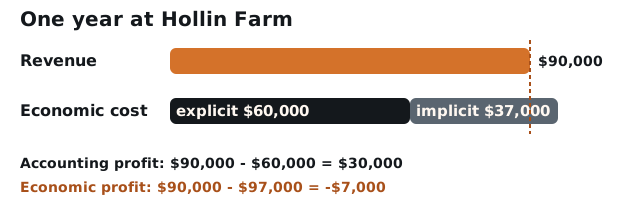
| Hollin Farm's year | $90,000 - $60,000 = $30,000 | $90,000 - $97,000 = -$7,000 |
Hollin Farm is a fictional potato farm that sells into a market with hundreds of farms selling identical potatoes. This year the farm brought in $90,000 and paid $60,000 in explicit costs for seed, fuel, wages and the lease. Its owner, Mara, could have earned $35,000 as a crop scientist. She also has $50,000 of her own savings in the farm, which could have earned 4% interest, or $2,000, in a bank. Her implicit costs are $37,000.
Part 2 of 3 Normal Profit
Implicit costs include the cost of financial capital, compensation for risk and the owner's time. Accounting profit leaves them out. When accounting profit is just large enough to pay all of the implicit costs, the firm earns normal profit, and its economic profit is zero.
Hollin Farm would earn normal profit with an accounting profit of $37,000. At that point, Mara does exactly as well on the farm as in her best other choice.
Part 3 of 3 Why Firms Respond to Economic Profit
Firms base their decisions on economic profit. Mara's accounting books show $30,000 of profit. Her economic loss of $7,000 tells her she would be better off as a crop scientist with her savings in the bank. If the loss continues, she has a reason to leave farming.
The same logic draws firms into markets. An economic profit means the owners earn more than in their best other use of their time and money, so other people have a reason to enter.
Economic profit counts every cost, including the owner's time and money. Zero economic profit is normal profit.
Key Terms
Practice Questions
6 questions. Nothing here is recorded or scored.
- Question 1CBA-2.C.2
Juniper's Bike Repair
Juniper runs a bike repair shop. Last year the shop earned $120,000 in revenue and paid $70,000 for rent, parts and an assistant's wages. Juniper could have earned $45,000 as a mechanic at a bike chain. She also used $20,000 of her savings to buy tools; those savings could have earned 5% a year in a bond fund.
What was the shop's accounting profit last year?
- A.$50,000
- B.$4,000
- C.$5,000
- D.$120,000
Check answerHide answer
Answer: A
- A.
- Correct. Accounting profit is total revenue minus explicit costs: $120,000 - $70,000 = $50,000.
- B.
- This also subtracts the implicit costs, which gives economic profit.
- C.
- This subtracts the forgone salary only. Accounting profit leaves out all implicit costs.
- D.
- This is total revenue before any costs.
- Question 2CBA-2.C.1, CBA-2.C.2
What was the shop's economic profit last year?
- A.$50,000
- B.$5,000
- C.$4,000
- D.-$15,000
Check answerHide answer
Answer: C
- A.
- This is accounting profit. Economic profit also subtracts Juniper's implicit costs.
- B.
- This leaves out the forgone interest. Five percent of $20,000 is $1,000 of implicit cost.
- C.
- Correct. Implicit costs are the $45,000 salary she gave up plus $1,000 of interest (5% of $20,000), or $46,000. Economic profit is $50,000 - $46,000 = $4,000.
- D.
- This subtracts the $20,000 of savings itself. The implicit cost is the interest those savings could earn, $1,000.
- Question 3CBA-2.C.1
Based on the shop's results, which of the following is the best conclusion?
- A.Juniper earns only a normal profit, so she should leave.
- B.Juniper earns an economic loss, so she should leave.
- C.Accounting profit shows she should stay, and economic profit does not matter.
- D.Juniper earns more than in her best alternative, so she has an incentive to stay.
Check answerHide answer
Answer: D
- A.
- Normal profit is zero economic profit, and even then she would have no reason to leave. Her economic profit is $4,000.
- B.
- Revenue covers both explicit and implicit costs, so there is no economic loss.
- C.
- Firms respond to economic profit, which counts what Juniper gives up.
- D.
- Correct. A positive economic profit means the shop covers all explicit and implicit costs with money left over. Firms respond to economic profit.
- Question 4CBA-2.C.2
A firm earns zero economic profit. Which of the following is true?
- A.Its accounting profit is also zero.
- B.It earns a normal profit.
- C.It should shut down at once.
- D.It has no implicit costs.
Check answerHide answer
Answer: B
- A.
- Accounting profit is positive whenever implicit costs are positive, because it does not subtract them.
- B.
- Correct. Zero economic profit means revenue covers explicit and implicit costs exactly. The owner does as well as in her best alternative, which is normal profit.
- C.
- A firm earning normal profit is doing as well as its best alternative, so it has no reason to leave.
- D.
- Zero economic profit means implicit costs are covered.
- Question 5CBA-2.C.2
Which of the following is an implicit cost for a restaurant owner?
- A.The wages paid to the restaurant's servers
- B.The monthly rent paid to the owner of the building
- C.The salary the owner gives up by not working elsewhere
- D.The cost of food bought from local suppliers each week
Check answerHide answer
Answer: C
- A.
- Wages paid to others are explicit costs.
- B.
- Rent paid to a landlord is an explicit cost.
- C.
- Correct. Implicit costs are the value of the owner's own resources in their best other use. No payment is made, but the forgone salary is a real cost.
- D.
- Payments to suppliers are explicit costs.
- Question 6CBA-2.C.1
In a market with no barriers to entry, firms are earning positive economic profit. Which of the following is most likely to happen?
- A.Existing firms exit the market.
- B.Nothing, because accounting profit is what attracts firms.
- C.Firms raise their prices because profits are high.
- D.New firms enter the market.
Check answerHide answer
Answer: D
- A.
- Firms exit when they expect economic losses.
- B.
- Firms respond to economic profit, which here is positive.
- C.
- In a competitive market, firms do not set prices. Entry tends to lower the price.
- D.
- Correct. Positive economic profit means firms earn more than their owners' best alternatives. Other people have an incentive to enter.
Practice every topic in Unit 3
CED Codes
CBA-2.C.1 · CBA-2.C.2