3.5 Profit Maximization
Profit maximization for AP Microeconomics: marginal revenue, the MR equals MC rule, and how to find the profit-maximizing quantity in a table.
Part 1 of 3 Marginal Revenue
Economists assume firms choose output to maximize profit. To do that, a firm compares marginal revenue with marginal cost.
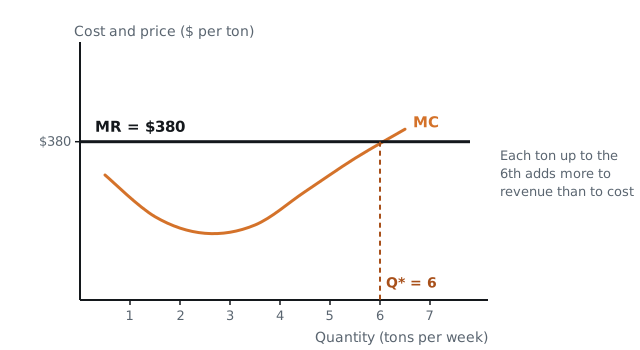
Marginal revenue (MR) is the extra revenue from selling one more unit. Hollin Farm is a fictional potato farm that sells into a market with hundreds of farms selling identical potatoes. The market price is $380 a ton, and the farm can sell every ton at that price. Each extra ton adds $380 to revenue, so MR is $380.
Part 2 of 3 The Profit-Maximizing Rule
The profit-maximizing rule says to produce the quantity where marginal revenue equals marginal cost. If MR is greater than MC for the next unit, producing it adds to profit. If MC is greater than MR, producing it lowers profit.
| Tons | Total revenue | Total cost | Profit | MR | MC |
|---|---|---|---|---|---|
| 4 | $1,520 | $1,440 | $80 | $380 | $180 |
| 5 | $1,900 | $1,700 | $200 | $380 | $260 |
| 6 | $2,280 | $2,040 | $240 | $380 | $340 |
| 7 | $2,660 | $2,450 | $210 | $380 | $410 |
The 6th ton adds $380 of revenue and $340 of cost, so the farm produces it. The 7th ton would add $380 of revenue and $410 of cost, so the farm stops at 6. Profit is largest at 6 tons, $240 a week.
Part 3 of 3 Using the Rule
In a table with whole units, MR and MC are rarely exactly equal. Produce the last unit for which MR is greater than or equal to MC. On a graph, find where the MR line crosses the rising part of the MC curve.
The rule holds even when the best the firm can do is a loss. If the price fell, the farm would still use MR = MC to find the quantity with the smallest loss. Whether to produce at all is a separate question, covered in the next topic.
The rule also applies to firms that are not price takers. For those firms, marginal revenue falls as they sell more, and the firm still produces where MR = MC.
Produce where marginal revenue equals marginal cost.
Key Terms
Practice Questions
6 questions. Nothing here is recorded or scored.
- Question 1CBA-2.D.1
Carver Candle Works
Carver Candle Works sells candles in a market where it can sell as many as it wants at $10 each. The table shows its total cost at different weekly outputs.
Candles (hundreds) | Total cost 0 | $1,000 1 | $1,600 2 | $2,100 3 | $2,700 4 | $3,500 5 | $4,600 How many hundred candles should Carver produce each week to maximize profit?
- A.5
- B.2
- C.4
- D.3
Check answerHide answer
Answer: C
- A.
- The 5th hundred adds $1,000 of revenue and $1,100 of cost, so producing it lowers profit.
- B.
- The 3rd hundred adds $1,000 of revenue and only $600 of cost, so Carver should produce it.
- C.
- Correct. Each hundred adds $1,000 of revenue (MR). Marginal costs are $600, $500, $600, $800 and $1,100. MR is at least MC through the 4th hundred and below MC for the 5th, so Carver produces 4 hundred.
- D.
- The 4th hundred adds $1,000 of revenue and $800 of cost, so it still raises profit.
- Question 2CBA-2.D.1
Candles (hundreds) | Total cost 0 | $1,000 1 | $1,600 2 | $2,100 3 | $2,700 4 | $3,500 5 | $4,600 What is Carver's profit at the profit-maximizing output?
- A.$500
- B.$300
- C.$400
- D.$4,000
Check answerHide answer
Answer: A
- A.
- Correct. At 4 hundred candles, total revenue is 400 x $10 = $4,000 and total cost is $3,500, so profit is $500.
- B.
- Three hundred is profit at 3 hundred candles: $3,000 - $2,700. Profit at 4 hundred is higher.
- C.
- Four hundred is profit at 5 hundred candles: $5,000 - $4,600.
- D.
- This is total revenue at 4 hundred candles. Profit subtracts total cost.
- Question 3CBA-2.D.1
Candles (hundreds) | Total cost 0 | $1,000 1 | $1,600 2 | $2,100 3 | $2,700 4 | $3,500 5 | $4,600 Carver's marginal revenue for each hundred candles equals which of the following?
- A.$10, the price of a single candle
- B.It falls as output rises, because each candle sells for less
- C.$600, the marginal cost of the first hundred candles
- D.$1,000, because it sells every candle at $10
Check answerHide answer
Answer: D
- A.
- Ten dollars is the revenue from one candle. Each hundred candles adds $1,000.
- B.
- Carver can sell as many as it wants at $10, so the price does not fall.
- C.
- Marginal cost is a cost measure. Marginal revenue comes from sales.
- D.
- Correct. Marginal revenue is the change in total revenue from selling one more hundred candles. At a constant $10 price, each hundred adds $1,000.
- Question 4CBA-2.D.1
A firm is producing an output at which marginal revenue is $40 and marginal cost is $25. To increase profit, the firm should do which of the following?
- A.Produce less, because marginal cost is positive
- B.Produce more, because MR is greater than MC
- C.Keep output the same, because profit is positive
- D.Raise price until MR equals average total cost
Check answerHide answer
Answer: B
- A.
- Positive marginal cost is normal. What matters is that MR is larger than MC.
- B.
- Correct. When MR is greater than MC, producing another unit adds $40 of revenue for $25 of cost, raising profit by $15. The firm should expand toward MR = MC.
- C.
- Profit could be higher. MR above MC means another unit adds to profit.
- D.
- The profit-maximizing rule compares marginal revenue with marginal cost.
- Question 5CBA-2.D.1
Which of the following states the profit-maximizing rule for any firm?
- A.Produce the quantity at which marginal revenue equals marginal cost.
- B.Produce the quantity at which total revenue is largest.
- C.Produce the quantity at which average total cost is lowest.
- D.Produce the quantity at which price equals average variable cost.
Check answerHide answer
Answer: A
- A.
- Correct. Firms are assumed to maximize profit by comparing marginal revenue with marginal cost. The rule applies in every market structure.
- B.
- Total revenue can keep rising while costs rise faster, so the largest revenue is not the largest profit.
- C.
- The lowest average cost does not account for revenue.
- D.
- Price equal to minimum AVC is the shutdown point.
- Question 6CBA-2.D.1
On a graph, a firm's horizontal marginal revenue line at $50 crosses the rising part of its marginal cost curve at 80 units. At 80 units, average total cost is $42. What is the firm's profit?
- A.$4,000
- B.$640
- C.$3,360
- D.$8
Check answerHide answer
Answer: B
- A.
- This is total revenue, $50 x 80. Profit subtracts total cost.
- B.
- Correct. The firm produces 80 units, where MR = MC. Profit is (price - ATC) x quantity = ($50 - $42) x 80 = $640.
- C.
- This is total cost, $42 x 80.
- D.
- Eight dollars is profit per unit. Multiply by 80 units for total profit.
Practice every topic in Unit 3
CED Codes
CBA-2.D.1