3.6 Firms’ Short-Run Decisions to Produce and Long-Run Decisions to Enter or Exit a Market
Shutdown and exit for AP Microeconomics: why a firm with losses may keep producing in the short run, the shutdown rule, and entry and exit in the long run.
Part 1 of 3 Operate or Shut Down in the Short Run
In the short run, a firm decides whether to operate, producing some output, or to shut down, producing zero. The firm compares total revenue with total variable cost, or price with average variable cost.
Hollin Farm is a fictional potato farm that sells into a market with hundreds of farms selling identical potatoes. Its fixed cost is $600 a week, and it must pay that cost even if it harvests nothing. Shutting down saves the variable cost and gives up the revenue.
| Price $220 a ton | Price $200 a ton | |
|---|---|---|
| Best quantity | 4 tons (the 5th ton costs $260) | 4 tons |
| Total revenue | $880 | $800 |
| Variable cost at 4 tons | $840 | $840 |
| Loss if it operates | $1,440 - $880 = $560 | $1,440 - $800 = $640 |
| Loss if it shuts down | $600 | $600 |
| Decision | Operate: revenue covers variable cost | Shut down: revenue does not cover variable cost |
A firm should shut down in the short run when price falls below minimum average variable cost. Hollin Farm's minimum AVC is $210. At $220, the farm covers its variable cost and has $40 left toward its fixed cost. At $200, operating would lose more than the $600 fixed cost.
Part 2 of 3 Three Price Zones
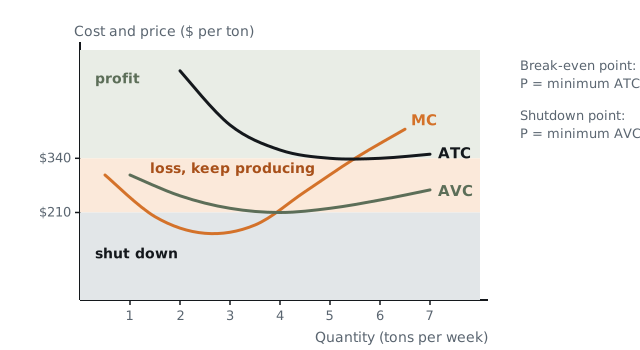
| Price | Short-run result | Long-run response |
|---|---|---|
| Above $340 (minimum ATC) | Economic profit | Other firms enter |
| Exactly $340 | Normal profit | No entry or exit |
| Between $210 and $340 | Loss, but keeps producing | Firms exit if losses are expected to continue |
| Below $210 (minimum AVC) | Shuts down; loses fixed cost | Firms exit |
Part 3 of 3 Entry and Exit in the Long Run
In the long run, fixed costs become variable. A farm can end its lease and sell its equipment. When there are no barriers to entry or exit, firms enter a market where they see profit opportunities and exit a market where they expect economic losses.
Suppose potato prices stay at $220 for years. In the short run, Hollin Farm keeps harvesting, because $220 covers its average variable cost of $210. In the long run, the farm can end its lease, so it compares price with average total cost instead. A price below minimum ATC of $340 means a lasting economic loss, and the farm leaves.
A shutdown is a short-run choice: the farm stops harvesting and still owes its lease. Exit is a long-run choice: the farm leaves the market and no longer has any costs there.
Short run: operate if price covers average variable cost. Long run: stay only if price covers average total cost.
Key Terms
Practice Questions
6 questions. Nothing here is recorded or scored.
- Question 1PRD-2.A.1
Fenwick Strawberry Farm
Fenwick Strawberry Farm sells in a perfectly competitive market. Its fixed cost is $2,000 a week. Its minimum average variable cost is $3 a crate, and its minimum average total cost is $5 a crate. The market price has just fallen to $4 a crate.
In the short run, what should Fenwick Farm do at a price of $4?
- A.Shut down, because the price is below its minimum average total cost
- B.Shut down, because any loss is worse than producing nothing
- C.Keep producing, because the price is above its minimum average variable cost
- D.Raise its price to $5 to cover average total cost
Check answerHide answer
Answer: C
- A.
- A price below minimum ATC means a loss, but the shutdown rule compares price with AVC.
- B.
- Producing nothing still costs $2,000 a week in fixed cost.
- C.
- Correct. At $4, the farm covers its variable cost on each crate and has something left toward its fixed cost. Its loss is smaller than the $2,000 it would lose by shutting down.
- D.
- A firm in perfect competition takes the market price as given.
- Question 2PRD-2.A.1
Suppose the price falls further, to $2.50 a crate. In the short run, what should the farm do?
- A.Shut down, because the price is below its minimum average variable cost
- B.Keep producing, because the price is still above zero
- C.Keep producing, because shutting down loses the fixed cost
- D.Exit the market immediately, because fixed costs end in the short run
Check answerHide answer
Answer: A
- A.
- Correct. At $2.50, revenue does not cover variable cost. Producing would lose more than the $2,000 fixed cost, so the farm shuts down.
- B.
- A positive price is not enough. Price must cover average variable cost.
- C.
- Shutting down loses $2,000. Producing at a price below AVC loses more.
- D.
- Fixed costs continue in the short run. Exit is a long-run choice.
- Question 3PRD-2.A.2
If the market price is expected to stay at $4 for years, what will Fenwick Farm most likely do in the long run?
- A.Stay, because the price covers its average variable cost
- B.Exit the market, because it expects continuing economic losses
- C.Stay, because farms cannot leave a perfectly competitive market
- D.Expand, because other farms will exit
Check answerHide answer
Answer: B
- A.
- Covering AVC matters only in the short run, when fixed costs must be paid regardless.
- B.
- Correct. At $4, below minimum ATC of $5, the farm loses money. In the long run its fixed costs become variable, and with no barriers to exit it leaves a market where it expects losses.
- C.
- Perfectly competitive markets have no barriers to entry or exit.
- D.
- Expanding at a price below minimum ATC would add to the farm's losses.
- Question 4PRD-2.A.1
A firm's total revenue is $9,000 and its total variable cost is $10,000. Its total fixed cost is $3,000. In the short run, what should the firm do?
- A.Produce, because its loss of $4,000 is less than its total cost
- B.Produce, because total revenue is greater than total fixed cost
- C.Shut down, because total revenue is less than total cost
- D.Shut down, because total revenue is less than total variable cost
Check answerHide answer
Answer: D
- A.
- Producing loses $4,000 ($9,000 - $13,000), more than the $3,000 loss from shutting down.
- B.
- The shutdown rule compares revenue with variable cost.
- C.
- A firm can keep producing with revenue below total cost as long as revenue covers variable cost. Here the deciding fact is that revenue is below variable cost.
- D.
- Correct. Revenue of $9,000 does not cover variable cost of $10,000. Shutting down limits the loss to the $3,000 fixed cost.
- Question 5PRD-2.A.1, PRD-2.A.2
Which of the following best distinguishes shutting down from exiting a market?
- A.Shutting down ends all costs; exiting leaves fixed costs.
- B.Shutting down and exiting are one and the same decision.
- C.Shutting down keeps fixed costs; exiting ends them.
- D.Firms shut down when price is below ATC and exit when price is below AVC.
Check answerHide answer
Answer: C
- A.
- This reverses the two.
- B.
- They happen in different time frames and have different effects on costs.
- C.
- Correct. A firm that shuts down produces zero output and still owes its fixed costs. A firm that exits leaves the market, which it can do once all costs become variable.
- D.
- The shutdown rule uses AVC, and long-run exit happens when price is expected to stay below ATC.
- Question 6PRD-2.A.2
In a market with no barriers to entry, firms are earning economic profits. Which of the following describes what happens in the long run?
- A.Existing firms exit, and the market price rises.
- B.New firms enter, and the market price rises as competition grows.
- C.Nothing changes, because profits are a short-run result.
- D.New firms enter, and price falls until economic profit is zero.
Check answerHide answer
Answer: D
- A.
- Firms exit in response to losses.
- B.
- Entry raises market supply, which lowers the price.
- C.
- Profits are the signal that draws firms in over the long run.
- D.
- Correct. Profit opportunities attract new firms. Their entry raises market supply and lowers the price until firms earn only normal profit.
Practice every topic in Unit 3
CED Codes
PRD-2.A.1 · PRD-2.A.2