3.7 Perfect Competition
Perfect competition for AP Microeconomics: price takers, the firm's demand curve, short-run profit and loss, long-run equilibrium and efficiency.
Part 1 of 4 What Makes a Market Perfectly Competitive
A perfectly competitive market has many firms selling identical products, with no barriers to entry and no market power. Each firm is a price taker: it can sell all of its output at the price the market sets.
Hollin Farm is a fictional potato farm that sells into a market with hundreds of farms selling identical potatoes. The potato market sets a price of $380 a ton. If Hollin Farm asks $381, buyers go to the next farm. If it asks less, it gives away money, since it can already sell every ton at $380.
For that reason, the farm's demand curve is a horizontal line at the market price. Every extra ton adds $380 to revenue, so price equals marginal revenue: P = MR = D.
Part 2 of 4 Short-Run Profit and Loss
The farm maximizes profit where MR = MC, at 6 tons. Its average total cost at 6 tons is $340. Economic profit is (P - ATC) x Q = ($380 - $340) x 6 = $240 a week.
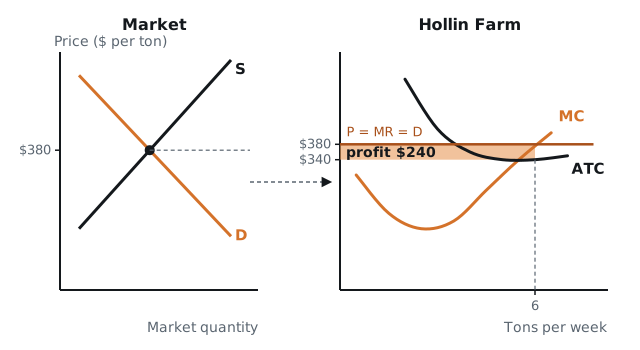
In a short-run equilibrium, price can be above or below its long-run level. If the price were $300, below minimum ATC of $340, the farm would earn an economic loss. Profits draw new farms in, and losses push farms out, which moves price and quantity toward long-run equilibrium.
Part 3 of 4 Long-Run Equilibrium
Hollin Farm's $240 profit attracts new farms. Their entry shifts market supply to the right, and the price falls. Entry stops when the price reaches minimum ATC, $340. At that price, each farm produces where P = MC = minimum ATC and earns zero economic profit, which is normal profit.
| Kind | Condition | What it means |
|---|---|---|
| Allocative efficiency | P = MC | The value buyers place on the last unit equals the cost of producing it |
| Productive efficiency | P = minimum ATC | Every firm produces at the lowest possible average cost |
In perfect competition, price tells buyers and sellers about each other's marginal benefit and marginal cost, and gives them a reason to act on it. A perfectly competitive market in long-run equilibrium is both allocatively and productively efficient.
Part 4 of 4 Constant, Increasing and Decreasing Cost Industries
When firms enter, the long-run price depends on what happens to input costs.
| Industry type | As the industry grows, input costs | Long-run price after entry |
|---|---|---|
| Constant cost | Stay the same | Returns to the original level |
| Increasing cost | Rise, as firms bid for scarce inputs such as farmland | Settles higher than before |
| Decreasing cost | Fall, as suppliers gain economies of scale | Settles lower than before |
In the long run, perfect competition drives price to minimum ATC: zero economic profit, P = MC and productive efficiency.
Key Terms
Practice Questions
6 questions. Nothing here is recorded or scored.
- Question 1PRD-3.A.4
The Market for Wheat
The wheat market in the fictional country of Ostern is perfectly competitive. The market price is $8 a bushel. One farm, Greywater Farm, maximizes profit by producing 1,000 bushels a week. At that output, its average total cost is $6 a bushel. The minimum of its average total cost is $5.
What is Greywater Farm's economic profit each week?
- A.$8,000
- B.$2,000
- C.$3,000
- D.$6,000
Check answerHide answer
Answer: B
- A.
- This is total revenue, $8 x 1,000. Profit subtracts total cost.
- B.
- Correct. Economic profit is (P - ATC) x Q = ($8 - $6) x 1,000 = $2,000.
- C.
- This uses minimum ATC, $5. Profit uses ATC at the output the farm actually produces, $6.
- D.
- This is total cost, $6 x 1,000.
- Question 2PRD-3.A.3
Which of the following best describes Greywater Farm's demand curve?
- A.A horizontal line at $8, which is also its marginal revenue
- B.A downward-sloping line, because buyers want less at higher prices
- C.A vertical line at 1,000 bushels
- D.The same as the market supply curve
Check answerHide answer
Answer: A
- A.
- Correct. A price taker can sell all it wants at the market price. Its demand curve is horizontal at $8, and each extra bushel adds $8 to revenue, so P = MR = D.
- B.
- The market demand curve slopes down. A single competitive firm faces a horizontal demand curve.
- C.
- The farm can sell more or less than 1,000 bushels at $8.
- D.
- The farm's demand curve is a horizontal line at the market price. The market supply curve slopes upward.
- Question 3PRD-3.A.6, PRD-3.A.7
If the wheat market is in short-run equilibrium today, what will happen in the long run?
- A.Farms exit, and the market price rises toward $8.
- B.New farms enter, and the market price stays at $8.
- C.New farms enter, and the market price falls toward $5.
- D.Nothing changes, because the farm is already maximizing profit.
Check answerHide answer
Answer: C
- A.
- Farms exit when they have losses. Greywater earns a profit.
- B.
- Entry increases market supply, which lowers the price.
- C.
- Correct. The $2,000 profit attracts new farms. Entry raises market supply and lowers the price until it equals minimum ATC, $5, where farms earn zero economic profit.
- D.
- Maximizing profit in the short run does not stop new firms from entering.
- Question 4PRD-3.A.7, PRD-3.A.9
In long-run equilibrium, a perfectly competitive firm produces where price equals marginal cost and price equals minimum average total cost. Which of the following describes this outcome?
- A.It is allocatively efficient and productively inefficient.
- B.It is productively efficient and allocatively inefficient.
- C.It is neither allocatively nor productively efficient.
- D.It is allocatively and productively efficient.
Check answerHide answer
Answer: D
- A.
- Producing at minimum ATC is productive efficiency.
- B.
- P = MC is the condition for allocative efficiency.
- C.
- Both conditions hold in long-run competitive equilibrium.
- D.
- Correct. P = MC means the value of the last unit to buyers equals its cost, which is allocative efficiency. P = minimum ATC means firms produce at the lowest average cost, which is productive efficiency.
- Question 5PRD-3.A.8
As firms enter a perfectly competitive industry, the prices of the specialized inputs they use rise. Which of the following describes the long-run industry supply curve?
- A.It slopes upward, because this is an increasing cost industry.
- B.It is horizontal, because this is a constant cost industry.
- C.It slopes downward, because this is a decreasing cost industry.
- D.It is vertical, because the number of firms is fixed.
Check answerHide answer
Answer: A
- A.
- Correct. When entry bids up input prices, each firm's costs rise. The long-run price after entry settles higher than before, so the long-run industry supply curve slopes up.
- B.
- A constant cost industry has input prices that stay the same as it grows.
- C.
- A decreasing cost industry has input costs that fall as it grows.
- D.
- Firms enter freely in perfect competition.
- Question 6PRD-3.A.1, PRD-3.A.3
Which of the following is a characteristic of a perfectly competitive market?
- A.Each firm sets its own price to maximize profit.
- B.Firms are price takers and face no barriers to entry.
- C.Firms earn economic profit in the long run.
- D.Each firm sells a product that differs from its rivals' products.
Check answerHide answer
Answer: B
- A.
- A competitive firm takes the market price as given.
- B.
- Correct. Many firms sell identical products, none has market power, and firms can enter and leave freely.
- C.
- Entry drives economic profit to zero in the long run.
- D.
- Firms in perfect competition sell identical products.
Practice every topic in Unit 3
CED Codes
PRD-3.A.1 · PRD-3.A.2 · PRD-3.A.3 · PRD-3.A.4 · PRD-3.A.5 · PRD-3.A.6 · PRD-3.A.7 · PRD-3.A.8 · PRD-3.A.9