4.1 Introduction to Imperfectly Competitive Markets
Four imperfectly competitive market structures, why these firms must cut price to sell more, why price ends up above marginal cost, and barriers to entry.
Part 1 of 4 Four Imperfectly Competitive Market Structures
A market is imperfectly competitive when its firms have some control over price. Imperfectly competitive markets include monopoly, oligopoly and monopolistic competition in product markets, and monopsony in factor markets.
| Structure | Market | Firms | Entry |
|---|---|---|---|
| Monopoly | Product market | One seller of a product with no close substitute | Blocked by barriers to entry |
| Oligopoly | Product market | A few sellers whose choices affect each other | High barriers to entry |
| Monopolistic competition | Product market | Many sellers of differentiated products | Free entry and exit |
| Monopsony | Factor market | One buyer of a factor, such as the only employer in a town | Few other buyers to hire the factor |
A perfectly competitive firm sells an identical product alongside many rivals, so it takes the market price as given. Every firm in the four structures above has market power, meaning it can raise its price without losing all of its sales.
Part 2 of 4 Selling More Means Cutting Price
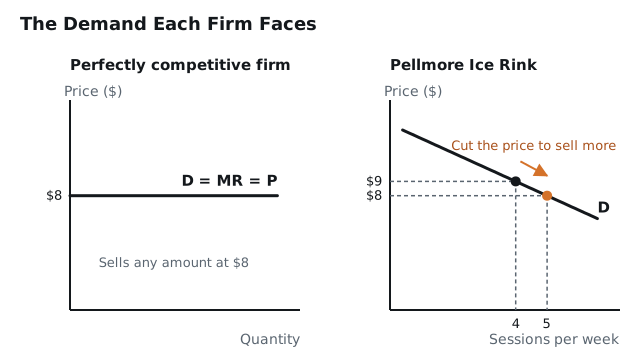
Pellmore Ice Rink is the only rink in the town of Pellmore, and it rents its ice to private hockey groups by the session. In an imperfectly competitive output market, a firm must lower its price to sell additional units, assuming everything else stays the same. The rink charges one price to every group, so the lower price applies to every session, including the sessions it could have sold at the higher price.
| Price | Sessions sold | Total revenue | Revenue added by the last session |
|---|---|---|---|
| $12 | 1 | $12 | $12 |
| $11 | 2 | $22 | $10 |
| $10 | 3 | $30 | $8 |
| $9 | 4 | $36 | $6 |
| $8 | 5 | $40 | $4 |
| $7 | 6 | $42 | $2 |
To sell a fifth session, the rink drops its price from $9 to $8. The fifth group pays $8, and the four groups already booked each pay $1 less, so total revenue rises by only $4. The revenue added by one more unit is marginal revenue, and for this rink marginal revenue is below price for every session after the first.
Part 3 of 4 Price Above Marginal Cost
Each extra session costs the rink $4 in staff time and power. The rink keeps adding sessions while the revenue from the next one at least covers its $4 cost, so it sells 5 sessions at $8. At that output the price of $8 is greater than the marginal cost of $4.
A sixth group would pay $7 for a session that costs $4 to provide. That session would add $3 more to the buyer's benefit than to the rink's cost, yet the rink skips it, because selling it means cutting the price for all six groups. This is inefficiency: consumers and producers respond to a price that is above marginal cost, and units worth more to buyers than they cost to make go unproduced.
In an inefficient market, price is greater than marginal cost.
Part 4 of 4 Barriers to Entry
If the rink earns a profit, other firms have an incentive to open a second rink. Barriers to entry can reduce that incentive, and barriers can sustain imperfectly competitive market structures.
| Barrier | How it keeps rivals out | Example |
|---|---|---|
| High fixed or start-up costs | A rival must spend heavily before it sells a single unit | A second rink needs a building and a refrigeration plant |
| Legal barriers to entry | Patents, licenses and government franchises limit who may sell | A city grants one company the only license to run ferries to an island |
| Exclusive ownership of a key resource | Rivals cannot get an input the product requires | One company owns the only quarry of a rare green marble |
Key Terms
Practice Questions
6 questions. Nothing here is recorded or scored.
- Question 1PRD-3.B.1
Velk County has one hospital, and it is the only employer of registered nurses within 80 miles. Which market structure best describes the market for nurses in Velk County?
- A.Monopoly, because the hospital is the only seller of hospital care in the county
- B.Oligopoly, because a few nurses supply most of the labor the hospital buys
- C.Monopsony, because the hospital is the only buyer of nursing labor in the area
- D.Monopolistic competition, because each nurse offers a slightly different set of skills
Check answerHide answer
Answer: C
- A.
- The question asks about the market for nurses, a factor market. Being the only seller of hospital care describes the product market, a different market.
- B.
- Oligopoly describes a few sellers of a product. Here the nurses are many sellers of labor, and the single hospital is on the buying side.
- C.
- Correct. A monopsony is a market with a single buyer of a factor. The hospital is the only employer of nurses within reach, so it is the only buyer of nursing labor, which makes the market an imperfectly competitive factor market.
- D.
- Monopolistic competition describes many sellers of differentiated products with free entry. The defining feature here is that there is only one buyer.
- Question 2PRD-3.B.2
Introduction to Imperfectly Competitive Markets
Corla Kayaks is the only kayak rental shop on Lake Venn. It charges every customer the same price. The shop can rent 10 kayaks a day at $50 each. To rent an eleventh kayak, it must lower the price to $48 for every rental.
What is the marginal revenue of the eleventh rental?
- A.$48
- B.$28
- C.$2
- D.$50
Check answerHide answer
Answer: B
- A.
- $48 is the price of the eleventh rental. Marginal revenue also counts the $2 lost on each of the first 10 rentals.
- B.
- Correct. Total revenue at 10 rentals is 10 x $50 = $500. At 11 rentals it is 11 x $48 = $528. Marginal revenue is $528 - $500 = $28. An imperfectly competitive firm must cut its price to sell more, so marginal revenue falls below price.
- C.
- $2 is the price cut on each rental. Marginal revenue is the change in total revenue, $528 - $500.
- D.
- $50 is the old price. The eleventh rental sells only at the lower price of $48, and the price cut applies to all rentals.
- Question 3PRD-3.B.3
At its profit-maximizing output, an imperfectly competitive firm charges $14 for a product with a marginal cost of $9. Which statement best describes this outcome?
- A.The outcome is inefficient, because some buyers value another unit at more than the $9 it costs, yet it is not produced.
- B.The outcome is efficient, because the firm produces where marginal revenue equals marginal cost.
- C.The outcome is inefficient, because the firm produces too much output when price is above marginal cost.
- D.The outcome is efficient, because consumers choose freely whether to pay the $14 price.
Check answerHide answer
Answer: A
- A.
- Correct. When price is greater than marginal cost, the next unit is worth more to a buyer than it costs to make. The firm skips those units because selling them would require a lower price on every unit, so output is below the efficient level.
- B.
- MR = MC maximizes the firm's profit. Efficiency for society requires price, which measures marginal benefit, to equal marginal cost.
- C.
- Price above marginal cost signals too little output. The firm stops short of units that buyers value above their cost.
- D.
- Free choice does not make an outcome efficient. The test is whether price equals marginal cost, and $14 is above $9.
- Question 4PRD-3.B.4
Talvo Pharmaceuticals holds a 20-year patent on a new migraine drug, and no other firm may sell the drug while the patent lasts. Which barrier to entry protects Talvo?
- A.High fixed or start-up costs
- B.Exclusive ownership of a key resource
- C.Product differentiation through advertising
- D.A legal barrier to entry
Check answerHide answer
Answer: D
- A.
- Start-up costs may be high in the drug industry, but the barrier described here is the patent, which bars rivals by law.
- B.
- Exclusive ownership means controlling a physical input rivals need. A patent is a legal right granted by government.
- C.
- Advertising can differentiate a product, but it does not stop rivals from selling the same drug. The patent does.
- D.
- Correct. A patent is a legal barrier to entry: the law forbids other firms from selling the drug for 20 years, which can sustain Talvo's market power.
- Question 5PRD-3.B.2
Assuming all else is constant, which statement is true of an imperfectly competitive firm and false of a perfectly competitive firm?
- A.It maximizes profit by producing where marginal revenue equals marginal cost.
- B.It faces a horizontal demand curve at the market price.
- C.It can sell any quantity it wants without changing its price.
- D.It must lower its price to sell additional units.
Check answerHide answer
Answer: D
- A.
- Every profit-maximizing firm produces where MR equals MC, so the statement is true of both.
- B.
- A horizontal demand curve describes a perfectly competitive firm, which takes the market price as given.
- C.
- Selling any quantity at one price describes a perfectly competitive firm.
- D.
- Correct. An imperfectly competitive firm faces a downward-sloping demand curve, so it must cut its price to sell more units. A perfectly competitive firm can sell all it wants at the market price.
- Question 6PRD-3.B.4
Orrin Mining owns every known deposit of a rare mineral used in solar panels and earns large economic profits year after year. Which best explains why no new firm enters the mineral market?
- A.Orrin's exclusive ownership of a key resource blocks entry.
- B.Orrin's profits fall to zero in the long run, so entry has no reward.
- C.Demand for the mineral is perfectly elastic, so rivals could not sell at a profit.
- D.Orrin charges a price equal to marginal cost, which leaves no room for rivals.
Check answerHide answer
Answer: A
- A.
- Correct. A rival cannot produce the mineral without a deposit, and Orrin owns them all. Exclusive ownership of a key resource is a barrier to entry that can sustain profit in the long run.
- B.
- The question states that Orrin earns large profits year after year. Profits fall to zero only when entry is free.
- C.
- A single seller facing perfectly elastic demand would have no market power. Orrin earns large profits, which signals market power.
- D.
- A firm with market power charges a price above marginal cost. Nothing in the scenario suggests price equals marginal cost.
Practice every topic in Unit 4
CED Codes
PRD-3.B.1 · PRD-3.B.2 · PRD-3.B.3 · PRD-3.B.4