4.2 Monopoly
How a monopoly picks output where MR equals MC, why its price exceeds marginal cost, its surplus and deadweight loss, and natural monopoly.
Part 1 of 4 Why a Monopoly Exists
A monopoly is a market with one seller of a product that has no close substitute. A monopoly exists because of barriers to entry, such as high start-up costs, legal barriers like a government license, or exclusive ownership of a key resource.
Brightwater Cable Car holds the only license to carry passengers from the valley station up to the mountain town of Brightwater. Its demand curve is the market demand curve. At $20 a ride nobody rides, and each $1 cut in the price adds 100 rides a day. Each ride costs the company $4 to provide, so its marginal cost and its average total cost both equal $4.
Part 2 of 4 Choosing Output Where MR Equals MC
Like any firm with market power, the cable car must cut its price to sell more rides, so its marginal revenue (MR) curve lies below its demand curve. For a straight-line demand curve, the MR curve starts at the same price and falls twice as steeply.
In a monopoly, the equilibrium, profit-maximizing quantity is where marginal revenue equals marginal cost. The cable car's MR curve crosses its $4 marginal cost at 800 rides a day. The price comes from the demand curve at that quantity: 800 riders will pay $12. The price charged is greater than the marginal cost, $12 against $4.
Marginal revenue is positive only on the elastic part of a demand curve. When marginal cost is above zero, MR equals MC where MR is still positive, so a profit-maximizing monopoly produces on the elastic part of its demand curve. The cable car's MR falls to zero at 1,000 rides, where the price is $10 and total revenue peaks at $10,000. Its chosen 800 rides sit to the left of that point, on the elastic part.
Part 3 of 4 Surplus, Profit and Deadweight Loss
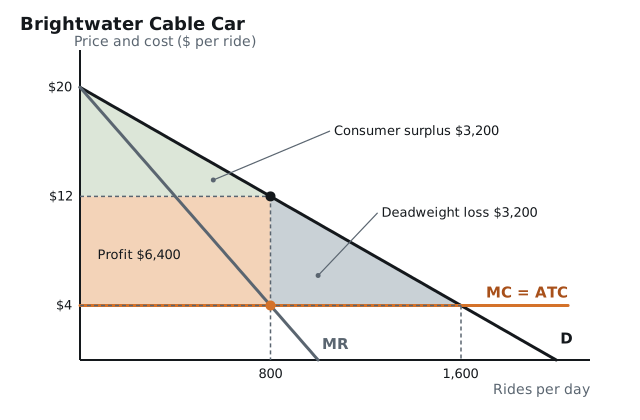
| Area | Shape | Calculation | Value per day |
|---|---|---|---|
| Consumer surplus | Triangle between demand and the price | 1/2 x ($20 - $12) x 800 | $3,200 |
| Profit | Rectangle between price and ATC | ($12 - $4) x 800 | $6,400 |
| Deadweight loss | Triangle between demand and MC, from 800 to 1,600 rides | 1/2 x ($12 - $4) x 800 | $3,200 |
Profit is (price minus average total cost) times quantity. Here the cable car has no fixed cost, so its producer surplus equals its profit. A monopoly can still post a loss if average total cost at its chosen output sits above the price.
A competitive market would produce where price equals marginal cost: 1,600 rides at $4, with total surplus of 1/2 x ($20 - $4) x 1,600 = $12,800. The monopoly keeps $3,200 + $6,400 = $9,600 of that total. The missing $3,200 is deadweight loss: rides that riders value above their $4 cost never happen. Imperfectly competitive prices can leave trades that would benefit both sides undone, and that leads to inefficient output.
A monopoly produces less and charges more than a competitive market facing the same demand and costs.
Part 4 of 4 Natural Monopoly
In a natural monopoly, a single firm enjoys long-run economies of scale across the whole range of demand for its product. The long-run average total cost (LRATC) curve is still falling where it meets demand, so one firm can serve the whole market at a lower average cost than two or more firms could.
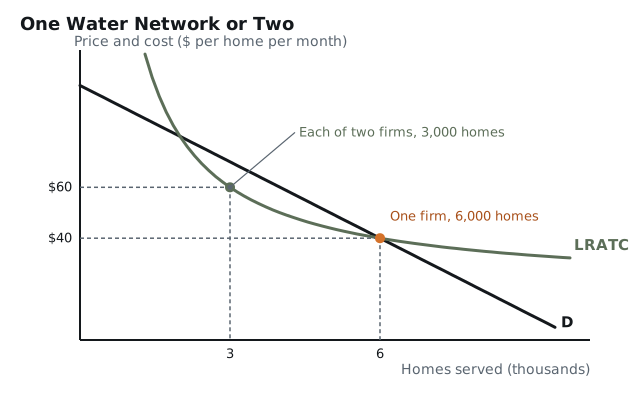
A water network in the town of Ostler serves 6,000 homes at an average cost of $40 per home per month. Two rival networks would each lay a full set of pipes to serve 3,000 homes, and each would pay $60 per home. Utilities with large networks of pipes or wires are common examples of natural monopolies.
Key Terms
Practice Questions
6 questions. Nothing here is recorded or scored.
- Question 1PRD-3.B.6
A Monopolist With Constant Cost
A monopolist faces the demand curve P = 60 - 2Q and the marginal revenue curve MR = 60 - 4Q. Its marginal cost and average total cost are constant at $12 per unit.
What are the monopolist's profit-maximizing quantity and price?
- A.12 units at $12
- B.24 units at $12
- C.12 units at $36
- D.18 units at $24
Check answerHide answer
Answer: C
- A.
- 12 units is right, but $12 is marginal cost. The price comes from the demand curve at 12 units: 60 - 2(12) = $36.
- B.
- 24 units at $12 is where demand meets marginal cost, the competitive outcome. A monopolist produces where MR equals MC.
- C.
- Correct. Set MR equal to MC: 60 - 4Q = 12, so Q = 12. The price comes from the demand curve at that quantity: P = 60 - 2(12) = $36. The price is greater than the $12 marginal cost.
- D.
- 18 units is halfway between the monopoly and competitive quantities and matches no rule. At 18 units, MR is 60 - 72 = -$12, well below MC.
- Question 2PRD-3.B.6
A Monopolist With Constant Cost
A monopolist faces the demand curve P = 60 - 2Q and the marginal revenue curve MR = 60 - 4Q. Its marginal cost and average total cost are constant at $12 per unit.
What is the deadweight loss at the monopolist's profit-maximizing output?
- A.$144
- B.$288
- C.$72
- D.$576
Check answerHide answer
Answer: A
- A.
- Correct. The monopoly sells 12 units at $36. A competitive market would sell where P = MC: 60 - 2Q = 12, so Q = 24. Deadweight loss is the triangle between demand and MC from 12 to 24 units: 1/2 x ($36 - $12) x 12 = $144.
- B.
- $288 is the monopoly profit, ($36 - $12) x 12. Deadweight loss is a triangle, so it takes one half of base times height.
- C.
- $72 uses a base of 6 units. The gap runs from 12 units to the competitive quantity of 24 units, a base of 12.
- D.
- $576 is the total surplus a competitive market would produce, 1/2 x $48 x 24. Deadweight loss is only the part the monopoly destroys.
- Question 3PRD-3.B.7
Which description of a market indicates a natural monopoly?
- A.The government grants one firm a patent on the product for 20 years.
- B.One firm's long-run average total cost is still falling at the quantity where the cost curve meets market demand.
- C.One firm reaches its minimum long-run average total cost at an output that is small relative to market demand.
- D.One firm's marginal cost rises steeply as it expands output.
Check answerHide answer
Answer: B
- A.
- A patent is a legal barrier. A natural monopoly arises from cost conditions, with no law required.
- B.
- Correct. In a natural monopoly, long-run economies of scale for one firm last across the entire range of market demand, so one firm can serve the whole market at a lower average cost than two or more firms could.
- C.
- If minimum average cost comes at a small output, many firms can each produce efficiently, which points toward a competitive market.
- D.
- Steeply rising marginal cost signals diseconomies, which make it cheaper to split output among several firms.
- Question 4PRD-3.B.6
A monopoly maximizes profit by selling 400 units at $15 each. Its marginal cost at 400 units is $9. Which statement is correct?
- A.The monopoly should raise output until price equals marginal cost, because that would increase its profit.
- B.The outcome is allocatively efficient, because the monopoly produces where marginal revenue equals marginal cost.
- C.The monopoly is earning an economic loss, because its price is above its marginal cost.
- D.Society would gain from more output, because buyers value the 401st unit at more than its marginal cost.
Check answerHide answer
Answer: D
- A.
- Producing up to P = MC would lower the monopoly's profit, since MR is below MC past 400 units. The monopolist maximizes profit at MR = MC.
- B.
- MR = MC maximizes the firm's profit. Allocative efficiency requires price to equal marginal cost, and $15 is above $9.
- C.
- Profit depends on price compared with average total cost. Price above marginal cost says nothing about a loss.
- D.
- Correct. The demand curve shows that the next buyer values a unit at close to $15, while it costs about $9 to make. Units like this go unproduced, which creates deadweight loss.
- Question 5PRD-3.B.6
Monopoly
Dalwick Rail, the only rail line serving a mountain region, produces where marginal revenue equals marginal cost. At that output it carries 50,000 passengers a month at a fare of $20. Its average total cost at that output is $24, and its average variable cost is $17.
Which statement describes Dalwick Rail's short-run situation?
- A.It earns a loss of $200,000 a month and keeps operating in the short run.
- B.It earns a loss of $200,000 a month and should shut down at once.
- C.It earns a profit of $200,000 a month.
- D.It earns a loss of $150,000 a month and keeps operating in the short run.
Check answerHide answer
Answer: A
- A.
- Correct. Loss = ($24 - $20) x 50,000 = $200,000 a month. The fare of $20 is above the $17 average variable cost, so operating covers all variable cost and part of fixed cost. The line loses less by operating than by shutting down.
- B.
- The loss is correct, but a firm shuts down in the short run only when price falls below average variable cost. $20 is above $17.
- C.
- Price is below average total cost, so the firm earns a loss. A monopoly can still lose money when demand is weak relative to cost.
- D.
- $150,000 is ($20 - $17) x 50,000, the amount by which revenue exceeds variable cost. The loss uses average total cost: ($24 - $20) x 50,000.
- Question 6PRD-3.B.5
Why can a monopoly keep earning economic profit in the long run when a perfectly competitive firm cannot?
- A.A monopoly produces where marginal revenue equals marginal cost.
- B.A monopoly faces perfectly elastic demand for its product.
- C.Barriers to entry keep new firms out of the monopoly's market.
- D.A monopoly charges a price equal to its marginal cost.
Check answerHide answer
Answer: C
- A.
- Both kinds of firm produce where MR equals MC, so that rule cannot explain the difference.
- B.
- Perfectly elastic demand describes a perfectly competitive firm. A monopoly faces the downward-sloping market demand curve.
- C.
- Correct. A monopoly exists because of barriers to entry. Economic profit would attract new firms, but the barriers stop them, so the profit can last. Free entry erases profit in perfect competition.
- D.
- A monopoly charges a price above marginal cost. Price equal to marginal cost describes perfect competition.
Practice every topic in Unit 4
CED Codes
PRD-3.B.5 · PRD-3.B.6 · PRD-3.B.7