4.3 Price Discrimination
How price discrimination raises a firm's profit, the conditions it needs, and why perfect price discrimination reaches P = MC while capturing all surplus.
Part 1 of 3 What Price Discrimination Is
Price discrimination is charging different buyers different prices for the same product when the price differences do not come from differences in cost. Under certain conditions, a firm with market power can use price discrimination to raise its profit or capture more consumer surplus.
| Condition | Why the firm needs it |
|---|---|
| Market power | A firm that takes the market price as given cannot charge anyone more than that price |
| A way to sort buyers by willingness to pay | The firm must know, or reliably guess, who will pay more, such as by age, student status or booking date |
| A way to stop resale | If low-price buyers can resell to high-price buyers, the high price collapses |
Part 2 of 3 Single Price Versus Perfect Price Discrimination
Calloway Planetarium is the only planetarium in its region. At $20 a ticket nobody visits, and each $1 cut in the price adds 100 visitors a day. Each visitor costs the planetarium $4 in staff and power. Charging one price, it sets marginal revenue equal to marginal cost: 800 visitors at $12 each.
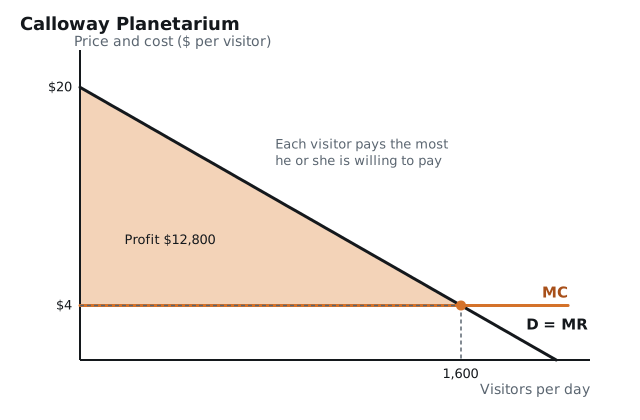
Under perfect price discrimination, the planetarium charges every visitor the most that visitor is willing to pay. A sale to one more visitor no longer lowers the price for anyone else, so the price of each extra ticket is also its marginal revenue, and the demand curve becomes the marginal revenue curve. The planetarium keeps selling until the last visitor's price equals the $4 marginal cost, at 1,600 visitors.
| One price | Perfect price discrimination | |
|---|---|---|
| Visitors per day | 800 | 1,600 |
| Price | $12 for everyone | Each visitor's maximum, from just under $20 down to $4 |
| Profit | ($12 - $4) x 800 = $6,400 | 1/2 x ($20 - $4) x 1,600 = $12,800 |
| Consumer surplus | 1/2 x ($20 - $12) x 800 = $3,200 | $0 |
| Deadweight loss | 1/2 x ($12 - $4) x 800 = $3,200 | $0 |
A perfectly price-discriminating monopolist produces where price equals marginal cost, the same quantity a competitive market would produce. It also takes all of the economic surplus for itself and leaves no deadweight loss. The outcome is efficient, because every visitor who values a ticket at more than $4 gets one. Consumers keep none of the surplus.
Part 3 of 3 Price Discrimination in Practice
Perfect price discrimination needs the firm to know each buyer's exact willingness to pay, which few firms do. Most firms sort buyers into groups instead. The planetarium could charge adults one price and students, who show an ID card at the door, a lower price. A ticket checked against a name at entry is hard to resell.
Charging each group its own price lets the firm sell to buyers who would skip a single high price, while still charging more to the buyers who will pay it. Group pricing like this can raise the firm's profit compared with a single price.
Price discrimination turns consumer surplus into profit for the seller.
Key Terms
Practice Questions
6 questions. Nothing here is recorded or scored.
- Question 1PRD-3.B.8
Which of the following is NOT a condition a firm needs in order to practice price discrimination?
- A.The firm has market power.
- B.The firm faces perfectly elastic demand for its product.
- C.The firm can sort buyers by their willingness to pay.
- D.The firm can prevent buyers who pay low prices from reselling to buyers who would pay more.
Check answerHide answer
Answer: B
- A.
- Market power is required. A firm that must take the market price cannot charge anyone more than that price.
- B.
- Correct. A firm facing perfectly elastic demand loses all of its sales if it charges above the market price, so it cannot charge some buyers more. Price discrimination needs market power, a way to sort buyers and a way to stop resale.
- C.
- Sorting buyers is required. The firm must know, or reliably guess, which buyers will pay more.
- D.
- Preventing resale is required. If low-price buyers could resell, the high price would collapse.
- Question 2PRD-3.B.9
A Monopolist That Can Price Discriminate
A monopolist faces the demand curve P = 40 - Q and the marginal revenue curve MR = 40 - 2Q under a single price. Its marginal cost and average total cost are constant at $10.
If this monopolist practices perfect price discrimination, how many units does it sell, and what is consumer surplus?
- A.15 units, with consumer surplus of $0
- B.30 units, with consumer surplus of $450
- C.30 units, with consumer surplus of $0
- D.15 units, with consumer surplus of $112.50
Check answerHide answer
Answer: C
- A.
- 15 units is the single-price quantity where MR = MC. A perfect price discriminator keeps selling until price equals marginal cost.
- B.
- 30 units is right, but $450 is the total surplus, and under perfect price discrimination the firm takes all of it as profit.
- C.
- Correct. With perfect price discrimination the demand curve is the marginal revenue curve, so the firm sells until P = MC: 40 - Q = 10, which gives Q = 30. Each buyer pays his or her maximum, so consumer surplus is zero.
- D.
- These are the single-price figures: 15 units and consumer surplus of 1/2 x ($40 - $25) x 15 = $112.50.
- Question 3PRD-3.B.9
A Monopolist That Can Price Discriminate
A monopolist faces the demand curve P = 40 - Q and the marginal revenue curve MR = 40 - 2Q under a single price. Its marginal cost and average total cost are constant at $10.
By how much does the monopolist's profit rise when it moves from charging a single price to perfect price discrimination?
- A.$112.50
- B.$450
- C.$337.50
- D.$225
Check answerHide answer
Answer: D
- A.
- $112.50 is the single-price consumer surplus, or the single-price deadweight loss. The gain in profit is both of them together.
- B.
- $450 is the profit under perfect price discrimination. The question asks for the increase over single-price profit.
- C.
- $337.50 adds the single-price profit to consumer surplus. The increase is perfect discrimination profit minus single-price profit.
- D.
- Correct. Single price: MR = MC gives 40 - 2Q = 10, so Q = 15 and P = $25, for profit of ($25 - $10) x 15 = $225. Perfect discrimination: profit is the whole triangle between demand and MC, 1/2 x ($40 - $10) x 30 = $450. The increase is $450 - $225 = $225.
- Question 4PRD-3.B.8
Glimmer Bay Aquarium charges visitors $30 a ticket and local residents $18 a ticket. Residents must show an ID with a local address at the gate. Why does the aquarium check IDs at the gate?
- A.To sort buyers into groups and stop visitors from buying the cheaper tickets
- B.To raise its marginal cost so that the higher adult price is justified
- C.To make the demand for its tickets perfectly elastic for both groups
- D.To meet a legal rule that every buyer must pay exactly the same price
Check answerHide answer
Answer: A
- A.
- Correct. Price discrimination needs a way to sort buyers and stop resale. Checking IDs sorts locals from visitors and stops visitors from buying the lower-priced tickets.
- B.
- Checking IDs does not change the cost of serving a visitor. The price gap comes from different willingness to pay.
- C.
- Perfectly elastic demand would wipe out the aquarium's pricing power, which it needs in order to price discriminate.
- D.
- Charging two prices for the same ticket is the opposite of every buyer paying the same price.
- Question 5PRD-3.B.9
Compared with charging a single price, perfect price discrimination by a monopolist has which effects?
- A.Output falls, consumer surplus rises and deadweight loss rises.
- B.Output rises, consumer surplus falls to zero and deadweight loss is eliminated.
- C.Output rises, consumer surplus rises and deadweight loss is eliminated.
- D.Output stays the same, consumer surplus falls and deadweight loss stays the same.
Check answerHide answer
Answer: B
- A.
- Perfect price discrimination expands output to the point where price equals marginal cost, so output rises and deadweight loss disappears.
- B.
- Correct. The perfect price discriminator sells to every buyer who values the good at or above marginal cost, the same quantity a competitive market would sell. It takes all surplus as profit, so consumer surplus is zero and no deadweight loss remains.
- C.
- Output rises and deadweight loss disappears, but each buyer pays his or her maximum, so consumer surplus falls to zero.
- D.
- Output changes because the firm no longer has to cut its price on every unit to sell one more.
- Question 6PRD-3.B.8
A theater that can price discriminate sells tickets to two groups: students and other adults. Students' demand for tickets is more elastic than other adults' demand. To maximize profit, how should the theater set its prices?
- A.Charge students a higher price, because students buy more tickets.
- B.Charge both groups the same price, because the tickets cost the same to provide.
- C.Charge students a lower price, because their purchases respond more strongly to price.
- D.Charge other adults a lower price, because their demand is less elastic.
Check answerHide answer
Answer: C
- A.
- The size of a group's purchases does not decide its price. The group whose purchases respond more to price gets the lower price.
- B.
- Equal costs do not require equal prices for a firm with market power. Charging each group its own price can raise profit.
- C.
- Correct. A group with more elastic demand cuts its purchases sharply when the price rises, so the theater earns more by charging it less. The group with less elastic demand will keep buying at a higher price.
- D.
- Less elastic demand means buyers keep buying when the price rises, so that group gets the higher price.
Practice every topic in Unit 4
CED Codes
PRD-3.B.8 · PRD-3.B.9