4.4 Monopolistic Competition
Monopolistic competition: differentiated products, advertising, short-run profit or loss, zero long-run profit, excess capacity and P above MC.
Part 1 of 4 Many Firms, Differentiated Products
In monopolistic competition, many firms sell differentiated products and firms can enter or leave the market freely. Fennick Street has a dozen noodle shops. Each shop's broth and toppings differ, so each shop faces its own downward-sloping demand curve and picks its own price.
Firms typically use advertising as a means of differentiating their product. A shop that convinces diners its broth is the best on the street makes its demand curve less elastic and keeps more customers when it raises its price. Each shop still chooses the output where marginal revenue equals marginal cost and reads its price from its demand curve.
Part 2 of 4 Short-Run Profit or Loss
In the short run, a firm selling a differentiated product may earn a positive, negative or zero economic profit. What happens next depends on which case holds.
| Short-run case | At the MR = MC output | What follows |
|---|---|---|
| Economic profit | Price is above ATC | New shops open; each existing shop loses diners, so its demand curve shifts left |
| Economic loss | Price is below ATC | Some shops close; each remaining shop gains diners, so its demand curve shifts right |
| Zero economic profit | Price equals ATC | No shop enters or exits |
Free entry and exit drive economic profit to zero in the long run. Entry and exit stop when each shop's demand curve just touches its average total cost curve at the profit-maximizing output.
Part 3 of 4 The Long Run: Zero Profit and Excess Capacity
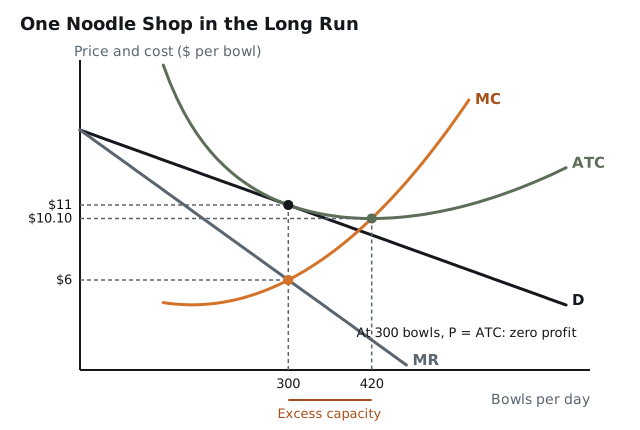
In the long run, one Fennick Street shop sells 300 bowls a day at $11. Marginal revenue equals marginal cost of $6 at 300 bowls, and average total cost there is also $11, so the shop earns zero economic profit. The shop's average total cost would fall to its minimum, about $10.10, at 420 bowls a day.
The output level is smaller than the output level needed to minimize average total cost, creating excess capacity. The shop could serve 120 more bowls a day at a lower average cost, but selling them would require a lower price on every bowl. The price is greater than marginal cost, creating allocative inefficiency: diners would pay $11 for a bowl that costs $6 to make, and some of those bowls never get made.
Part 4 of 4 Compared With Perfect Competition
| Monopolistic competition | Perfect competition | |
|---|---|---|
| Product | Differentiated | Identical |
| Long-run economic profit | Zero | Zero |
| Price and marginal cost | Price is greater than MC | Price equals MC |
| Output and minimum ATC | Output is below the minimum-ATC output: excess capacity | Output is at minimum ATC |
Free entry erases long-run profit in both structures. Only monopolistic competition keeps price above marginal cost.
Key Terms
Practice Questions
6 questions. Nothing here is recorded or scored.
- Question 1PRD-3.B.10
A firm in a monopolistically competitive industry is in long-run equilibrium. Which set of conditions describes its outcome?
- A.Price equals marginal cost, and the firm produces at minimum average total cost.
- B.Price is above average total cost, and the firm earns positive economic profit.
- C.Price equals marginal cost, and the firm has excess capacity.
- D.Price equals average total cost, price is above marginal cost and the firm has excess capacity.
Check answerHide answer
Answer: D
- A.
- Price equal to marginal cost at minimum ATC describes long-run perfect competition.
- B.
- Free entry erases economic profit in the long run, so price equals average total cost.
- C.
- The firm does have excess capacity, but its price is above marginal cost because it faces a downward-sloping demand curve.
- D.
- Correct. Entry and exit drive economic profit to zero, so P = ATC. The demand curve is tangent to ATC to the left of its minimum, so output is below the minimum-ATC level, which is excess capacity, and price is above marginal cost.
- Question 2PRD-3.B.10
Hair salons in the town of Fenmoor operate in a monopolistically competitive market, and each salon is currently earning positive economic profit. What will happen in the long run?
- A.New salons open, and each existing salon's demand curve shifts left until economic profit is zero.
- B.Salons close, and each remaining salon's demand curve shifts right until economic profit is zero.
- C.Nothing changes, because each salon's differentiated product protects its profit.
- D.Salons merge until one salon is left in Fenmoor.
Check answerHide answer
Answer: A
- A.
- Correct. Free entry draws new salons in. Customers spread across more salons, so each existing salon's demand shifts left until price equals average total cost and economic profit is zero.
- B.
- Exit happens when firms earn losses. With positive profit, firms enter.
- C.
- Differentiation gives each salon some pricing power, but free entry still erases economic profit in the long run.
- D.
- Nothing in a monopolistically competitive market drives firms to merge into one. Free entry adds firms.
- Question 3PRD-3.B.10
Why do firms in monopolistic competition typically spend money on advertising?
- A.To lower their marginal cost of production
- B.To differentiate their product so that buyers see fewer close substitutes
- C.To make the demand for their product perfectly elastic
- D.To set up a legal barrier that stops new firms from entering
Check answerHide answer
Answer: B
- A.
- Advertising is a cost. It raises total cost and does not lower the marginal cost of making each unit.
- B.
- Correct. Firms typically use advertising to differentiate their product. Buyers who believe a product is special see fewer close substitutes, which makes demand less elastic and gives the firm more room to set its price.
- C.
- Perfectly elastic demand would remove all pricing power. Advertising aims to make demand less elastic.
- D.
- Advertising creates no legal barrier. Entry stays free in monopolistic competition.
- Question 4PRD-3.B.10
Monopolistic Competition
Pellwood Grill is a restaurant in a monopolistically competitive market. In long-run equilibrium it serves 200 meals a day at a price of $15, which equals its average total cost. Its average total cost would reach its minimum of $13 at 260 meals a day.
How much excess capacity does Pellwood Grill have?
- A.200 meals a day
- B.260 meals a day
- C.60 meals a day
- D.$2 per meal
Check answerHide answer
Answer: C
- A.
- 200 meals is the restaurant's actual output. Excess capacity is the gap between actual output and the minimum-ATC output.
- B.
- 260 meals is the output that would minimize average total cost. Excess capacity is the shortfall from that level.
- C.
- Correct. Excess capacity is the difference between the output that minimizes average total cost and the output the firm actually produces: 260 - 200 = 60 meals a day.
- D.
- $2 is the gap between the restaurant's ATC and its minimum ATC. Excess capacity is measured in units of output.
- Question 5PRD-3.B.10
A monopolistically competitive bakery maximizes profit by selling 100 loaves a day at $9 each, while its average total cost is $11. What does the bakery earn, and what happens to its demand in the long run?
- A.A profit of $200 a day; its demand shifts left as new bakeries enter.
- B.A loss of $200 a day; its demand shifts left as bakeries exit.
- C.A loss of $900 a day; its demand stays the same.
- D.A loss of $200 a day; its demand shifts right as some bakeries exit.
Check answerHide answer
Answer: D
- A.
- Price is below average total cost, so the bakery earns a loss, which leads firms to exit.
- B.
- The loss is right, but when bakeries exit, their customers move to the remaining bakeries, which shifts each survivor's demand right.
- C.
- $900 is total revenue, 100 x $9. The loss is ($11 - $9) x 100 = $200, and exit changes demand.
- D.
- Correct. Loss = ($11 - $9) x 100 = $200 a day. Losses lead some bakeries to exit, and the remaining bakeries gain customers, so each one's demand shifts right until price equals average total cost.
- Question 6PRD-3.B.10
In long-run equilibrium, a monopolistically competitive firm charges a price above its marginal cost. What does this imply?
- A.The market is allocatively inefficient, since buyers value extra units above their cost.
- B.The firm keeps earning positive economic profit in the long run.
- C.The firm produces more than the quantity that minimizes average total cost.
- D.The market is allocatively efficient, because the firm earns zero economic profit.
Check answerHide answer
Answer: A
- A.
- Correct. Price measures what buyers will pay for one more unit. When price is above marginal cost, more output would add more benefit than cost, so the market produces too little and is allocatively inefficient.
- B.
- Free entry drives long-run economic profit to zero, even though price stays above marginal cost.
- C.
- The firm produces less than the minimum-ATC quantity, which is excess capacity.
- D.
- Zero economic profit does not make a market allocatively efficient. Efficiency requires price to equal marginal cost.
Practice every topic in Unit 4
CED Codes
PRD-3.B.10