4.5 Oligopoly and Game Theory
Oligopoly and game theory: collusion, cartels, payoff matrices, dominant strategies, Nash equilibrium, the prisoner's dilemma and changing incentives.
Part 1 of 4 Few Firms Acting Interdependently
An oligopoly is an inefficient market structure with high barriers to entry, where a few firms act interdependently: each firm's best choice depends on what its rivals choose. Quillan Air and Sorrel Air are the only two airlines flying between the islands of Mora and Teal, so each airline's fare decision changes the other's profit.
Oligopoly firms have an incentive to collude and to form cartels. In collusion, rival firms agree to limit output or raise prices. A cartel is a group of firms that formally agrees to act together as a single monopoly would. The United States and many other countries prohibit price-fixing agreements among competitors.
Part 2 of 4 Games, Strategies and Payoffs
Game theory studies these choices. A game is any situation where several players each take an action and each player's payoff depends directly on both its own choice and the other players' choices. A strategy is a complete plan of actions for playing a game.
The normal form of a game, also called a payoff matrix, shows the payoffs that result from each combination of strategies, one strategy for each player. In the fare game, each airline chooses a high fare or a low fare, and the matrix shows each airline's daily profit. By convention, the first payoff in a cell belongs to the player listed down the side, here Quillan Air.
| Sorrel: high fare | Sorrel: low fare | |
|---|---|---|
| Quillan: high fare | ($10,000, $10,000) | ($4,000, $14,000) |
| Quillan: low fare | ($14,000, $4,000) | ($6,000, $6,000) |
Part 3 of 4 Dominant Strategies and Nash Equilibrium
A player has a dominant strategy when the payoff to one action is always higher, whatever action the other player takes. If Sorrel charges a high fare, Quillan earns $14,000 with a low fare against $10,000 with a high fare. If Sorrel charges a low fare, Quillan earns $6,000 with a low fare against $4,000 with a high fare. A low fare is Quillan's dominant strategy, and the same numbers make it Sorrel's too.
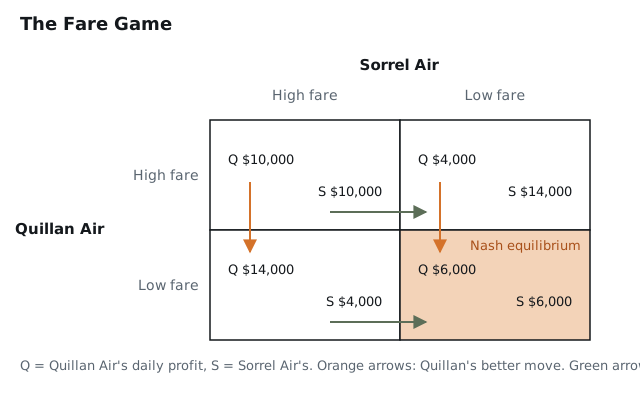
A Nash equilibrium is a set of actions in which no player can raise its payoff by changing its own action alone, given the other players' actions. At (low fare, low fare), an airline that switched to a high fare alone would drop from $6,000 to $4,000, so neither switches. The game is a prisoner's dilemma: both airlines would earn $10,000 with high fares, yet each one's own interest pulls it to the low fare.
Oligopolists have difficulty reaching the monopoly outcome for the same reason the players in a prisoner's dilemma miss the cooperative outcome.
Even so, oligopoly and duopoly markets generally have higher prices and lower quantities than perfectly competitive markets. A duopoly is an oligopoly with exactly two firms, like this air route.
Part 4 of 4 Changing the Incentive
A payment or penalty can change a dominant strategy. Suppose an airline association fines any member that cuts its fare by an amount F. Quillan prefers a high fare when Sorrel charges a high fare only if $10,000 is more than $14,000 minus F, which needs F above $4,000. When Sorrel charges a low fare, a high fare wins only if $4,000 is more than $6,000 minus F, which needs F above $2,000.
For a high fare to be Quillan's dominant strategy, it must win in both columns, so the fine must be more than $4,000. At exactly $4,000, Quillan earns the same with either fare when Sorrel charges a high fare.
Key Terms
Practice Questions
6 questions. Nothing here is recorded or scored.
- Question 1PRD-3.C.5
Brava and Cindra
Brava Roasters and Cindra Coffee are the only two coffee roasters in a city. Each decides whether to advertise. The payoff matrix shows monthly profits, with Brava's profit listed first. Both firms know all of the payoffs, and they choose at the same time.
| Cindra advertises | Cindra does not advertise Brava advertises | ($40,000, $30,000) | ($70,000, $20,000) Brava does not advertise | ($30,000, $60,000) | ($50,000, $45,000) Does Brava have a dominant strategy?
- A.No, because Brava's best choice depends on what Cindra does.
- B.Yes, Brava's dominant strategy is to advertise.
- C.Yes, Brava's dominant strategy is not to advertise.
- D.No, because the firms choose at the same time.
Check answerHide answer
Answer: B
- A.
- Brava's best choice is the same in both columns, so it does not depend on Cindra's choice.
- B.
- Correct. If Cindra advertises, Brava earns $40,000 by advertising and $30,000 by not advertising. If Cindra does not advertise, Brava earns $70,000 by advertising and $50,000 by not. Advertising pays more either way, so it is Brava's dominant strategy.
- C.
- Not advertising pays Brava less in both columns: $30,000 against $40,000, and $50,000 against $70,000.
- D.
- Players who choose at the same time can still have dominant strategies. A dominant strategy wins whatever the other player picks.
- Question 2PRD-3.C.6
Brava and Cindra
Brava Roasters and Cindra Coffee are the only two coffee roasters in a city. Each decides whether to advertise. The payoff matrix shows monthly profits, with Brava's profit listed first. Both firms know all of the payoffs, and they choose at the same time.
| Cindra advertises | Cindra does not advertise Brava advertises | ($40,000, $30,000) | ($70,000, $20,000) Brava does not advertise | ($30,000, $60,000) | ($50,000, $45,000) What is the Nash equilibrium of this game?
- A.Neither firm advertises.
- B.Brava advertises and Cindra does not.
- C.Both firms advertise.
- D.Brava does not advertise and Cindra advertises.
Check answerHide answer
Answer: C
- A.
- If neither advertises, each firm could raise its profit by advertising alone: Brava from $50,000 to $70,000, and Cindra from $45,000 to $60,000.
- B.
- At this cell, Cindra could raise its profit from $20,000 to $30,000 by advertising.
- C.
- Correct. Advertising is a dominant strategy for both firms. Cindra earns $30,000 against $20,000 when Brava advertises, and $60,000 against $45,000 when Brava does not. At (advertise, advertise), neither firm can raise its profit by changing its choice alone.
- D.
- At this cell, Brava could raise its profit from $30,000 to $40,000 by advertising.
- Question 3PRD-3.C.5
Brava and Cindra
Brava Roasters and Cindra Coffee are the only two coffee roasters in a city. Each decides whether to advertise. The payoff matrix shows monthly profits, with Brava's profit listed first. Both firms know all of the payoffs, and they choose at the same time.
| Cindra advertises | Cindra does not advertise Brava advertises | ($40,000, $30,000) | ($70,000, $20,000) Brava does not advertise | ($30,000, $60,000) | ($50,000, $45,000) The city places a fixed tax on Cindra each month that Cindra advertises. Which tax is the smallest that makes not advertising a dominant strategy for Cindra?
- A.Any tax greater than $5,000
- B.Any tax greater than $10,000
- C.Any tax greater than $25,000
- D.Any tax greater than $15,000
Check answerHide answer
Answer: D
- A.
- $5,000 is not a gap between Cindra's payoffs in either case. Compare Cindra's two choices for each of Brava's choices.
- B.
- A tax above $10,000 makes not advertising better when Brava advertises ($20,000 against $30,000 minus the tax). When Brava does not advertise, Cindra still prefers to advertise unless the tax tops $15,000.
- C.
- $25,000 is more than enough, but smaller taxes also work. The smallest sufficient tax is anything above $15,000.
- D.
- Correct. When Brava advertises, not advertising wins if $20,000 > $30,000 - T, so T > $10,000. When Brava does not advertise, not advertising wins if $45,000 > $60,000 - T, so T > $15,000. Not advertising is dominant only when it wins in both cases, so the tax must exceed $15,000.
- Question 4PRD-3.C.2, PRD-3.C.7
Brava and Cindra
Brava Roasters and Cindra Coffee are the only two coffee roasters in a city. Each decides whether to advertise. The payoff matrix shows monthly profits, with Brava's profit listed first. Both firms know all of the payoffs, and they choose at the same time.
| Cindra advertises | Cindra does not advertise Brava advertises | ($40,000, $30,000) | ($70,000, $20,000) Brava does not advertise | ($30,000, $60,000) | ($50,000, $45,000) Suppose Brava and Cindra secretly agree that neither will advertise. Which statement best explains why the agreement is likely to break down?
- A.Each firm can raise its own profit by advertising while the other keeps the agreement.
- B.Each firm earns less by not advertising than it earns when both advertise.
- C.Neither firm has a dominant strategy, so neither can predict the other.
- D.The agreement moves both firms to the Nash equilibrium, which is unstable.
Check answerHide answer
Answer: A
- A.
- Correct. If Cindra keeps the agreement, Brava gains $20,000 by advertising ($70,000 against $50,000), and Cindra has the same temptation. This incentive to cheat is why oligopolists have difficulty holding a collusive outcome, as in the prisoner's dilemma.
- B.
- Both firms earn more when neither advertises ($50,000 and $45,000) than when both advertise ($40,000 and $30,000). That is why they want the agreement.
- C.
- Both firms have a dominant strategy: advertise. The temptation to cheat comes from that dominant strategy.
- D.
- The agreement moves the firms away from the Nash equilibrium. A Nash equilibrium is stable, because no player gains by changing alone.
- Question 5PRD-3.C.6, PRD-3.C.5
Xeno and Yarrow
Xeno Freight and Yarrow Freight are the only two shipping firms at a port. Each decides whether to expand its fleet or hold it at its current size. The payoff matrix shows yearly profits, with Xeno's profit listed first. Both firms know all of the payoffs and choose at the same time.
| Yarrow expands | Yarrow holds Xeno expands | ($2 million, $4 million) | ($6 million, $3 million) Xeno holds | ($3 million, $5 million) | ($5 million, $2 million) What is the Nash equilibrium of this game?
- A.Xeno expands and Yarrow expands.
- B.Xeno holds and Yarrow expands.
- C.Xeno expands and Yarrow holds.
- D.Xeno holds and Yarrow holds.
Check answerHide answer
Answer: B
- A.
- At (expand, expand), Xeno could raise its profit from $2 million to $3 million by holding.
- B.
- Correct. Expanding is Yarrow's dominant strategy: $4 million against $3 million when Xeno expands, and $5 million against $2 million when Xeno holds. Xeno has no dominant strategy, but given that Yarrow expands, Xeno earns more by holding ($3 million against $2 million). At (hold, expand), neither firm gains by changing alone.
- C.
- At (expand, hold), Yarrow could raise its profit from $3 million to $4 million by expanding.
- D.
- At (hold, hold), Yarrow could raise its profit from $2 million to $5 million by expanding.
- Question 6PRD-3.C.1, PRD-3.C.7
Compared with a perfectly competitive market facing the same demand and costs, an oligopoly typically has which outcome?
- A.A lower price and a larger quantity
- B.The same price and the same quantity
- C.A higher price and a smaller quantity
- D.A higher price and a larger quantity
Check answerHide answer
Answer: C
- A.
- A lower price and a larger quantity than perfect competition would mean output past the efficient level, which oligopolies do not produce.
- B.
- Oligopolists rarely reach the full monopoly outcome, but they still keep prices above the competitive level.
- C.
- Correct. Oligopolists have difficulty reaching the monopoly outcome, but prices are generally higher and quantities lower in oligopoly than in perfect competition. Oligopoly is an inefficient market structure.
- D.
- A higher price reduces the quantity buyers want, so price and quantity cannot both rise along the same demand curve.
Practice every topic in Unit 4
CED Codes
PRD-3.C.1 · PRD-3.C.2 · PRD-3.C.3 · PRD-3.C.4 · PRD-3.C.5 · PRD-3.C.6 · PRD-3.C.7