5.1 Introduction to Factor Markets
Factor markets for labor, capital and land, the factor prices they set, derived demand, marginal revenue product, marginal factor cost and labor markets.
Part 1 of 3 What a Factor Market Is
A factor market is a market where firms buy the services of the factors of production: labor, capital and land. Each factor earns a factor price. Labor earns a wage, capital earns interest and land earns rent.
| Factor | What the firm buys | Factor price |
|---|---|---|
| Labor | Hours of human work | Wage |
| Capital | The use of machines, tools and buildings | Interest |
| Land | The use of natural resources and sites | Rent |
| Product market | Factor market | |
|---|---|---|
| Buyers | Households buy goods and services | Firms buy the services of labor, capital and land |
| Sellers | Firms sell goods and services | Households sell the factors they own |
| Price | The price of the product | The wage, interest or rent |
Factors of production respond to factor prices. A higher wage for orchard work draws more people into picking, and a higher rent for farmland draws more land into farming.
Part 2 of 3 Why Firms Hire
A firm wants workers only because workers help it make something it can sell, so the demand for labor is a derived demand: it comes from the demand for the product. A firm decides whether to hire based on the factor's productivity, the price of the output and the cost of the factor.
Tamsin Valley is a farming valley where dozens of orchards hire pickers by the day, and its apples sell for $6 a crate. At one orchard, a third picker adds 25 crates a day. That picker's marginal revenue product (MRP) is the extra revenue the picker brings in: 25 crates x $6 = $150 a day. The picker's marginal factor cost (MFC), the extra cost of hiring one more picker, is the $120 daily wage. The third picker adds $150 of revenue and $30 more than her cost, so the orchard hires her.
Marginal revenue product equals the change in total revenue divided by the change in labor. Marginal factor cost equals the change in total cost divided by the change in labor.
Part 3 of 3 The Labor Market
A labor market brings together the firms that hire one kind of work and the people who offer it. Other things constant, the quantity of labor demanded is negatively related to the wage, and the quantity of labor supplied is positively related to the wage.
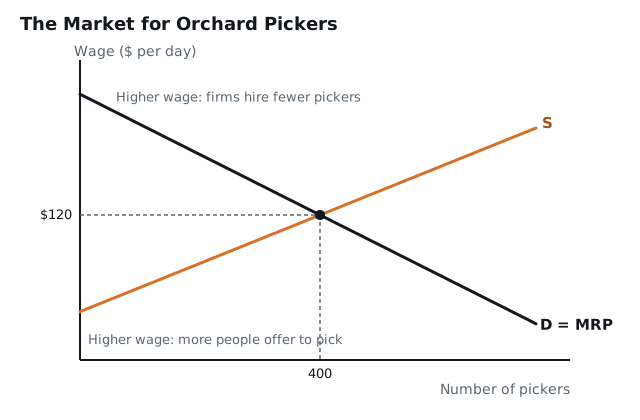
Each extra picker adds less than the one before, so at a higher wage fewer pickers are worth hiring and the labor demand curve slopes down. A higher wage also draws people away from other jobs and from leisure, so the labor supply curve slopes up. In the Tamsin Valley the two curves cross at a wage of $120 a day, with 400 pickers employed.
Firms buy factors, households sell them, and the factor price balances the two sides.
Key Terms
Practice Questions
6 questions. Nothing here is recorded or scored.
- Question 1PRD-4.A.1
In factor markets, which pairing of a factor of production with its factor payment is correct?
- A.Labor earns rent.
- B.Capital earns interest.
- C.Land earns wages.
- D.Capital earns wages.
Check answerHide answer
Answer: B
- A.
- Labor earns a wage. Rent is the payment for the use of land.
- B.
- Correct. Capital, such as machines and buildings, earns interest. Labor earns wages, and land earns rent.
- C.
- Land earns rent. Wages are the payment to labor.
- D.
- Wages are the payment to labor. The payment to capital is interest.
- Question 2PRD-4.A.1
Hollin Honey
Hollin Honey sells jars of honey in a perfectly competitive market at $5 a jar. The table shows its daily output as it hires more workers.
Workers | Total output (jars per day) 0 | 0 1 | 12 2 | 22 3 | 30 4 | 36 What is the marginal revenue product of the third worker?
- A.$150
- B.$30
- C.$8
- D.$40
Check answerHide answer
Answer: D
- A.
- $150 is total revenue with three workers, 30 jars x $5. MRP counts only the revenue the third worker adds.
- B.
- 30 jars is total output with three workers. MRP is a dollar amount for one extra worker.
- C.
- 8 jars is the third worker's marginal product. MRP multiplies it by the $5 the firm earns on each jar.
- D.
- Correct. The third worker raises output from 22 to 30 jars, a marginal product of 8 jars. Each jar sells for $5, so the MRP is 8 x $5 = $40.
- Question 3PRD-4.A.1
Sales of electric bicycles rise sharply in the city of Ardvale. What is the most likely effect on the demand for bicycle mechanics in Ardvale?
- A.It increases, because the demand for mechanics is derived from the demand for the bikes they service.
- B.It decreases, because more bikes in the city make each mechanic less productive.
- C.It stays the same, because the demand for labor depends only on the wage.
- D.It increases, because higher bike sales raise the wage mechanics are paid.
Check answerHide answer
Answer: A
- A.
- Correct. Firms hire mechanics to service and build the bikes customers buy. When bike sales rise, the revenue each mechanic brings in rises, so the demand for mechanics increases. Labor demand is a derived demand.
- B.
- More bikes give mechanics more work. Nothing in the scenario lowers what each mechanic can do.
- C.
- A change in the wage moves along the labor demand curve. A change in demand for the product shifts the curve.
- D.
- The wage may rise, but as a result of the higher demand for mechanics. The higher wage does not cause the increase.
- Question 4PRD-4.A.1
A bakery is deciding whether to hire one more baker. Which set of information does it need?
- A.The baker's age, the bakery's rent and the price of flour
- B.The number of bakers in town, the bakery's profit last year and the baker's wage
- C.The baker's marginal product, the price of the bread and the baker's wage
- D.The total output of all bakers, the bakery's fixed cost and the price of the bread
Check answerHide answer
Answer: C
- A.
- Rent is a fixed cost that does not change with one more hire. The decision depends on what the baker adds to revenue and to cost.
- B.
- Last year's profit is past information. The decision compares what one more baker adds to revenue with the cost of hiring the baker.
- C.
- Correct. A firm decides to hire based on the factor's productivity, the price of the output and the cost of the factor. Marginal product times the bread price gives the revenue the baker adds, and the wage is the added cost.
- D.
- Total output and fixed cost do not show what one more baker adds. The firm needs the baker's marginal product.
- Question 5PRD-4.A.2
Other things constant, the wage for warehouse workers in a city rises. What happens in the warehouse labor market?
- A.Labor demand shifts left, and labor supply shifts right.
- B.The quantity of labor demanded falls, and the quantity of labor supplied rises.
- C.The quantity of labor demanded rises, and the quantity of labor supplied falls.
- D.Labor demand shifts right, and labor supply shifts left.
Check answerHide answer
Answer: B
- A.
- A change in the wage moves along both curves. Neither curve shifts.
- B.
- Correct. The quantity of labor demanded is negatively related to the wage, and the quantity supplied is positively related to it. A higher wage moves firms up their demand curve to hire fewer workers and moves workers up the supply curve to offer more work.
- C.
- This reverses both relationships. Firms hire fewer workers at a higher wage, and more people offer to work.
- D.
- A change in the wage itself does not shift either curve.
- Question 6PRD-4.A.1
A landscaping firm hires workers in a perfectly competitive labor market at a wage of $90 a day. What is the marginal factor cost of the fifth worker?
- A.$450
- B.$18
- C.More than $90, because the firm must raise the wage to hire another worker
- D.$90
Check answerHide answer
Answer: D
- A.
- $450 is the total wage bill for five workers. MFC is the added cost of one more worker.
- B.
- $18 is $90 divided by five. MFC is the change in total cost when one worker is added.
- C.
- A firm in a perfectly competitive labor market can hire as many workers as it wants at the market wage. Raising the wage to hire more describes a monopsony.
- D.
- Correct. In a perfectly competitive labor market, the firm takes the wage as given, so each extra worker adds exactly the wage to total cost. The MFC of the fifth worker is $90.
Practice every topic in Unit 5
CED Codes
PRD-4.A.1 · PRD-4.A.2