5.2 Changes in Factor Demand and Factor Supply
What shifts labor demand (output price, productivity) and labor supply (immigration, education, conditions, age, options, leisure, culture), with results.
Part 1 of 3 What Shifts Labor Demand
Port Velan is a harbor city with hundreds of bakeries that hire pastry chefs. Labor demand shows how many chefs the bakeries want to hire at each wage. Because labor demand is derived from the demand for pastries, a change in the output price or in worker productivity shifts the labor demand curve.
| Change | Why the MRP of each chef changes | Labor demand |
|---|---|---|
| Pastries sell for a higher price | Each pastry a chef makes brings in more revenue | Shifts right (increase) |
| New mixers let each chef make more pastries | Each chef adds more output, so more revenue | Shifts right (increase) |
| Pastries sell for a lower price | Each pastry brings in less revenue | Shifts left (decrease) |
| Worker productivity falls | Each chef adds less output | Shifts left (decrease) |
Here is the chain for a price change. A chef who adds 40 croissants a day adds $80 of revenue when croissants sell for $2. If the price rises to $2.50, the same 40 croissants bring in $100, so the chef's MRP rises from $80 to $100. At every wage, more chefs are now worth hiring, and the whole labor demand curve shifts right. Better equipment works the same way through the other half of MRP: if new mixers raise the chef's output to 50 croissants at $2, the MRP again rises to $100.
Part 2 of 3 What Shifts Labor Supply
Labor supply shows how many people offer to work as pastry chefs at each wage. Changes in the determinants of labor supply shift the labor supply curve. Each determinant changes how many people are able or willing to do the work at a given wage. A change that adds willing chefs at every wage shifts the curve right, and a change that removes them shifts it left.
| Determinant | A change that increases supply | A change that decreases supply |
|---|---|---|
| Immigration | Trained chefs move to Port Velan | Chefs leave the city |
| Education | A new culinary school graduates more chefs | Training programs close |
| Working conditions | Kitchens add breaks and air conditioning | Shifts grow longer and hotter |
| Age distribution | More of the population reaches working age | More chefs reach retirement age |
| Alternative options | Wages fall in restaurant jobs that use the same skills | Hotels offer chefs higher pay |
| Preferences for leisure | People choose to work more hours | People choose more time off |
| Cultural expectations | Baking becomes a respected career choice | Families steer children away from kitchen work |
Part 3 of 3 Reading the New Equilibrium
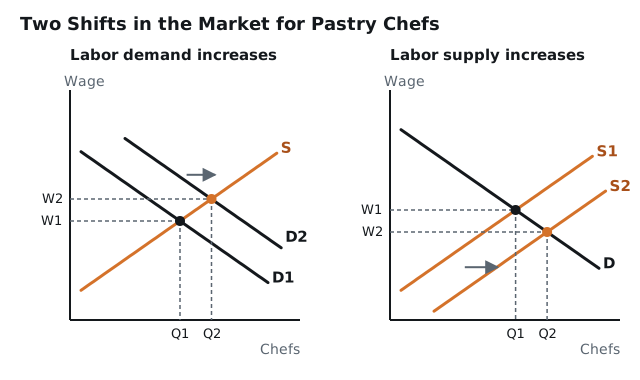
| Shift | Wage | Number employed |
|---|---|---|
| Labor demand increases | Rises | Rises |
| Labor demand decreases | Falls | Falls |
| Labor supply increases | Falls | Rises |
| Labor supply decreases | Rises | Falls |
Suppose pastry prices in Port Velan rise during the tourist season. Each chef's MRP rises, labor demand shifts right, and both the wage and the number of chefs employed rise. If a new culinary school then graduates a large class, labor supply shifts right, the wage falls back, and employment rises again.
Labor demand and wages move together. Labor supply and wages move in opposite directions.
Key Terms
Practice Questions
6 questions. Nothing here is recorded or scored.
- Question 1PRD-4.B.1
The price of furniture rises in a country where furniture makers hire carpenters in a competitive labor market. What happens in the market for carpenters?
- A.Labor demand increases, and both the wage and employment rise.
- B.Labor supply increases, and the wage falls while employment rises.
- C.Labor demand decreases, and both the wage and employment fall.
- D.Nothing changes, because the price of furniture is set in a different market.
Check answerHide answer
Answer: A
- A.
- Correct. A higher furniture price raises the revenue each carpenter's output brings in, so each carpenter's MRP rises and labor demand shifts right. The wage and the number of carpenters employed both rise.
- B.
- The furniture price affects firms, the buyers of labor. It shifts labor demand.
- C.
- A higher output price raises the value of each carpenter's work, which increases labor demand.
- D.
- Labor demand is derived from the demand for the product, so a change in the output price shifts it.
- Question 2PRD-4.B.1
New design software lets each architect at a firm complete more projects per month. Assuming the price of a project is unchanged, how does the software affect the labor market for architects?
- A.Labor supply shifts right, so the wage falls.
- B.Labor demand shifts left, because firms need fewer architects to finish each project.
- C.Labor demand shifts right, because each architect's marginal revenue product rises.
- D.Labor supply shifts left, because architects choose to work fewer hours.
Check answerHide answer
Answer: C
- A.
- The software changes what architects produce. It does not change how many people offer to work as architects.
- B.
- Each project needs less time, but each architect now brings in more revenue per month, which makes architects more valuable to hire.
- C.
- Correct. Higher productivity raises each architect's marginal product. With the project price unchanged, MRP rises, so firms want more architects at every wage, and labor demand shifts right.
- D.
- Nothing in the scenario changes architects' willingness to work.
- Question 3PRD-4.B.2
Many trained nurses immigrate to the country of Tessary. Other things constant, what happens to the wage and employment of nurses in Tessary?
- A.The wage rises and employment rises.
- B.The wage falls and employment rises.
- C.The wage falls and employment falls.
- D.The wage rises and employment falls.
Check answerHide answer
Answer: B
- A.
- Rising wages and employment together come from an increase in labor demand. Immigration increases labor supply.
- B.
- Correct. Immigration adds nurses willing to work at every wage, so labor supply shifts right. The equilibrium wage falls and the number of nurses employed rises.
- C.
- A rightward supply shift moves down the demand curve, which raises the number employed.
- D.
- A higher wage with lower employment comes from a decrease in labor supply.
- Question 4PRD-4.B.2
Trucking firms in the neighboring region of Corwen raise their pay sharply. Truck drivers can move between the two regions easily. What happens in the market for truck drivers in the region of Lisk?
- A.Labor demand in Lisk shifts left, and the wage in Lisk falls.
- B.Labor supply in Lisk shifts right, and employment in Lisk rises.
- C.Labor demand in Lisk shifts right, and the wage in Lisk rises.
- D.Labor supply in Lisk shifts left, the wage in Lisk rises and employment in Lisk falls.
Check answerHide answer
Answer: D
- A.
- Lisk's trucking firms want the same number of drivers at each wage as before. The change affects the drivers.
- B.
- A better option elsewhere pulls drivers away from Lisk, which decreases supply in Lisk.
- C.
- Nothing in the scenario changes the value of a driver to Lisk's firms.
- D.
- Correct. Better-paid work in Corwen is an alternative option for Lisk's drivers, so fewer drivers offer to work in Lisk at each wage. Labor supply in Lisk shifts left, which raises the wage and lowers employment there.
- Question 5PRD-4.B.2
The market wage for welders rises because demand for welders increased. How does the higher wage affect the labor supply curve for welders?
- A.The curve does not shift; the quantity of welding labor supplied increases along it.
- B.The curve shifts right, because more people want to become welders.
- C.The curve shifts left, because welders can earn the same income with fewer hours.
- D.The curve becomes horizontal at the new wage.
Check answerHide answer
Answer: A
- A.
- Correct. A change in the wage is a movement along the labor supply curve. Only a change in a determinant, such as education or immigration, shifts it. Here the wage rose because demand shifted.
- B.
- More people offering to weld at the higher wage is a movement along the supply curve, an increase in quantity supplied.
- C.
- Treating the wage change as a shift confuses a movement along the curve with a shift of the curve.
- D.
- A horizontal labor supply curve describes what a single wage-taking firm faces, and a wage change does not create it.
- Question 6PRD-4.B.1, PRD-4.B.2
In the city of Port Hesk, restaurant meal prices rise at the same time that a new cooking school graduates a large class of chefs. Which outcome in the market for chefs can be predicted with certainty?
- A.The wage rises.
- B.The wage falls.
- C.The number of chefs employed rises.
- D.The number of chefs employed falls.
Check answerHide answer
Answer: C
- A.
- Higher meal prices push the wage up, but the larger supply of chefs pushes it down. Without the sizes of the shifts, the wage change cannot be known.
- B.
- The supply increase pushes the wage down, but the demand increase pushes it up, so the direction is uncertain.
- C.
- Correct. Higher meal prices raise each chef's MRP and increase labor demand, which raises employment. The new graduates increase labor supply, which also raises employment. Both shifts raise employment, while their effects on the wage pull in opposite directions.
- D.
- Both shifts raise the number of chefs employed.
Practice every topic in Unit 5
CED Codes
PRD-4.B.1 · PRD-4.B.2