5.3 Profit-Maximizing Behavior in Perfectly Competitive Factor Markets
How a wage-taking firm hires where MRP equals the wage, how MRP relates to the value of the marginal product, and the least-cost rule for inputs.
Part 1 of 4 A Wage Set by the Market
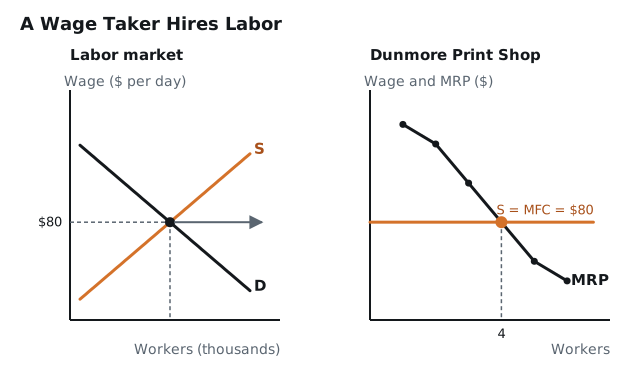
In a perfectly competitive labor market, many firms hire workers with the same skill and many workers offer it. The market sets the wage, and each firm hires as many workers as it wants at that wage. One firm's hiring is too small to move the market wage, so the firm is a wage taker.
Dunmore Print Shop prints T-shirts in a city full of print shops that hire from the same pool of press operators, at a market wage of $80 a day. Hiring one more operator raises the shop's costs by exactly $80, so its marginal factor cost equals the wage. A firm may be a perfect competitor in its labor market even when it is an imperfect competitor in its output market: a shop with its own brand of shirts still pays the going wage for operators.
Part 2 of 4 Hiring Until MRP Equals the Wage
Dunmore sells its plain shirts in a perfectly competitive market at $8 each. The table shows how output grows as the shop adds operators to its fixed set of presses.
| Workers | Total shirts | Marginal product | MRP (MP x $8) |
|---|---|---|---|
| 1 | 20 | 20 | $160 |
| 2 | 38 | 18 | $144 |
| 3 | 52 | 14 | $112 |
| 4 | 62 | 10 | $80 |
| 5 | 68 | 6 | $48 |
| 6 | 72 | 4 | $32 |
A firm keeps hiring while each new worker's marginal revenue product is above the market wage. The first three workers each add more than $80 of revenue. The fourth adds exactly $80, so the shop hires four workers, the point where the MRP of labor equals the $80 marginal factor cost. A fifth worker would add $48 of revenue and cost $80, so the shop stops at four.
Part 3 of 4 MRP and the Value of the Marginal Product
Marginal revenue product is the change in total revenue divided by the change in a factor. It also equals the marginal product of the factor times marginal revenue.
Marginal revenue product equals marginal product times marginal revenue. The value of the marginal product of labor equals the marginal product of labor times the output price.
A firm in a perfectly competitive output market sells every shirt at the market price, so its marginal revenue equals the price. For that firm, the MRP of labor equals the value of the marginal product of labor: the fourth worker's 10 shirts x $8 = $80. A firm that must cut its price to sell more has a marginal revenue below its price, so its MRP is smaller than the value of the marginal product.
Part 4 of 4 The Least-Cost Rule
Firms combine labor with other inputs, such as press time. To minimize costs or maximize profits, a firm spreads its spending so that the last dollar spent on each input buys the same marginal product. This is the least-cost rule.
At four workers, Dunmore's last worker adds 10 shirts for $80, or 0.125 shirts per dollar. One more hour on a rented heat press adds 6 shirts for $30, or 0.2 shirts per dollar. A dollar buys more output on the press, so the shop should shift spending toward press time. As it does, each extra press hour adds less, the last worker's marginal product rises, and the two ratios move toward each other until they are equal.
Hire each input until the last dollar spent on it buys as much output as the last dollar spent on any other input.
Key Terms
Practice Questions
6 questions. Nothing here is recorded or scored.
- Question 1PRD-4.C.1, PRD-4.C.2
Fenwick Farms
Fenwick Farms sells boxes of berries in a perfectly competitive market at $4 a box and hires pickers in a perfectly competitive labor market. The table shows its daily output.
Workers | Total output (boxes per day) 1 | 15 2 | 28 3 | 39 4 | 48 5 | 54 6 | 58 If the market wage is $36 a day, how many pickers should Fenwick Farms hire to maximize profit?
- A.3
- B.4
- C.5
- D.6
Check answerHide answer
Answer: B
- A.
- The fourth picker adds 9 boxes x $4 = $36 of revenue, which covers the $36 wage, so the farm hires past 3.
- B.
- Correct. MRP is marginal product times $4: $60, $52, $44, $36, $24 and $16 for pickers 1 to 6. The farm hires while MRP is at least the wage. The fourth picker's MRP equals the $36 wage, and the fifth adds only $24, so the farm hires 4.
- C.
- The fifth picker adds 6 boxes x $4 = $24 of revenue but costs $36, which lowers profit.
- D.
- The sixth picker adds only $16 of revenue at a $36 wage.
- Question 2PRD-4.C.2
Fenwick Farms
Fenwick Farms sells boxes of berries in a perfectly competitive market at $4 a box and hires pickers in a perfectly competitive labor market. The table shows its daily output.
Workers | Total output (boxes per day) 1 | 15 2 | 28 3 | 39 4 | 48 5 | 54 6 | 58 If the market wage falls to $24 a day, how many pickers will Fenwick Farms hire?
- A.3
- B.4
- C.5
- D.6
Check answerHide answer
Answer: C
- A.
- At a $24 wage, the fourth and fifth pickers both add at least $24 of revenue, so the farm hires more than 3.
- B.
- The fifth picker adds 6 boxes x $4 = $24, which covers the lower wage, so the farm adds a fifth picker.
- C.
- Correct. The farm hires while each picker's MRP is at least the wage. The fifth picker's MRP is $24, equal to the new wage, and the sixth picker's MRP is $16, so the farm hires 5.
- D.
- The sixth picker adds 4 boxes x $4 = $16 of revenue, less than the $24 wage.
- Question 3PRD-4.C.3
A print shop uses labor and machine time. The marginal product of the last worker hour is 20 pages at a wage of $10 an hour. The marginal product of the last machine hour is 30 pages at a price of $20 an hour. What should the shop do to produce its current output at the lowest cost?
- A.Use more labor and less machine time.
- B.Use more machine time and less labor.
- C.Keep the current mix, because the machine hour produces more pages.
- D.Cut both inputs by the same amount.
Check answerHide answer
Answer: A
- A.
- Correct. Labor yields 20 / $10 = 2 pages per dollar, and machine time yields 30 / $20 = 1.5 pages per dollar. A dollar moved from machine time to labor adds more output than it removes, so the shop should shift spending toward labor until the last dollar spent on each input yields the same marginal product.
- B.
- Machine time yields fewer pages per dollar, 1.5 against 2, so shifting toward it raises cost.
- C.
- The comparison uses marginal product per dollar spent. The machine hour produces more pages but costs twice as much.
- D.
- Cutting both inputs lowers output. The least-cost rule changes the mix of inputs.
- Question 4PRD-4.C.4
For a firm that sells its output in a perfectly competitive market, the marginal revenue product of labor equals which of the following?
- A.The wage times the number of workers
- B.Total revenue divided by the number of workers
- C.The marginal product of labor times the wage
- D.The marginal product of labor times the output price
Check answerHide answer
Answer: D
- A.
- The wage times the number of workers is total labor cost.
- B.
- Total revenue divided by workers is revenue per worker on average. MRP is the revenue added by the last worker.
- C.
- MRP multiplies marginal product by marginal revenue. The wage is the cost of the worker.
- D.
- Correct. MRP equals marginal product times marginal revenue. A perfectly competitive seller's marginal revenue equals the price, so its MRP equals the value of the marginal product: MP x P.
- Question 5PRD-4.C.4, PRD-4.C.1
Drayton Optics is the only maker of a patented lens, and it hires technicians in a perfectly competitive labor market. How does Drayton's marginal revenue product of labor compare with the value of the marginal product of labor?
- A.MRP equals the value of the marginal product, because Drayton takes the wage as given.
- B.MRP is less than the value of the marginal product, because Drayton must cut its price to sell more lenses.
- C.MRP is greater than the value of the marginal product, because Drayton earns economic profit.
- D.MRP equals the wage at every level of employment.
Check answerHide answer
Answer: B
- A.
- Taking the wage as given describes Drayton's labor market. MRP depends on its output market, where Drayton has market power.
- B.
- Correct. A monopoly must lower its price to sell more, so its marginal revenue is below the price. MRP = MP x MR is therefore smaller than the value of the marginal product, MP x P.
- C.
- Economic profit does not change the relationship. Marginal revenue below price makes MRP smaller.
- D.
- MRP falls as more technicians are hired. It equals the wage only at the profit-maximizing number of workers.
- Question 6PRD-4.C.1
Which statement describes a single firm hiring in a perfectly competitive labor market?
- A.The supply of labor to the firm is horizontal at the market wage, so marginal factor cost equals the wage.
- B.The supply of labor to the firm slopes upward, so marginal factor cost is above the wage.
- C.The firm sets the wage where its labor demand curve crosses its marginal factor cost curve.
- D.The firm must pay a higher wage to every worker each time it hires one more.
Check answerHide answer
Answer: A
- A.
- Correct. The market sets the wage, and the firm can hire as many workers as it wants at that wage. Each worker adds exactly the wage to cost, so MFC equals the wage.
- B.
- An upward-sloping supply curve facing the firm, with MFC above the wage, describes a monopsony.
- C.
- A wage-taking firm does not set the wage. The market supply and demand for labor set it.
- D.
- Raising every worker's pay to hire one more describes a monopsony.
Practice every topic in Unit 5
CED Codes
PRD-4.C.1 · PRD-4.C.2 · PRD-4.C.3 · PRD-4.C.4