5.4 Monopsonistic Markets
Why a monopsony, the only buyer of labor in a market, faces a marginal factor cost above the wage and hires fewer workers at a lower wage.
Part 1 of 3 One Buyer of Labor
A monopsony is a market with a single buyer of a factor. Kessring Mill is the only employer in a remote valley town, so the mill faces the whole upward-sloping labor supply curve of the town. To hire one more worker, it must raise the wage, and it pays the higher wage to every worker it employs.
A firm in a competitive labor market can hire as many workers as it wants at the market wage. The mill has no such option. Workers in the valley have few other employers within reach, so the mill sets the wage, and the wage it sets decides how many people take the job.
Part 2 of 3 Why Marginal Factor Cost Rises Above the Wage
| Workers | Wage (supply price) | Total labor cost | Marginal factor cost | MRP |
|---|---|---|---|---|
| 1 | $80 | $80 | $80 | $200 |
| 2 | $90 | $180 | $100 | $180 |
| 3 | $100 | $300 | $120 | $160 |
| 4 | $110 | $440 | $140 | $140 |
| 5 | $120 | $600 | $160 | $120 |
| 6 | $130 | $780 | $180 | $100 |
To hire a fourth worker, the mill raises the wage from $100 to $110. The new worker costs $110, and the three workers already employed each get a $10 raise, so total labor cost climbs by $110 + $30 = $140. The marginal factor cost of a new worker is that worker's wage plus the wage increase paid to every existing worker.
When a monopsony hires more workers, its marginal factor cost is greater than the supply price of labor. For the fourth worker, the MFC of $140 is above the $110 wage on the supply curve. On a graph, the MFC curve lies above the labor supply curve.
Part 3 of 3 How Many Workers and at What Wage
A monopsony keeps hiring while the next worker's marginal revenue product exceeds that worker's marginal factor cost. Kessring's fourth worker adds $140 of revenue and $140 of cost, so the mill hires 4 workers. It then pays the lowest wage that brings 4 workers forward, which is $110 on the supply curve.
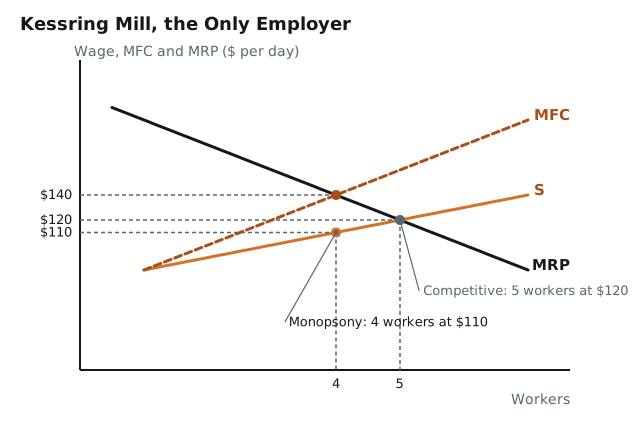
In a competitive labor market with the same workers and the same MRP, the wage would settle where MRP meets the supply curve: 5 workers at $120. The monopsony hires 1 fewer worker and pays $10 less.
A monopsony hires fewer workers and pays a lower wage than a competitive labor market would.
Key Terms
Practice Questions
6 questions. Nothing here is recorded or scored.
- Question 1PRD-4.D.1
Breck Quarry
Breck Quarry is the only employer in a remote town. It pays all of its workers the same daily wage. The table shows the wage it must pay to attract each number of workers and the marginal revenue product of each worker.
Workers | Wage needed to attract this many workers | Marginal revenue product 1 | $50 | $140 2 | $60 | $115 3 | $70 | $90 4 | $80 | $80 5 | $90 | $60 To maximize profit, how many workers does Breck Quarry hire, and what wage does it pay?
- A.3 workers at $90
- B.4 workers at $80
- C.3 workers at $70
- D.4 workers at $110
Check answerHide answer
Answer: C
- A.
- $90 is the marginal factor cost of the third worker. The quarry pays the wage on the supply schedule, $70.
- B.
- 4 workers at $80 is where MRP equals the wage, the competitive outcome. A monopsony compares MRP with MFC.
- C.
- Correct. Total labor cost is $50, $120, $210, $320 and $450, so MFC is $50, $70, $90, $110 and $130. The third worker's MRP of $90 equals the MFC of $90, and the fourth worker's MRP of $80 is below the MFC of $110. The quarry hires 3 and pays the $70 wage needed to attract them.
- D.
- $110 is the MFC of the fourth worker. Hiring a fourth worker adds $80 of revenue and $110 of cost.
- Question 2PRD-4.D.2
Breck Quarry
Breck Quarry is the only employer in a remote town. It pays all of its workers the same daily wage. The table shows the wage it must pay to attract each number of workers and the marginal revenue product of each worker.
Workers | Wage needed to attract this many workers | Marginal revenue product 1 | $50 | $140 2 | $60 | $115 3 | $70 | $90 4 | $80 | $80 5 | $90 | $60 What is the marginal factor cost of the fourth worker?
- A.$80
- B.$320
- C.$30
- D.$110
Check answerHide answer
Answer: D
- A.
- $80 is the fourth worker's wage. MFC also includes the raise paid to the first three workers.
- B.
- $320 is total labor cost with four workers. MFC is the change in total cost.
- C.
- $30 is the total raise paid to the first three workers. MFC adds the new worker's $80 wage.
- D.
- Correct. Total labor cost rises from 3 x $70 = $210 to 4 x $80 = $320, so MFC is $110. That is the fourth worker's $80 wage plus a $10 raise for each of the three existing workers, and it is greater than the $80 supply price.
- Question 3PRD-4.D.2
Why is a monopsonist's marginal factor cost of labor greater than the wage it pays?
- A.The monopsonist pays each worker more than the value of the worker's marginal product.
- B.To hire one more worker, it must raise the wage paid to all of its existing workers.
- C.The monopsonist sells its output in a perfectly competitive market.
- D.Labor supply to the monopsonist is horizontal at the market wage.
Check answerHide answer
Answer: B
- A.
- A monopsony pays a wage below what workers add to revenue at its chosen output.
- B.
- Correct. A monopsonist faces the upward-sloping market supply of labor. Hiring one more worker means paying a higher wage, and it pays that wage to every worker, so the added cost is the new wage plus the raises.
- C.
- Conditions in the output market do not explain why MFC exceeds the wage.
- D.
- A horizontal supply of labor at the market wage describes a wage taker, for which MFC equals the wage.
- Question 4PRD-4.D.1
Compared with a perfectly competitive labor market with the same labor supply and the same marginal revenue product, a monopsony does which of the following?
- A.Hires fewer workers and pays a lower wage
- B.Hires more workers and pays a lower wage
- C.Hires fewer workers and pays a higher wage
- D.Hires the same number of workers and pays a lower wage
Check answerHide answer
Answer: A
- A.
- Correct. A monopsony hires where MRP equals MFC, which lies above the supply curve, so it stops hiring sooner. It then pays the lower wage read off the supply curve at that smaller quantity.
- B.
- Moving down the supply curve to a lower wage reduces the number of workers who will accept the job.
- C.
- Fewer workers along an upward-sloping supply curve means a lower wage.
- D.
- A lower wage on an upward-sloping supply curve attracts fewer workers, so employment cannot stay the same.
- Question 5PRD-4.D.1
Which situation describes a monopsonistic labor market?
- A.One firm is the only seller of a product with no close substitutes.
- B.Many firms hire the same kind of worker, and each takes the market wage as given.
- C.One mining company is the only employer in a remote town, and workers cannot easily move.
- D.A few firms sell a similar product and watch each other's prices.
Check answerHide answer
Answer: C
- A.
- The only seller of a product is a monopoly, which is a product market.
- B.
- Many firms taking the wage as given describes a perfectly competitive labor market.
- C.
- Correct. A monopsony is a market with a single buyer of a factor. The mining company is the only buyer of labor in the town, so it faces the town's whole labor supply curve.
- D.
- A few interdependent sellers describes an oligopoly in a product market.
- Question 6PRD-4.D.1, POL-4.A.3
Breck Quarry
Breck Quarry is the only employer in a remote town. It pays all of its workers the same daily wage. The table shows the wage it must pay to attract each number of workers and the marginal revenue product of each worker.
Workers | Wage needed to attract this many workers | Marginal revenue product 1 | $50 | $140 2 | $60 | $115 3 | $70 | $90 4 | $80 | $80 5 | $90 | $60 The government sets a minimum wage of $80 a day in the town. How many workers does Breck Quarry now hire?
- A.2
- B.3
- C.5
- D.4
Check answerHide answer
Answer: D
- A.
- The minimum wage makes extra workers cheaper at the margin for the quarry, so it hires more than before.
- B.
- Three was the choice before the minimum wage. With the wage fixed at $80, the fourth worker no longer raises the pay of the other three.
- C.
- At $80, only 4 workers are willing to work, and the fifth worker's MRP of $60 is below $80.
- D.
- Correct. With a $80 minimum, the quarry pays every worker $80 for up to 4 workers, so its MFC is a flat $80 over that range. It hires while MRP is at least $80, which gives 4 workers. Both the wage and employment rise from the monopsony outcome of 3 workers at $70.
Practice every topic in Unit 5
CED Codes
PRD-4.D.1 · PRD-4.D.2