6.1 Socially Efficient and Inefficient Market Outcomes
Social efficiency where marginal benefit equals marginal cost, how private incentives lead to inefficient outcomes, and measuring deadweight loss.
Part 2 of 4 When Private Choices Go Wrong
Rational buyers and sellers act on their own costs and benefits. Rational agents make their best decisions by equating private marginal benefit with private marginal cost, and that can leave a market inefficient. Rational agents can also act to gain or use market power, such as a firm that buys out its rivals and then restricts output.
| Situation | What goes wrong |
|---|---|
| Monopoly, oligopoly or monopolistic competition | Firms with market power set price above marginal cost and produce too little |
| Negative externality in production or consumption | A cost falls on outsiders, so the market produces too much |
| Positive externality in production or consumption | A benefit goes to outsiders, so the market produces too little |
| Asymmetric information | One side of a trade knows more than the other, so some valuable trades never happen |
| Public goods | People can benefit without paying, so private firms produce too little |
Each of these is a market failure: the market, left alone, produces a quantity other than the efficient one.
Part 3 of 4 Measuring Deadweight Loss
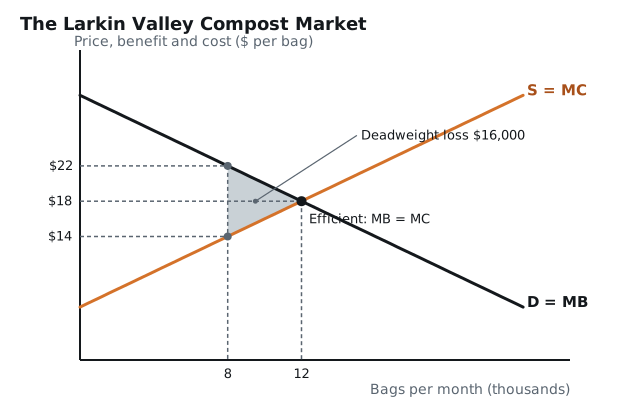
Producing any quantity other than the efficient one creates deadweight loss, the surplus lost because the wrong quantity is made. Suppose a supply problem limits Larkin Valley sales to 8,000 bags. The 8,000th bag is worth $22 to a buyer and costs $14 to make, so every bag from 8,000 to 12,000 would have added surplus. The deadweight loss is the triangle 1/2 x ($22 - $14) x 4,000 = $16,000.
Producing too much loses surplus too. At 16,000 bags, the last bag costs $22 to make and is worth only $14 to a buyer, and the deadweight loss is again 1/2 x $8 x 4,000 = $16,000.
Part 4 of 4 Fixing Inefficiency
Policymakers use cost-benefit analysis to compare actions that reduce or remove market inefficiency. A policy is worth adopting when the surplus it recovers is larger than its cost. Inefficiency disappears when a policy brings marginal social benefit and marginal social cost into equality at the quantity produced.
Efficiency means producing every unit worth more than it costs, and no unit that costs more than it is worth.
Key Terms
Practice Questions
6 questions. Nothing here is recorded or scored.
- Question 1POL-2.A.1
A Bread Market
The table shows the marginal benefit and marginal cost of bread in a small town, with no externalities.
Quantity (thousand loaves) | Marginal benefit | Marginal cost 1 | $20 | $4 2 | $17 | $6 3 | $14 | $8 4 | $11 | $11 5 | $8 | $14 6 | $5 | $17 What is the socially efficient quantity of bread?
- A.1 thousand loaves
- B.4 thousand loaves
- C.6 thousand loaves
- D.3 thousand loaves
Check answerHide answer
Answer: B
- A.
- At 1 thousand loaves, marginal benefit ($20) is far above marginal cost ($4), so producing more adds surplus.
- B.
- Correct. The efficient quantity is where the marginal benefit of the last unit equals its marginal cost. At 4 thousand loaves, both equal $11, and total surplus is as large as it can be.
- C.
- At 6 thousand loaves, marginal cost ($17) is above marginal benefit ($5), so the last units destroy surplus.
- D.
- At 3 thousand loaves, marginal benefit ($14) is still above marginal cost ($8), so one more unit adds surplus.
- Question 2POL-2.C.2
Firewood in Selby
In the market for firewood in the region of Selby, demand is P = 50 - Q and supply is P = 10 + Q, where Q is thousands of bundles per month. Buyers and sellers bear all of the benefits and costs of each bundle.
A supply disruption limits sales to 14 thousand bundles a month. What is the deadweight loss?
- A.$72,000
- B.$18,000
- C.$144,000
- D.$36,000
Check answerHide answer
Answer: D
- A.
- $72,000 omits the one half in the triangle formula: $12 x 6 thousand.
- B.
- $18,000 uses half of the price gap as the height. The height is the full gap between marginal benefit and marginal cost at 14 thousand bundles.
- C.
- $144,000 multiplies the $24 marginal cost by 6 thousand bundles. Deadweight loss is the triangle between marginal benefit and marginal cost.
- D.
- Correct. The efficient quantity is where 50 - Q = 10 + Q, so Q = 20 thousand. At 14 thousand, marginal benefit is $36 and marginal cost is $24. Deadweight loss = 1/2 x ($36 - $24) x 6 thousand = $36,000.
- Question 3POL-2.A.2
When does the equilibrium quantity in a competitive market equal the socially optimal quantity?
- A.When buyers and sellers bear every social benefit and cost of the good
- B.Whenever the market has many buyers and many sellers of the good
- C.When the government sets the price of the good
- D.When producers in the market earn zero economic profit
Check answerHide answer
Answer: A
- A.
- Correct. The market quantity is optimal only when the people trading bear every social benefit and cost. Then demand shows marginal social benefit and supply shows marginal social cost, and total surplus is maximized.
- B.
- Many buyers and sellers are not enough. A competitive market with an externality still produces the wrong quantity.
- C.
- A government-set price can push quantity away from the efficient level.
- D.
- Zero profit is a long-run feature of competitive markets, but external costs or benefits can still make the quantity inefficient.
- Question 4POL-2.C.1
Which situation is most likely to lead to an inefficient market outcome?
- A.Many farmers sell identical wheat to many buyers, and no one outside the market is affected.
- B.A competitive bakery market adjusts after a rise in the price of flour.
- C.A used-car seller knows a car has a hidden defect, and buyers cannot detect it.
- D.Free entry drives economic profit to zero in a perfectly competitive industry.
Check answerHide answer
Answer: C
- A.
- A perfectly competitive market with no externalities produces where marginal benefit equals marginal cost.
- B.
- A cost increase changes the equilibrium, and the competitive market still settles where marginal benefit equals marginal cost.
- C.
- Correct. This is asymmetric information: one side knows more than the other. Buyers who cannot tell good cars from bad ones may refuse to pay what a good car is worth, so some valuable trades never happen.
- D.
- Zero long-run profit in perfect competition comes with price equal to marginal cost, an efficient outcome.
- Question 5POL-2.B.3, POL-2.B.4
Lawmakers study a rule that would cost firms $2 million a year to follow and would recover $5 million a year of surplus lost to a market inefficiency. Using cost-benefit analysis, what should they conclude?
- A.Reject the rule, because it raises firms' costs.
- B.Adopt the rule, because the surplus it recovers is larger than its cost.
- C.Reject the rule, because any intervention creates deadweight loss.
- D.Adopt the rule only if it removes the inefficiency entirely.
Check answerHide answer
Answer: B
- A.
- Raising costs alone is not a reason to reject a policy. The test compares the benefit with the cost.
- B.
- Correct. Policymakers use cost-benefit analysis to evaluate actions that reduce market inefficiencies. The rule adds $5 million of surplus at a cost of $2 million, a net gain of $3 million a year.
- C.
- A well-designed intervention can reduce deadweight loss by moving the market toward the quantity where marginal social benefit equals marginal social cost.
- D.
- A policy that recovers more surplus than it costs is worth adopting even if some inefficiency remains.
- Question 6POL-2.C.2, POL-2.B.2
Firewood in Selby
In the market for firewood in the region of Selby, demand is P = 50 - Q and supply is P = 10 + Q, where Q is thousands of bundles per month. Buyers and sellers bear all of the benefits and costs of each bundle.
Suppose a subsidy pushes output to 26 thousand bundles a month. Which statement is correct?
- A.Total surplus rises, because more firewood is sold.
- B.There is no deadweight loss, because buyers pay less than before.
- C.Deadweight loss arises only when output is below the efficient quantity.
- D.Deadweight loss arises, since bundles past 20 thousand cost more than buyers value them.
Check answerHide answer
Answer: D
- A.
- Total surplus falls, because each bundle past the efficient quantity of 20 thousand adds more cost than benefit.
- B.
- Lower prices for buyers do not remove the loss. The units past 20 thousand cost more than they are worth.
- C.
- Producing any quantity other than the efficient one creates deadweight loss, whether output is too low or too high.
- D.
- Correct. Beyond 20 thousand bundles, marginal cost is above marginal benefit. At 26 thousand, MC is $36 and MB is $24, so the deadweight loss is 1/2 x $12 x 6 thousand = $36,000.
Practice every topic in Unit 6
CED Codes
POL-2.A.1 · POL-2.A.2 · POL-2.B.1 · POL-2.B.2 · POL-2.B.3 · POL-2.B.4 · POL-2.C.1 · POL-2.C.2