6.2 Externalities
Negative and positive externalities, why markets ignore external costs and benefits, the optimal quantity where MSB equals MSC, and corrective policies.
Part 1 of 4 Costs and Benefits Outside the Market
An externality is a cost or benefit of a market activity that falls on people outside the trade. A negative externality imposes a cost on outsiders, and a positive externality gives them a benefit.
Externalities arise when property rights are not well defined, when transaction costs are high, or both. Nobody owns the river below a factory, so nobody can charge the factory for dirtying it. Thousands of people downstream would each have to bargain with the factory, which costs more time and money than any one of them would recover. Rational agents respond to their own private costs and benefits and ignore external ones.
Part 2 of 4 A Negative Externality in Production
Fertilizer plants along the Brisk River sell in a competitive market. Runoff from each ton they make costs fish farms downstream $6. The plants' supply curve reflects only their marginal private cost (MPC). Marginal social cost (MSC) adds the $6 external cost, so the MSC curve sits $6 above supply.
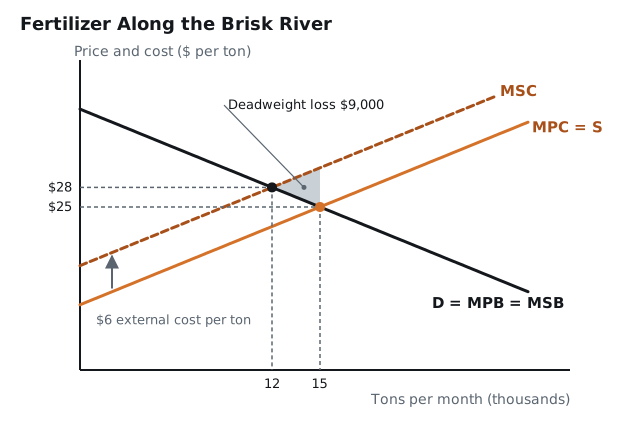
The socially optimal quantity is where the marginal social benefit (MSB) of the last unit equals its marginal social cost. The market settles at 15,000 tons a month at $25, where demand meets MPC. The optimum is 12,000 tons at $28, where demand meets MSC. Each of the extra 3,000 tons costs society more than it is worth, and the deadweight loss is 1/2 x $6 x 3,000 = $9,000 a month.
Part 3 of 4 A Positive Externality in Consumption
A flu shot protects the person who gets it and also lowers the chance that neighbors catch the flu. Marginal social benefit equals marginal private benefit plus that external benefit, so the MSB curve lies above the demand curve. Buyers act on private benefit alone, so the market produces fewer flu shots than the socially optimal quantity.
When a good is non-excludable, rational agents have an incentive to free ride: they enjoy the benefit and let others pay. A resident who knows the neighbors are vaccinated gains some protection without getting a shot, which weakens the private incentive to buy one.
Part 4 of 4 Policies That Address Externalities
| Policy | How it works | Example |
|---|---|---|
| Per-unit tax | Adds the external cost to the producer's private cost | A $6 tax per ton moves fertilizer output to 12,000 tons |
| Per-unit subsidy | Adds the external benefit to the buyer's private benefit | A payment for each flu shot raises the number given |
| Environmental regulation | Limits the harmful activity directly | A cap on runoff per ton produced |
| Public provision | Government supplies the good itself | Free flu shots at public clinics |
| Assigning property rights | Gives someone ownership of the affected resource | The fish farms are granted the right to clean water |
| Reassigning rights through private deals | Owners trade rights in voluntary transactions | A plant pays the fish farms for permission to release runoff |
Every corrective policy works by making buyers and sellers face the full social cost or benefit of their choices.
Key Terms
Practice Questions
6 questions. Nothing here is recorded or scored.
- Question 1POL-3.A.3
A factory's production releases smoke that harms nearby residents, and the factory pays nothing for the harm. Compared with the socially optimal quantity, how much does the market produce?
- A.The same quantity, because the factory responds to all costs
- B.Less, because the smoke raises the factory's private costs
- C.More, because the factory ignores the external cost of the smoke
- D.Less, because residents buy less of the factory's product
Check answerHide answer
Answer: C
- A.
- The factory responds to its private costs. The harm to residents is an external cost it does not pay.
- B.
- The factory does not pay for the harm, so the smoke does not raise its private costs.
- C.
- Correct. Rational producers respond to private costs and ignore external costs. Marginal social cost is above the supply curve, so the market produces more than the socially optimal quantity, where marginal social benefit equals marginal social cost.
- D.
- Nothing in the scenario changes buyers' demand. The problem is a cost that falls outside the market.
- Question 2POL-3.A.1, POL-3.B.1
Paper in Morrow
The market for paper in the region of Morrow has demand P = 80 - 2Q and supply, equal to marginal private cost, P = 20 + Q, where Q is thousands of tons. Each ton of paper produced releases pollution that costs downstream towns $15.
What are the socially optimal quantity of paper and the per-unit tax that would bring the market to it?
- A.15 thousand tons, with a $15 tax per ton
- B.20 thousand tons, with a $15 tax per ton
- C.15 thousand tons, with a $5 tax per ton
- D.20 thousand tons, with no tax
Check answerHide answer
Answer: A
- A.
- Correct. Marginal social cost is P = 35 + Q. Setting 80 - 2Q = 35 + Q gives Q = 15 thousand tons. A $15 tax per ton, equal to the external cost, shifts supply up to marginal social cost, so the market produces 15 thousand tons.
- B.
- 20 thousand tons is the market quantity, where 80 - 2Q = 20 + Q. The optimal quantity uses marginal social cost.
- C.
- 15 thousand tons is right, but the tax must equal the $15 external cost per ton to make producers face the full social cost.
- D.
- 20 thousand tons is the market outcome without correction. It is more than the socially optimal quantity.
- Question 3POL-3.B.1, POL-3.A.1
Students who learn a second language also make it easier for local businesses to serve visitors from abroad. Which policy would move the market for language classes toward the socially optimal quantity?
- A.A per-unit tax on language classes
- B.A per-unit subsidy for language classes
- C.A price ceiling below the current price of classes
- D.A cap on the number of classes offered
Check answerHide answer
Answer: B
- A.
- A tax would lower the quantity of classes. With a positive externality the market already produces too few.
- B.
- Correct. The benefit to local businesses is a positive externality, so marginal social benefit is above demand and the market produces too few classes. A subsidy equal to the external benefit raises the quantity to where marginal social benefit equals marginal social cost.
- C.
- A binding price ceiling reduces the quantity schools offer, which moves the market further from the optimum.
- D.
- A cap limits output when the problem is too little output.
- Question 4POL-3.B.1, POL-3.A.2
A court rules that the residents of Lake Tarra own the right to clean water. A resort that drains runoff into the lake then pays the residents for permission to keep doing so. Which policy approach does this illustrate?
- A.A per-unit tax on the resort's output
- B.Public provision of clean water
- C.Environmental regulation that bans runoff
- D.Assigning property rights, then trading them privately
Check answerHide answer
Answer: D
- A.
- No tax is involved. The resort pays the residents directly.
- B.
- Public provision means government supplies the good. Here private parties settle the matter.
- C.
- A ban would forbid runoff. Here runoff continues once the residents agree to a payment.
- D.
- Correct. Externalities can arise from poorly defined property rights. The court assigns the right to the residents, and the resort and residents then reassign part of it through a private deal, which makes the resort pay for the harm it causes.
- Question 5POL-3.A.4
A homeowner pays to spray her yard for mosquitoes, which also cuts the number of mosquitoes in her neighbors' yards. Her neighbors decline to help pay. Which concept best explains the neighbors' behavior?
- A.Free riding on a non-excludable benefit
- B.A negative externality in production
- C.Price discrimination by the spraying company
- D.Diminishing marginal product of the spray
Check answerHide answer
Answer: A
- A.
- Correct. The neighbors receive the benefit whether or not they pay, because the homeowner cannot exclude them from it. When a benefit is non-excludable, rational agents have an incentive to free ride, which leaves too little spraying.
- B.
- Spraying creates a benefit for outsiders, which is a positive externality.
- C.
- Nothing in the scenario involves different prices for the same service.
- D.
- Diminishing marginal product describes production, and it does not explain why the neighbors refuse to pay.
- Question 6POL-3.A.2
Why do externalities often go uncorrected when thousands of people are each harmed a small amount by one polluter?
- A.The polluter pays a tax equal to the harm in every case.
- B.The harm disappears when it is spread across many people.
- C.High transaction costs make it too costly for each person to bargain with the polluter.
- D.Each harmed person has a well-defined property right that the polluter must buy.
Check answerHide answer
Answer: C
- A.
- A corrective tax does not happen automatically. Without a policy, the polluter pays nothing for the harm.
- B.
- Spreading the harm does not remove it. The total external cost can still be large.
- C.
- Correct. Externalities arise from poorly defined property rights or high transaction costs. Organizing thousands of people to bargain with one polluter costs more than any one person would recover, so no deal happens.
- D.
- Well-defined property rights would help solve the problem. The externality persists when rights are unclear and bargaining is costly.
Practice every topic in Unit 6
CED Codes
POL-3.A.1 · POL-3.A.2 · POL-3.A.3 · POL-3.A.4 · POL-3.B.1