6.3 Public and Private Goods
Rival and excludable goods, private and public goods, the free rider problem, government-provided private goods, and overuse of open-access resources.
Part 1 of 4 Rival and Excludable
Economists sort goods by two questions. A good is rival when one person's use leaves less for everyone else. A good is excludable when a seller can keep people who do not pay from using it.
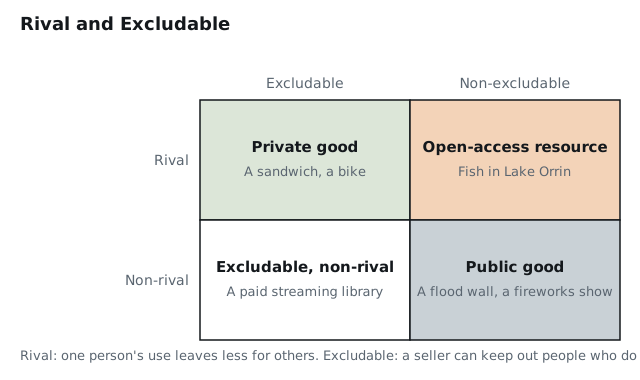
A private good is both rival and excludable. A public good is neither rival nor excludable. A private good like a sandwich can be eaten by only one person, and the shop hands it over only after payment. A public good like a flood wall protects every house behind it, and one more house behind the wall takes no protection away from the others.
Part 2 of 4 Public Goods and the Free Rider Problem
The 2,000 households of the river town of Harrow each value a new flood wall at $50, so the wall is worth $100,000 to the town. It costs $60,000 to build, so building it adds $40,000 of surplus. No private builder will put it up, because the builder cannot keep any household that refuses to pay from being protected.
Each household reasons that the wall will protect it whether or not it chips in, so each one waits for the others to pay. This is the free rider problem. Because of free riding, private individuals usually lack an incentive to produce public goods, which often leaves government as the only producer. Harrow's town council can build the wall and pay for it with taxes.
Part 3 of 4 Government-Provided Private Goods
Governments sometimes produce private goods and allow free access to them. A seat in a classroom is rival, since a class holds only so many students, and excludable, since a school could charge tuition. Many governments still run public schools and offer the seats at no charge to students.
Part 4 of 4 Open-Access Resources
Some natural resources are rival and non-excludable by their nature. These are open-access resources. Every fish one boat pulls from Lake Orrin is a fish no other boat can catch, and nobody can stop a boat from launching. Each boat ignores the cost its catch imposes on other boats, so private individuals overuse open-access resources, and the lake is fished faster than its stock can recover.
| Kind of good | Rival? | Excludable? | Market outcome |
|---|---|---|---|
| Private good | Yes | Yes | Markets supply it |
| Public good | No | No | Private firms underproduce it because of free riding |
| Open-access resource | Yes | No | Users overconsume it |
| Excludable, non-rival good | No | Yes | A seller can charge, and extra users cost little |
Free riding starves public goods of funding. Open access drains rival resources.
Key Terms
Practice Questions
6 questions. Nothing here is recorded or scored.
- Question 1POL-3.C.1
The town of Merrow puts on a fireworks show over its harbor that anyone in town can see. One more viewer does not reduce anyone else's view. How is the show best classified?
- A.A private good
- B.A public good
- C.An open-access resource
- D.A good that is rival and excludable
Check answerHide answer
Answer: B
- A.
- A private good is rival and excludable. The show is neither.
- B.
- Correct. The show is non-rival, because one more viewer leaves the view unchanged for others, and non-excludable, because no one can be kept from looking up. A good that is non-rival and non-excludable is a public good.
- C.
- An open-access resource is rival: one person's use leaves less for others. The show is non-rival.
- D.
- The show is neither rival nor excludable.
- Question 2POL-3.C.4
Anyone may fish in the Varn Sea, and every fish caught is one fewer for other boats. Which outcome is most likely?
- A.The sea is fished at the socially efficient rate, because fish are a private good.
- B.Too few fish are caught, because no one can charge for access.
- C.The fish stock is overused, because each boat ignores the cost its catch imposes on others.
- D.Fishing stops, because free riders refuse to pay for the fish.
Check answerHide answer
Answer: C
- A.
- The fish are rival but non-excludable, so they are an open-access resource. Private goods are excludable.
- B.
- The lack of a charge leads to too much fishing. Each boat captures the full gain from its catch.
- C.
- Correct. The fish are rival and non-excludable, so the sea is an open-access resource. Each boat responds to its own gain and ignores the fish it leaves unavailable to others, so private individuals overconsume the resource.
- D.
- Free riding describes non-rival goods like a flood wall. Here each boat takes fish directly.
- Question 3POL-3.C.2
Public and Private Goods
Each of the 500 households on Calder Street values a set of new streetlights at $30, and the lights would cost $9,000 to install. No household can be kept from the light once it is installed.
Why is a private company unlikely to install the lights?
- A.The lights are worth less to the street than they cost to install.
- B.The lights are a rival good, so each household would use up some of the light.
- C.The government forbids private firms from installing lights.
- D.Households can benefit without paying, so few would pay a private seller.
Check answerHide answer
Answer: D
- A.
- The lights are worth 500 x $30 = $15,000, which is more than the $9,000 cost.
- B.
- One household's use of the light leaves the same light for others, so the lights are non-rival.
- C.
- Nothing in the scenario mentions a ban. The problem is the incentive to free ride.
- D.
- Correct. The lights are non-excludable, so each household can wait for others to pay and still get the light. Because of this free rider problem, private sellers usually cannot collect enough to cover the cost, which often leaves government to provide public goods.
- Question 4POL-3.C.3
Which is an example of a government producing a private good and allowing free access to it?
- A.A public school that gives students seats at no charge
- B.A national defense system
- C.A free public fireworks show
- D.A flood wall that protects an entire town
Check answerHide answer
Answer: A
- A.
- Correct. A school seat is rival, since a class holds only so many students, and excludable, since a school could charge tuition. That makes it a private good, and governments sometimes produce such goods, like educational services, and allow free access.
- B.
- National defense is non-rival and non-excludable, so it is a public good.
- C.
- A fireworks show seen by everyone is non-rival and non-excludable, a public good.
- D.
- A flood wall protects every house behind it, so it is a public good.
- Question 5POL-3.C.1
A movie-streaming service lets any paying subscriber watch any film at any time, and one more viewer does not slow anyone else's stream. How is the service classified?
- A.Rival and excludable
- B.Non-rival and excludable
- C.Rival and non-excludable
- D.Non-rival and non-excludable
Check answerHide answer
Answer: B
- A.
- One more viewer does not reduce what others can watch, so the service is non-rival.
- B.
- Correct. The service can keep out anyone who does not pay, so it is excludable. One more viewer leaves the same films available to everyone else, so it is non-rival.
- C.
- The service blocks non-payers, so it is excludable, and extra viewers do not use it up, so it is non-rival.
- D.
- The service blocks non-payers, so it is excludable.
- Question 6POL-3.C.1, POL-3.C.2
Which statement correctly explains why private markets supply private goods well and public goods poorly?
- A.Private goods are non-rival, so firms can sell them to many buyers at no extra cost.
- B.Public goods are rival, so private firms cannot produce enough for everyone.
- C.Private goods have no free rider problem because they are non-excludable.
- D.Sellers can collect payment for private goods, while public goods invite free riding.
Check answerHide answer
Answer: D
- A.
- Private goods are rival: one person's use leaves less for others.
- B.
- Public goods are non-rival. The problem is that sellers cannot exclude non-payers.
- C.
- Private goods are excludable, and that excludability is what prevents free riding.
- D.
- Correct. A seller can keep non-payers from using a private good, so buyers must pay and markets can supply it. A public good cannot be withheld from non-payers, so people free ride and private firms underproduce it.
Practice every topic in Unit 6
CED Codes
POL-3.C.1 · POL-3.C.2 · POL-3.C.3 · POL-3.C.4