6.4 The Effects of Government Intervention in Different Market Structures
Per-unit and lump-sum taxes and subsidies, price ceilings and floors across market structures, regulating a natural monopoly and antitrust policy.
Part 1 of 5 Per-Unit Taxes and Subsidies
A per-unit tax charges a fixed amount on each unit sold. A per-unit tax or subsidy changes the price buyers pay, the price sellers keep, the equilibrium quantity, consumer and producer surplus, deadweight loss, and government revenue or cost.
Ice cream sellers in the country of Velmora compete in a perfectly competitive market. Before any tax, 8,000 tubs a week sell at $12. The government then charges sellers $4 a tub, which shifts supply up by $4. The new equilibrium is 6,000 tubs: buyers pay $14, and sellers keep $10 after the tax.
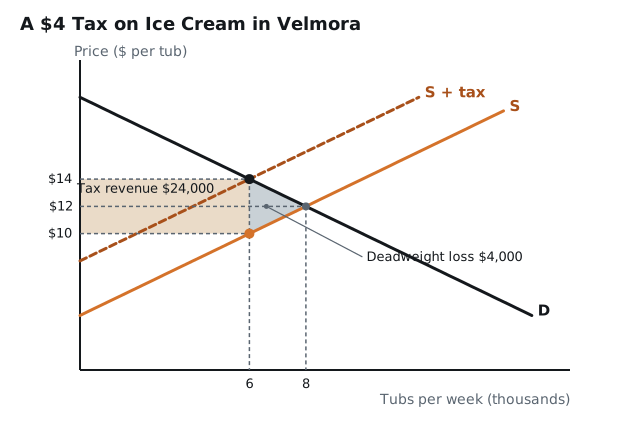
| Measure | Before the tax | After the $4 tax |
|---|---|---|
| Quantity | 8,000 tubs | 6,000 tubs |
| Price buyers pay | $12 | $14 |
| Price sellers keep | $12 | $10 |
| Consumer surplus | $32,000 | $18,000 |
| Producer surplus | $32,000 | $18,000 |
| Government revenue | $0 | $4 x 6,000 = $24,000 |
| Deadweight loss | $0 | 1/2 x $4 x 2,000 = $4,000 |
Total surplus falls from $64,000 to $18,000 + $18,000 + $24,000 = $60,000, and the missing $4,000 is the deadweight loss. How the burden splits depends on the price elasticities of demand and supply. The side of the market that is less elastic pays the larger share. A per-unit subsidy works in reverse: it shifts supply down, raises quantity, and costs the government the subsidy times the new quantity.
Part 2 of 5 Lump-Sum Taxes and Subsidies
A lump-sum tax or subsidy is a fixed amount that does not change with output, such as a $5,000 yearly license fee. Lump-sum taxes and subsidies leave marginal cost and marginal benefit unchanged and affect only fixed costs. A profit-maximizing firm still produces where MR equals MC, so its output and price stay the same, and only its profit changes.
Part 3 of 5 Price Ceilings and Floors Across Market Structures
A binding price ceiling or floor changes prices and quantities differently in different market structures, and the size of the change depends on the price elasticities of supply and demand.
| Market structure | Price control | Effect on quantity |
|---|---|---|
| Perfect competition | Ceiling below the equilibrium price | Quantity supplied falls and a shortage opens |
| Perfect competition | Floor above the equilibrium price | Quantity demanded falls and a surplus opens |
| Monopoly or monopolistic competition | Ceiling below the firm's price but above its marginal cost | The firm can no longer gain by holding output down, so quantity can rise |
| Monopsony | Minimum wage between the monopsony wage and the competitive wage | Both the wage and the number of workers can rise |
Government intervention in an imperfect market can raise efficiency when the policy targets the incentive behind the market failure. A monopsony holds hiring down because each new worker raises the wage of every worker. A minimum wage removes that incentive, so the firm hires more workers.
Part 4 of 5 Regulating a Natural Monopoly
Government can use price regulation to address the inefficiency of a monopoly. The Ostler water network is a natural monopoly: its marginal cost is $20 per home per month, and its fixed cost of $120,000 a month makes average total cost fall across all of demand.
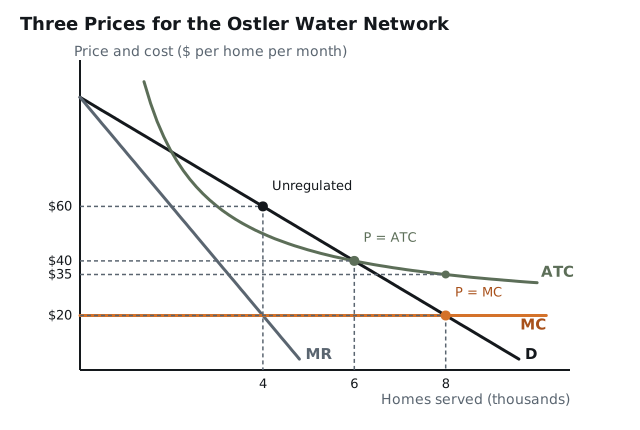
| Pricing rule | Homes served | Price | Result |
|---|---|---|---|
| Unregulated (MR = MC) | 4,000 | $60 | Profit of ($60 - $50) x 4,000 = $40,000 a month |
| Fair return (P = ATC) | 6,000 | $40 | Zero economic profit |
| Socially optimal (P = MC) | 8,000 | $20 | Loss of ($35 - $20) x 8,000 = $120,000 a month |
At the allocatively efficient quantity, price equals marginal cost and falls below average total cost, so the network loses money. A natural monopoly needs a lump-sum subsidy to produce the allocatively efficient quantity. Here the subsidy must cover the $120,000 monthly loss.
Part 5 of 5 Antitrust Policy
Governments use antitrust policy to try to make markets more competitive. Antitrust laws can block a merger that would leave one firm in control of a market, break up a firm that holds a monopoly, and punish firms that fix prices together.
A policy improves an imperfect market only when it changes the incentive that caused the inefficiency.
Key Terms
Practice Questions
6 questions. Nothing here is recorded or scored.
- Question 1POL-4.A.1
A $6 Per-Unit Tax
In a perfectly competitive market, demand is P = 30 - Q and supply is P = 6 + Q, where Q is thousands of units. The government places a $6 per-unit tax on sellers.
What are the government's tax revenue and the deadweight loss from the tax?
- A.Revenue of $72,000 and deadweight loss of $9,000
- B.Revenue of $54,000 and deadweight loss of $18,000
- C.Revenue of $54,000 and deadweight loss of $9,000
- D.Revenue of $135,000 and deadweight loss of $9,000
Check answerHide answer
Answer: C
- A.
- $72,000 multiplies the tax by the pre-tax quantity of 12 thousand. Revenue uses the quantity sold after the tax.
- B.
- $54,000 is the correct revenue, but $18,000 leaves out the one half in the triangle: 1/2 x $6 x 3 thousand = $9,000.
- C.
- Correct. Before the tax, 30 - Q = 6 + Q gives Q = 12 thousand. The tax shifts supply to P = 12 + Q, so 30 - Q = 12 + Q gives Q = 9 thousand, with buyers paying $21 and sellers keeping $15. Revenue = $6 x 9 thousand = $54,000. Deadweight loss = 1/2 x $6 x 3 thousand = $9,000.
- D.
- $135,000 is what sellers keep, $15 x 9 thousand. Government revenue is the $6 tax times the 9 thousand units sold.
- Question 2POL-4.A.1
The government places a per-unit tax on a medicine for which demand is very inelastic and supply is elastic. Who bears most of the burden of the tax?
- A.Buyers, because they keep buying when the price rises
- B.Sellers, because they are the ones who send the tax to the government
- C.Buyers and sellers equally, because the tax is the same per unit
- D.Neither, because inelastic demand means quantity does not change
Check answerHide answer
Answer: A
- A.
- Correct. The impact of a per-unit tax depends on the price elasticities of demand and supply. Buyers of a medicine with very inelastic demand cut purchases very little when the price rises, so most of the tax shows up in a higher price paid by buyers.
- B.
- Who sends the payment does not decide who bears the burden. The burden falls on the less elastic side of the market.
- C.
- An equal split happens only when demand and supply respond equally to price.
- D.
- Quantity falls only a little, but buyers still bear most of the tax through a higher price.
- Question 3POL-4.A.2
A city charges its only cable TV provider, a monopoly, a lump-sum fee of $500,000 a year. How does the fee affect the monopoly's profit-maximizing price and quantity?
- A.Price rises and quantity falls, because the fee raises marginal cost.
- B.Price and quantity stay the same, because the fee changes only fixed cost.
- C.Price falls and quantity rises, because the monopoly must sell more to pay the fee.
- D.The monopoly shuts down at once, because its profit falls.
Check answerHide answer
Answer: B
- A.
- A lump-sum fee does not change with output, so it does not change marginal cost.
- B.
- Correct. Lump-sum taxes do not change marginal cost or marginal revenue, so the monopoly still produces where MR equals MC at the same price. Only its fixed cost rises, and its profit falls by $500,000.
- C.
- The profit-maximizing output depends on MR and MC, neither of which changes.
- D.
- A lower profit does not force a shutdown. In the short run a firm shuts down only when price falls below average variable cost, which the fee does not affect.
- Question 4POL-4.A.6, POL-4.A.5
A regulator requires a natural monopoly to charge a price equal to its marginal cost. At that price, average total cost is above marginal cost. What else must the government do to keep the firm producing the efficient quantity?
- A.Nothing, because the firm earns a normal profit at P = MC
- B.Impose a per-unit tax equal to the gap between ATC and MC
- C.Raise the price to the unregulated monopoly level
- D.Give the firm a lump-sum subsidy that covers its loss
Check answerHide answer
Answer: D
- A.
- When average total cost is above price, the firm earns a loss, so it would not stay in business without help.
- B.
- A tax would raise the firm's cost and deepen its loss.
- C.
- Returning to the monopoly price would bring back the inefficiency the regulation was meant to remove.
- D.
- Correct. In a natural monopoly, ATC is still falling at the efficient quantity, so marginal cost is below average total cost. A price equal to marginal cost leaves a loss, and a lump-sum subsidy covering it lets the firm produce the allocatively efficient quantity without changing its marginal decisions.
- Question 5POL-4.A.3, POL-4.A.5
An unregulated monopoly sells 4,000 units at $60. The government sets a binding price ceiling of $45, which is above the firm's marginal cost at every output up to the competitive quantity. What happens to the monopoly's output?
- A.It falls, because a binding ceiling always creates a shortage.
- B.It stays at 4,000 units, because the firm still sets MR equal to MC.
- C.It rises, because the firm no longer has to cut its price on earlier units to sell more.
- D.It falls to zero, because the firm can no longer earn a profit.
Check answerHide answer
Answer: C
- A.
- A binding ceiling reduces quantity in a perfectly competitive market. For a monopoly, a ceiling between MC and the monopoly price can raise output.
- B.
- The ceiling changes the firm's marginal revenue. Up to the quantity buyers demand at $45, each extra unit adds $45 of revenue.
- C.
- Correct. Under the ceiling, the firm sells every unit at $45 up to the quantity demanded at that price, so its marginal revenue is $45 over that range. Since $45 is above marginal cost, the firm produces more than 4,000 units. Price regulation can reduce the inefficiency of monopoly.
- D.
- A ceiling of $45 can still leave price above average total cost. Nothing in the scenario implies the firm earns a loss.
- Question 6POL-4.A.7
Regulators block a proposed merger between the two largest grocery chains in a region. Which policy goal does this action most directly serve?
- A.Raising government revenue through a per-unit tax
- B.Making the market more competitive through antitrust policy
- C.Correcting a positive externality with a subsidy
- D.Providing a public good that markets underproduce
Check answerHide answer
Answer: B
- A.
- Blocking a merger raises no revenue.
- B.
- Correct. Governments use antitrust policy to try to make markets more competitive. A merger of the two largest chains would concentrate market power, so blocking it preserves competition.
- C.
- No external benefit or subsidy is involved.
- D.
- Groceries are private goods, and the merger decision does not provide a good.
Practice every topic in Unit 6
CED Codes
POL-4.A.1 · POL-4.A.2 · POL-4.A.3 · POL-4.A.4 · POL-4.A.5 · POL-4.A.6 · POL-4.A.7