1.1 How the Competition Works and Your Role
How the competition works, the 2026-27 dates, what an advisor may and may not do, and the rules that disqualify a team.
Part 1 of 5 What Your Team Signs Up For
The Wharton Global High School Investment Competition gives a team of four to six students a client, a simulated account and ten weeks. Your students manage money for that client, then explain every decision in writing. Your job is to coach them through it without doing it for them.
The Wharton Global Youth Program at the University of Pennsylvania runs the competition, and entry is free. Each team trades one shared account on WInS, the Wharton Investment Simulator. Each year Wharton writes a new client case about a real Wharton alum, with a money situation written for the competition. The case is the only source of facts about the client.
Wharton's competition page says success "is not determined by portfolio performance." Teams are judged on the quality of their strategy, how well it fits the client, the strength of their research and analysis, and how clearly they communicate and defend their recommendations. Tell your team this on day one. Students arrive expecting a stock-picking contest, and the ones who keep that idea write weak reports.
Your students have been hired to do a job for one person. Their favorite stocks do not matter.
Part 2 of 5 The Season at a Glance
| Date | What happens | Who acts |
|---|---|---|
| Sept 11, 2026 | Registration closes | You, the advisor |
| Sept 15 | Case and instructions released through SurveyMonkey Apply | Team leader |
| Sept 28 | Trading begins | Whole team |
| Oct 9 | Official roster due; no one can join after this | Team leader |
| Oct 23 | Trading Notes Analysis due | Team leader |
| Nov 6 | Investment Policy Statement (IPS) due | Team leader |
| Dec 4 | Final Report and school documentation due | Team leader |
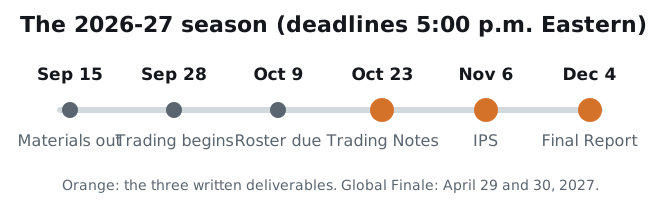
Wharton picks 50 semifinalists from the written work, and the semifinals take place online. The Learning Day and Global Finale are at the Wharton School in Philadelphia on April 29 and 30, 2027. Check the current key dates page each year.
Part 3 of 5 Your Role as Advisor
Wharton's rules page gives the advisor a defined role. Read it before you register.
- You must be a teacher or educator at the team's high school, and only you can register the team. Students cannot register themselves.
- You give guidance and support. You may not make decisions for the students or take part in trading or strategy.
- You can oversee up to five teams.
- A team may also have a secondary advisor, such as a parent or an industry professional, alongside you as the primary teacher advisor.
In practice, you run the calendar and ask the questions; the students make every decision and write every word. Explaining a concept, pointing to a rule, commenting on a draft and asking "why?" all fit the role. Choosing a stock, setting the allocation or rewriting a paragraph do not.
Part 4 of 5 The Rules That End a Competition
These rules come from Wharton's rules page. Breaking any one of them can end the competition for the whole team.
- The team drops below four members or goes above six at any point.
- The team removes a member or changes its advisor without Wharton's written approval.
- Anyone on the team contacts the client.
- The team uses a paid advisor, education consultant or other agent. Wharton prohibits these outright.
- A member enrolls in a non-Wharton extracurricular course, online or in person, that claims to teach the competition.
- Work is copied from any source, including advisors and unofficial advisors. Wharton treats plagiarism as grounds for dismissal.
- AI-generated work is submitted as the team's own, or AI material in a report goes uncited. Wharton handles AI misuse under its ethics and code of conduct policies.
Staying inside these rules is mostly a matter of who does the work. Use outside material, including this guide, to prepare yourself and plan sessions. Do not enroll students in outside programs, and do not hand them another source's analysis to adapt. If a family asks about paying for outside help with the competition, tell them it can disqualify the team.
Part 5 of 5 Questions to Ask Your Team
- Who is our team leader, and is that student at least 16 on the first day of trading? (Wharton's rules page requires this, with no exceptions, and the leader cannot change after trading begins; check the date in the current rules.)
- How will we be judged, in Wharton's words, and what does that mean for how we trade?
- What can each of us use AI for, and what must we never submit?
- What will we do if someone outside the team offers to help?
To show your team what a finished document looks like, use the free Sample Wharton Final Report page at /learn/wharton-final-report. It was written for an invented practice client. Students can study what it does; they must never copy its words or numbers.
Key Terms
Practice Questions
4 questions. Nothing here is recorded or scored.
- Question 1
A parent offers to pay a financial planner to review your team's strategy. What should you tell the parent?
- A.That is fine as long as the planner does not place trades
- B.That is fine if the team cites the planner
- C.Paid advisors and consultants are prohibited and can get the team disqualified, so the team must decline
- D.That is fine because the planner is not a tutor
Check answerHide answer
Answer: C
- A.
- The ban is on paid advisors, whatever they do. Trading has nothing to do with it.
- B.
- A citation does not make paid help allowed.
- C.
- Correct. Wharton's rules page prohibits paid advisors, education consultants and other agents.
- D.
- The rule covers paid advisors, consultants and other agents, so a paid planner falls under it.
- Question 2
A student asks you which stock the team should buy next. Which response fits the advisor role?
- A.Ask which line of the team's thesis the next purchase should serve, and how they would compare two candidates
- B.Place the trade yourself to save time
- C.Tell them to copy last year's winning portfolio
- D.Name a stock you like and explain why
Check answerHide answer
Answer: A
- A.
- Correct. You guide with questions; the students decide.
- B.
- Advisors may not take part in trading.
- C.
- Copying another source's strategy is plagiarism under Wharton's rules.
- D.
- Choosing holdings is a strategy decision, and Wharton says advisors may not make decisions for the team.
- Question 3
Your students want to join a weekend online course that advertises itself as teaching the Wharton competition. What should you do?
- A.Allow it if only one member enrolls
- B.Allow it if they do not mention it in the report
- C.Allow it if the course is free
- D.Tell them not to enroll, because Wharton bars non-Wharton extracurricular courses that claim to teach the competition
Check answerHide answer
Answer: D
- A.
- Any participant enrolling puts the team at risk.
- B.
- Hiding it does not make it allowed.
- C.
- The rule is about non-Wharton courses that claim to teach the competition, whatever they cost.
- D.
- Correct. Enrolling can disqualify the team.
- Question 4
A team's draft says its strategy worked because the WInS account rose 9 percent. What should you ask the team?
- A."How do you show the strategy fits the client without using WInS results?"
- B."Can you make the gain look bigger?"
- C."How did the other teams do?"
- D."Should you remove the strategy section?"
Check answerHide answer
Answer: A
- A.
- Correct. The 2026 instructions said WInS gains and losses are not evidence of a strategy's quality.
- B.
- Any WInS gain, large or small, is the wrong evidence.
- C.
- Standings have little to do with the outcome.
- D.
- The strategy has to stay. The evidence for it has to change.