1.2 Reading the Client Case With Your Team
Running the first case session so students pull out the objective, horizon, risk, liquidity and constraints themselves.
Part 1 of 5 Give the Case a Whole Session
The client case is the only source of facts about the client, and every later decision has to point back to a sentence in it. Spend the whole first session after release on the case, before anyone opens WInS.
Have the team read it twice. The first read is for the story: who the client is and what they want the money to do. The second read is with a pen, listing every fact that limits or shapes the money. Your part is to keep them reading and to stop the early rush to pick stocks.
Teams may not contact the client, so nobody can ask follow-up questions. When the case leaves something open, the team writes down the assumption it will make and its reason. Model that habit: when a student says "probably," ask them to turn it into a stated assumption.
A brilliant portfolio built for the wrong client scores nothing.
Part 2 of 5 Five Headings for the Board
Put five headings on the board and let students fill them from the case, with a quotation for each entry.
| Heading | The question it answers |
|---|---|
| Objective | What is the money for, and how much is needed? |
| Time horizon | When is each amount needed? |
| Risk tolerance | How large a fall can the client live through, and how large a fall can the plan survive? |
| Liquidity needs | What cash must be ready, and when? |
| Constraints | What rules out an investment: values, industries the client refuses to own, money that must stay untouched? |
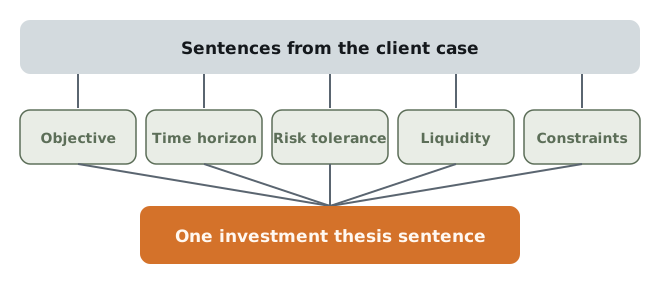
Watch for goals that blur together. Two goals with different dates are two different problems, even inside one account. If the board shows one line where the case has two goals, ask the team to split it.
Part 3 of 5 Willing and Able
Students often read risk tolerance as one number. Teach the two halves.
| Risk attitude | Risk capacity | |
|---|---|---|
| What it measures | How much loss the client is willing to accept | How much loss the plan can absorb without failing |
| Where students find it | What the client says and how they behaved in past markets | The amounts, the dates and the client's other money |
| Example | "I can sleep through a bad year." | A payment due in two years cannot wait for a recovery |
When the two disagree, the lower one usually sets the limit for money tied to a fixed date. Expect at least one student to argue for more risk because the client "likes risk." That argument is your opening to teach capacity.
Part 4 of 5 Keep the Reading Theirs
Resist summarizing the case for the team, even when they are slow. A summary from you becomes their analysis, and Wharton's rules say work cannot be copied from any source, including advisors. Ask questions, point to paragraphs, and let the students write the notes. Also have them read the instructions for what is outside their job; the 2026 Final Report instructions listed topics teams did not need to cover.
Part 5 of 5 Questions to Ask Your Team
- Which sentence in the case tells us that?
- How many separate goals does the client have, and what is the date on each?
- Where do the client's willingness and ability to take risk disagree?
- What does the case leave unsaid, and what assumption will we write down?
- What do the instructions say is outside our job?
Key Terms
Practice Questions
4 questions. Nothing here is recorded or scored.
- Question 1
During the case session, a student says, "The client loves risk, so we should be mostly in stocks." Most of the client's savings must pay a bill in eighteen months. What is the best coaching move?
- A.Tell the team the right allocation for the bill money
- B.Ask what happens to the bill if stocks fall 30 percent next year, and let the team work out what that means for risk capacity
- C.Move on, since allocation comes later
- D.Agree, because the client stated a preference
Check answerHide answer
Answer: B
- A.
- Setting the allocation is the team's decision.
- B.
- Correct. The question teaches capacity and leaves the decision with the students.
- C.
- This is the moment to teach the idea, while the case is fresh.
- D.
- Attitude is only half of risk tolerance, and the bill sets a hard limit.
- Question 2
The team's notes list "Client is careful" under constraints. What should you ask for?
- A.A longer list of adjectives
- B.Your own reading of the client
- C.Nothing; it is a fair summary
- D.The sentence from the case that shows it, quoted, with the team's rule on the next line
Check answerHide answer
Answer: D
- A.
- More adjectives still give no rule.
- B.
- Your reading would become their analysis.
- C.
- An adjective gives the team no rule to follow.
- D.
- Correct. Quotation as evidence and a rule as the team's reading is the habit to build.
- Question 3
The case does not say whether the client expects any other money in the next ten years. A student wants to look up the client online and ask directly. What do you say?
- A.Ignore the question in the report
- B.Go ahead, since it is a factual question
- C.Contacting the client is not allowed; write a clear assumption with a reason and test what changes if it is wrong
- D.Assume a large inheritance to simplify the plan
Check answerHide answer
Answer: C
- A.
- Silence hides a choice. Judges look for assumptions stated in the open.
- B.
- Teams may not contact the client, and doing so means disqualification.
- C.
- Correct. A stated, tested assumption is the expected way to handle a gap.
- D.
- Inventing good news makes the plan rest on something the case never said.
- Question 4
You advise two teams. One team's case notes are much stronger. Should you share them with the second team?
- A.Yes, to save the second team time
- B.No; coach the second team with questions so it builds its own notes
- C.Yes, if the second team rewrites them
- D.Yes, if both teams agree
Check answerHide answer
Answer: B
- A.
- Sharing one team's analysis with another means the second team submits work that is not its own.
- B.
- Correct. Each team's work must be its own, and you guide each one separately.
- C.
- Rewording another team's analysis is still copying.
- D.
- Agreement between teams does not change the plagiarism rule.