1.3 Teaching the Investing Basics
The investing basics to teach before the case arrives: what teams can buy, return, risk, drawdown and loss recovery.
Part 1 of 5 Teach Before the Case Arrives
Most students join knowing a few company names and little else. Use the weeks before the case is released to teach what they can buy, how it earns, and what can go wrong. Teaching general concepts is squarely inside the advisor's role.
| Holding | What you own | How it earns |
|---|---|---|
| Stock | A small share of one company | Price rises and any dividends |
| Bond | A loan to a government or company | Interest on a schedule, then the loan back at maturity |
| ETF | One share of a basket of many stocks or bonds | Whatever the basket earns, minus a small fee |
| Cash and cash equivalents | Money, or very short loans that act like money | A little interest |
Add two more ideas. A Treasury bond is a loan to the US government, which investors treat as the safest dollar bond. An index fund holds what an index holds, so one share spreads money across hundreds of companies.
Part 2 of 5 Return and Risk
Return counts income and price change together, as a share of what was paid. A worked example students can check: a stock bought at $50 that pays $1 in dividends and ends the year at $54 returned $5 on $50, or 10 percent.
Higher expected returns come with more risk. Two words help students describe it. Volatility is how much a price swings. Drawdown is the fall from a high to the next low. From its high on October 9, 2007, to its low on March 9, 2009, the S&P 500 price index fell about 57 percent (Federal Reserve Bank of Atlanta, 2009). Present that as history; it predicts nothing about next year.
Part 3 of 5 The Loss Recovery Lesson
One table changes how students think about risk. A loss needs a larger gain to get back to even, and the bigger the loss, the faster the needed gain grows.
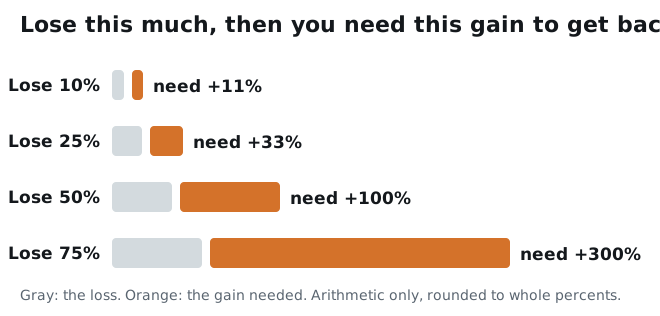
Have students work out the 50 percent row themselves: $100 becomes $50, and $50 has to double to return to $100. Then connect it to the client. Money the client needs soon cannot afford the bottom rows.
Part 4 of 5 What Can Go Wrong
| Holding | The main thing that can go wrong |
|---|---|
| One stock | The company has a bad year, a lawsuit or a failed product |
| A stock fund | The whole market falls, and a fund cannot dodge that |
| A bond or bond fund | Interest rates rise, so existing bonds lose value; a weak borrower can also miss payments |
| Cash | It earns little, and inflation can shrink what it buys |
Return for the risk you took is the goal. A return on its own tells the judges very little.
Keep this teaching general. Once the case arrives, the students apply these ideas to their client themselves.
Part 5 of 5 Questions to Ask Your Team
- What do we own when we buy one share of an ETF?
- What happens to a bond fund's price when interest rates rise, and why?
- If our portfolio fell 25 percent, what gain would bring it back?
- Which of the four building blocks can lose money, and how?
Key Terms
Practice Questions
4 questions. Nothing here is recorded or scored.
- Question 1
A student says cash is the one holding with no risk. What question best corrects this?
- A."Which stock would be safer?"
- B."Why not put everything in cash, then?"
- C."Are you sure?"
- D."If prices rise 3 percent a year and the cash earns 1 percent, what can the cash buy in five years?"
Check answerHide answer
Answer: D
- A.
- It changes the subject and suggests a stock is the safer choice.
- B.
- This invites a debate without teaching the missing idea.
- C.
- The question gives the student nothing to reason with.
- D.
- Correct. It leads the student to inflation risk with numbers they can check.
- Question 2
To show why big losses matter, which classroom task works best?
- A.You tell them losses are bad
- B.Students calculate the gain needed to recover from 10, 25, 50 and 75 percent losses
- C.Students pick the stock they think will fall least
- D.Students read last year's top WInS returns
Check answerHide answer
Answer: B
- A.
- A statement without the numbers rarely changes how students act.
- B.
- Correct. Doing the arithmetic themselves makes the pattern stick.
- C.
- That turns a lesson about risk into stock picking.
- D.
- WInS returns say little about risk and have little to do with the outcome.
- Question 3
A stock is bought for $40, pays $2 in dividends and ends the year at $38. A student calls the return negative 5 percent. What did the student miss?
- A.Nothing; the price fell 5 percent
- B.The $2 of dividends, which brings the total return to 0 percent
- C.The fee on the trade, which makes it worse
- D.Inflation, which makes it 10 percent
Check answerHide answer
Answer: B
- A.
- The price fell 5 percent, but return counts income too.
- B.
- Correct. A $2 price fall and $2 of dividends net to zero on $40.
- C.
- The example has no fee. The missing piece is the dividend.
- D.
- Inflation is not part of this calculation.
- Question 4
Before the case is released, which kind of help belongs to the advisor?
- A.Teaching general concepts such as diversification and interest rate risk
- B.Writing the team's thesis sentence for it
- C.Placing practice trades on the team's account
- D.Choosing a starter portfolio for the team to trade
Check answerHide answer
Answer: A
- A.
- Correct. Explaining concepts is guidance; the students still make every decision.
- B.
- A thesis written by you becomes your strategy.
- C.
- Advisors may not take part in trading.
- D.
- That is a strategy decision, which advisors may not make.