2.1 Coaching the Investment Policy Statement
What an IPS does, how to run the writing session, and how to keep the strategy and every word in student hands.
Part 1 of 6 What an IPS Is
An Investment Policy Statement, or IPS, is the written rulebook for a client's money. It says what the money must do, how much risk it may take, and how every decision will be made.
The CFA Institute's guide for individual investors (2010) organizes an IPS around a few questions: whose money this is and what it is for, who decides what, what return and risk the money must meet, what limits apply, and how the plan will be checked. It is a useful outline to show students.
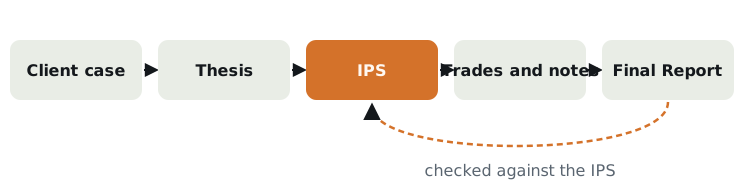
In 2026 the IPS was due November 6, in week six of trading. Teams trade from week one, so push your team to decide the strategy before the first trade and write it up formally later. A team that trades first and explains later spends the competition inventing reasons.
Part 2 of 6 The Thesis Comes First
Ask the team for one sentence, the investment thesis: what the client needs, by when, how much risk the money can take, what the portfolio will hold and avoid, and why. A sentence shape helps students start; the content must come from their reading of the case.
Because our client needs [amount] by [date] and can risk only [what is left], we will hold [what] and avoid [what], because [reason from the case].
Have the team write its thesis at the top of every meeting agenda. When a student pitches a trade, ask which part of the thesis it serves.
Part 3 of 6 What the IPS Must Make Clear
In 2026 the IPS was a short plain-text submission: an elevator pitch of at most 50 words and a statement of at most 500 words, with no charts, links or citations. Check the current instructions, since the limits can change. Five hundred words is about one page, so every sentence has to carry a decision. By the end, a reader should know:
- What the team is trying to do for the client.
- Why that strategy fits this client.
- How it balances growth, safety, cash needs and flexibility.
- How it will guide decisions as the client's needs change.
- Which money it protects first, and how.
The IPS sets the method and the rules. Detailed calculations and the list of holdings belong in the Final Report.
Part 4 of 6 Run the Writing Session
One meeting can produce a full draft if the decisions are already made. A plan that works:
- Lock the decisions first. Students put the thesis, key rates, percentages and dates on the board. Every paragraph uses exactly these.
- One owner per paragraph. Each student drafts a paragraph; one student edits the whole IPS to the word limit.
- Swap and check. Pairs read each other's paragraphs against the checklist above.
- Write the pitch last, together, out loud.
| A vague IPS sentence | A sentence with a decision in it |
|---|---|
| "We will keep the portfolio balanced." | "Stocks stay between 25 and 35 percent of the portfolio." |
| "We will review regularly." | "We review every week and rebalance when any asset class moves 5 points from its target." |
A rule without a trigger is a wish. Point students to rebalancing triggers and allowable ranges when their rules have no numbers.
Part 5 of 6 Keep the Words Theirs
You may comment on drafts. You may not write them, and neither may anyone else outside the team. Students may brainstorm with AI, but they may not submit AI-generated text as their own, and any AI material used must be cited. Comment with questions in the margin ("Which case fact supports this?") instead of replacement sentences.
Part 6 of 6 Questions to Ask Your Team
- Could another team's client use this sentence unchanged? If so, what case fact is missing?
- Which word here is an adjective standing in for a decision?
- Do the numbers in paragraph two match the ones on the board?
- Will we still follow this rule in December?
Key Terms
Practice Questions
4 questions. Nothing here is recorded or scored.
- Question 1
A student's draft paragraph says, "We will invest responsibly for our client." What comment fits the advisor role?
- A."Good, keep it"
- B."Delete the paragraph"
- C.Rewrite it as "Stocks stay below 35 percent"
- D."What would 'responsibly' look like as a number, a date or a rule?"
Check answerHide answer
Answer: D
- A.
- The sentence names no action, amount or time.
- B.
- The team needs the paragraph, with a decision in it.
- C.
- Writing the sentence for them makes it your work and your decision.
- D.
- Correct. The question pushes for a decision and leaves the writing to the student.
- Question 2
In December the team decides its IPS was too cautious and wants to present a bolder strategy in the Final Report. What do you advise?
- A.Leave the IPS out of the report
- B.Go ahead; the Final Report is the latest word
- C.Keep the IPS strategy and explain the change of view honestly in the Team Reflection
- D.Quietly adjust the numbers to match
Check answerHide answer
Answer: C
- A.
- Evaluators read all deliverables together.
- B.
- The 2026 instructions said the Final Report could not create a new strategy or revise the IPS.
- C.
- Correct. The strategy stays locked; the reflection is the place for second thoughts.
- D.
- Hidden changes break the consistency evaluators check for.
- Question 3
A student wrote the elevator pitch with a chatbot and wants to submit it as written. What do you say?
- A.Fine, it is only 50 words
- B.Fine, if it is cited
- C.Keep any ideas it gave, then write the pitch in the team's own words and follow the citation rule
- D.Send it to you and you will fix it
Check answerHide answer
Answer: C
- A.
- Length does not matter. AI-generated work may not be submitted as the team's own.
- B.
- Citation is required for AI material used, but the submission must still be the team's own work.
- C.
- Correct. Brainstorming with AI is allowed; the submitted words must be the students'.
- D.
- You may comment, but you may not write the team's work.
- Question 4
Paragraph two of the draft IPS says stocks are 40 percent; paragraph four says 50 percent. What is the best move?
- A.Ask the team which number it decided on the board, and have the editor make every paragraph match
- B.Average them to 45 percent
- C.Leave both; evaluators will not notice
- D.Pick the number you prefer
Check answerHide answer
Answer: A
- A.
- Correct. Inconsistent numbers are a common way a team-written IPS falls apart, and the fix is theirs to make.
- B.
- A number nobody decided is worse than either.
- C.
- Evaluators check consistency across all deliverables.
- D.
- Choosing the allocation is the team's decision.