2.2 Asset Allocation and Diversification
Teaching allocation by job, targets and ranges, sector spread and a glide path, with questions that leave decisions to students.
Part 1 of 5 Split the Money by Job
Asset allocation is how a portfolio divides money among types of investment. It drives more of the result than any single stock choice, so it is the decision to slow your team down on.
Teach students to start from the client's goals. Money with a fixed payment date soon has one job: be there, in full, on that date. Money the client will not touch for years has another: grow. Each job gets its own part of the portfolio, often called a sleeve or bucket.
| Safe money | Growth money | |
|---|---|---|
| Its job | Pay a known amount on a known date | Grow over a long horizon |
| What it typically holds | Cash and short-term government bonds | Mostly broad stock funds, a few single stocks |
| What a bad year does | Very little | It can fall a lot and need years to recover |
Holding safe bonds sized to a known payment on its due date is called liability matching. It lets a team say that payment does not depend on the stock market.
Part 2 of 5 Targets and Ranges
An IPS can set a target for each asset class and an allowable range around it. For illustration, a target of 30 percent stocks with a range of 25 to 35 percent. Markets move the mix every day; that wandering is drift. Rebalancing trades back toward the targets. A written trigger keeps the decision from depending on the team's mood that week.
Part 3 of 5 Spreading Risk
Diversification spreads money across holdings that do not all rise and fall together. Ten technology stocks are one bet made ten times. The idea students need is correlation: how closely two holdings move together.
Diversification works at two levels: across asset classes and within each one, across many companies, sectors and countries. The Global Industry Classification Standard sorts listed companies into eleven sectors, from energy and health care to utilities and real estate.
| Risk | Where it comes from | Can diversification reduce it? |
|---|---|---|
| Unsystematic risk | One company or one industry | Yes, by owning many companies in many industries |
| Systematic risk | The whole market or economy | No; it is managed with the split between stocks and safe money |
Part 4 of 5 Shift Toward Safety
As a payment date gets closer, a fall in stocks has less time to recover. A crash just before money is drawn does the most damage; that is sequence risk. Many plans answer it with a glide path, moving money from growth to safe holdings on a schedule.
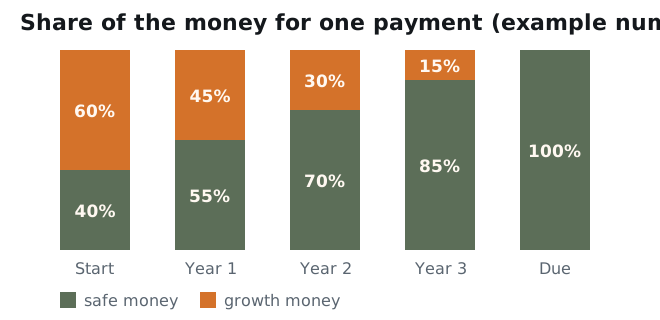
The team chooses the schedule from its own case. Your job is to ask for dates and percentages until the schedule is specific enough to follow.
Nobody controls returns. A team controls how much risk it takes, how it spreads that risk, and whether the risk fits the client.
Part 5 of 5 Questions to Ask Your Team
- What job does each part of our portfolio do, and which goal does it serve?
- How many of the eleven sectors do we cover, and where are we concentrated?
- If the market fell 30 percent the month before the payment, what would happen to the payment?
- What exact event makes us rebalance?
Key Terms
Practice Questions
4 questions. Nothing here is recorded or scored.
- Question 1
A team's eight stocks are all in technology and social media. What should you ask?
- A."Can we buy more tech to diversify?"
- B."Which stock will go up most?"
- C."If that part of the market had a bad year, how much of our portfolio would fall with it?"
- D."Should we sell everything?"
Check answerHide answer
Answer: C
- A.
- More of the same sector adds to the concentration.
- B.
- That pushes stock picking and ignores the concentration.
- C.
- Correct. The question surfaces correlation and lets the team find the fix.
- D.
- It suggests an answer without teaching the idea.
- Question 2
A team's IPS sets stocks at 40 percent with a 35 to 45 percent range. After a strong month stocks are 47 percent and the team wants to leave it. What do you ask?
- A."Should we raise the target to 47?"
- B."What does our written rule say happens when stocks leave the range?"
- C."Why not sell all the stocks and lock in gains?"
- D.Nothing; good returns are fine
Check answerHide answer
Answer: B
- A.
- Moving the target to fit the drift breaks the IPS.
- B.
- Correct. It points the team to its own trigger without making the trade for them.
- C.
- That abandons the growth job and is not what the rule says.
- D.
- The drift is exactly the case the rule was written for.
- Question 3
A student says owning 300 stocks protects the portfolio from a recession. Which idea is the student missing?
- A.Unsystematic risk cannot be diversified
- B.Index funds are not permitted
- C.Recessions only affect bonds
- D.Systematic risk reaches nearly every stock, so it is managed through the split between stocks and safe money
Check answerHide answer
Answer: D
- A.
- That has it backward. Company risk is the kind diversification reduces.
- B.
- In 2026 ETFs were permitted, and the question is about risk.
- C.
- Recessions usually hit stock prices hard.
- D.
- Correct. Diversifying among stocks reduces company risk; a recession is market-wide.
- Question 4
The team's glide path says only "move to safety near the date." What should you push for?
- A.Your own recommended percentages
- B.Specific dates and percentages the team will follow
- C.Nothing; that is clear enough
- D.A promise to time the market well
Check answerHide answer
Answer: B
- A.
- The schedule is the team's decision.
- B.
- Correct. A schedule with numbers can be carried out and judged.
- C.
- Without dates and percentages, nobody can follow or check it.
- D.
- Nobody can time markets reliably, and a schedule exists to avoid trying.