2.3 Building and Trading the Portfolio
Running a student-led build and trading session, coaching position sizing and stock pitches, and staying off the keyboard.
Part 1 of 4 A Student-Run Build Session
Once the strategy is set, the team turns its percentages into actual holdings. Run this as a student-led session: a student chairs, one student drives WInS, one takes notes, and you watch the clock.
Suggest an order. The team fills the safe money first, then the growth money. Broad stock ETFs usually form the growth core, and single stocks come last, each kept small. Every holding gets checked in WInS against the current trading rules before the team votes on it.
Remind the team that the WInS portfolio should look like what it would recommend to the client, at the weights it would use. A portfolio the team would never propose tells the judges nothing about its strategy.
| Role | Job |
|---|---|
| Chair | Runs the vote on each line and keeps the session on time |
| Driver | The only one logged in; places each trade in the agreed order and reads each weight aloud |
| Note-taker | Writes one line per trade: what, how much, and which part of the thesis it serves |
| Strategy lead | Challenges any trade the thesis cannot explain |
Part 2 of 4 Position Sizing
Position sizing decides how much one mistake can cost. Show this figure before the team votes on single stocks.
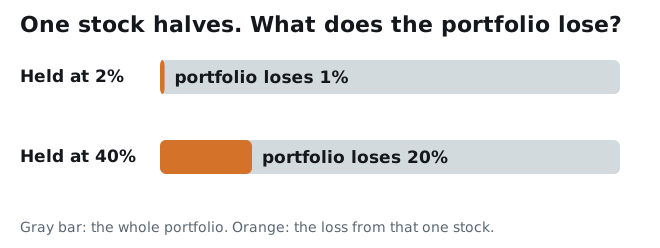
Teams often write a concentration limit into the IPS, such as a cap on any one company and a cap on all single stocks together. If the team has no cap, ask what loss on one holding it could live with.
Part 3 of 4 Coaching Stock Pitches
When a student pitches a single stock, have the team ask four questions:
- What does the company sell, and who pays for it?
- Why this company over its closest competitor?
- What could go wrong? A SWOT analysis organizes the answer.
- Would we still want it if we could not sell for five years?
Teach price and value as different numbers. A company's market capitalization is its share price times its number of shares. The price-to-earnings ratio (P/E) divides the share price by earnings per share: a $60 share with $3 of yearly earnings per share has a P/E of 20. A high P/E signals high expectations and less room for disappointment.
Require a source and a date beside every number. Prices change daily, and Wharton warns that AI-generated content can be inaccurate or misleading.
Every trade answers to the thesis. A good story about a company is not enough.
Part 4 of 4 Questions to Ask Your Team
- Which line of our thesis does this holding serve?
- What share of the portfolio is it, and what would we lose if it halved?
- Is it permitted, and did we check in WInS?
- Where did this number come from, and on what date?
- Would we recommend this exact portfolio to the client?
Expect practice portfolios to be deleted before official trading, and read the current trading activity requirements with your team so nobody misses one.
Key Terms
Practice Questions
4 questions. Nothing here is recorded or scored.
- Question 1
During the vote, the team chooses a 15 percent position in one stock, above its own 5 percent cap. What should you do?
- A.Overrule the vote and set it to 5 percent
- B.Ask the team what its IPS cap says and whether it means to change the rule before the IPS is final
- C.Place a smaller trade yourself
- D.Stay silent; it is their choice
Check answerHide answer
Answer: B
- A.
- Advisors may not make decisions for the team.
- B.
- Correct. You point to their own rule; they decide whether to follow it or change it on purpose.
- C.
- Advisors may not take part in trading.
- D.
- Asking about their own rule is guidance, and silence lets them break it unknowingly.
- Question 2
A student pitches a stock with "it has a great product and I use it every day." What question helps most?
- A."Why this company over its closest competitor, and what could go wrong?"
- B."Is that your favorite stock?"
- C."Should we buy it right now?"
- D."How much will it go up?"
Check answerHide answer
Answer: A
- A.
- Correct. Those questions turn a preference into analysis.
- B.
- Preference is the problem to coach past.
- C.
- Deciding comes after analysis, and the decision is the team's.
- D.
- Nobody can answer that, and it pushes prediction over analysis.
- Question 3
A share costs $45 and the company earned $3 per share last year. A student says the P/E is 3. What did the student do?
- A.Forgot to multiply by 100
- B.Used the wrong price
- C.Divided correctly
- D.Reported earnings per share in place of the ratio; the P/E is 15
Check answerHide answer
Answer: D
- A.
- P/E is a plain ratio with no percent sign.
- B.
- The price was right; the division was missing.
- C.
- $45 divided by $3 is 15.
- D.
- Correct. P/E is price divided by earnings per share.
- Question 4
A single stock held at 3 percent of the portfolio falls 40 percent. A student says the portfolio lost 40 percent. What is the correct loss?
- A.1.2 percent
- B.40 percent
- C.3 percent
- D.0.4 percent
Check answerHide answer
Answer: A
- A.
- Correct. 40 percent of a 3 percent position is 1.2 percent of the portfolio.
- B.
- The stock lost 40 percent; it is only 3 percent of the portfolio.
- C.
- That would require the stock to lose everything.
- D.
- This treats the position as 1 percent of the portfolio.