2.4 Trading Notes and the Trading Notes Analysis
Building a trading-note habit, running the weekly review, and coaching the Trading Notes Analysis without drafting it.
Part 1 of 5 Why Notes Matter
A trading note is a team's written reason for one trade, recorded when the trade is made. Notes show the judges what students were thinking before anyone knew how the trade would turn out.
Teams write their notes with their trades in WInS. Over ten weeks the notes become the raw material for the Trading Notes Analysis in October and the Final Report in December. The habit is the advisor's to build: a team that writes notes on the day has done much of its December writing already.
Part 2 of 5 A Five-Field Note
Here is one shape that works. Teams keep all five fields in their own log and keep the note in WInS short and complete.
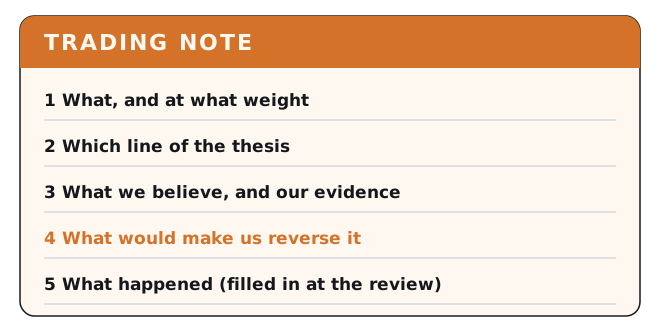
- What and how much. What was bought or sold, at what share of the portfolio.
- Which line of the thesis. The part of the strategy the trade serves.
- Belief and evidence. What the team believes about the holding, and where that came from.
- What would reverse it. The event that would make the team sell.
- What happened. Filled in later, at the weekly review.
Field four is the one students skip. Insist on it: written before the result is known, it proves the decision was planned.
| Strong note | Weak note | |
|---|---|---|
| What | Bought a broad bond ETF, 10 percent of the portfolio | Bought a bond fund |
| Why | Steadies the account while the payment money moves into Treasuries; serves the "keep the payment safe" line | Very safe, good choice |
| Reverse if | The payment date moves closer and the money needs to be in cash | (nothing) |
Part 3 of 5 Run a Weekly Review
Hold a short review every week of live trading. The team looks at the portfolio, hears new pitches and writes down why. A week with no trade still gets a log line: what was held, and the reason. The review fills in field five, and if the thesis has to change, it changes there, in writing, with a reason. Your role is to keep the meeting on schedule and to ask "which line of the thesis?" until students ask it of each other.
Part 4 of 5 The Trading Notes Analysis
In 2026 the Trading Notes Analysis was due October 23, before the IPS. The 2026 instructions asked each team to:
- Choose three trading notes from trades it actually placed in WInS. Wharton said it would check them against WInS.
- Copy each note exactly as it appears in WInS.
- Write a reflection of no more than 100 words for each one, explaining why the team made the decision, how it fit the strategy, and how it served the client's goals, funding needs or risks.
Help the team choose by asking which three decisions best show its strategic thinking. The 2026 instructions said a chosen note did not have to be for a holding still owned, so a reversed trade with clear reasoning can be a strong pick. The reasoning is what scores, which means a losing trade can be a good choice.
Part 5 of 5 Questions to Ask Your Team
- Which line of the thesis did this trade serve?
- What would make us sell it, and did we write that down on the day?
- Which three decisions best show how we think, regardless of how they turned out?
- Does each reflection answer why, how it fit the strategy, and how it served the client?
Key Terms
Practice Questions
4 questions. Nothing here is recorded or scored.
- Question 1
It is week six and a team has a list of trades but no notes. What should you advise?
- A.Start a note for every trade from today, and record what the team remembers about earlier trades, dated today
- B.Skip notes and rely on memory in December
- C.Ask an AI tool to write reasons for each past trade
- D.Write notes for the old trades now and date them as if written on the day
Check answerHide answer
Answer: A
- A.
- Correct. Honest notes from now on, with dated recollections, are the best available record.
- B.
- Memory in December describes price moves and loses the reasoning.
- C.
- That would be generated work submitted as the team's own.
- D.
- That misrepresents when the reasoning was written, which is dishonest.
- Question 2
A team wants to pick its three best-performing trades for the Trading Notes Analysis. What question should you ask?
- A."Can you include more than three?"
- B."Which stocks are still in the portfolio?"
- C."Which ones made the most money?"
- D."Which three decisions best show how our strategy guided us, whatever happened afterward?"
Check answerHide answer
Answer: D
- A.
- The 2026 instructions asked for three.
- B.
- The 2026 instructions said notes did not need to match current holdings.
- C.
- That repeats the mistake. Performance is not the test.
- D.
- Correct. The 2026 instructions focused on reasoning and the role of each decision.
- Question 3
A student drafts the reflection "This was a great trade that went up a lot." What comment helps most?
- A."Make it longer"
- B."Add the exact percentage gain"
- C."Why did we make it, which part of our strategy did it serve, and how did it help the client?"
- D."Let me rewrite it for you"
Check answerHide answer
Answer: C
- A.
- Length does not fix missing reasoning, and the limit was 100 words.
- B.
- That strengthens the wrong evidence.
- C.
- Correct. Those three questions match what the 2026 instructions asked each reflection to explain.
- D.
- The reflection must be the team's own writing.
- Question 4
Which field of a trading note best proves a decision was planned before the result was known?
- A.The date of the trade
- B.What the holding returned by December
- C.What would make the team reverse the trade
- D.The ticker
Check answerHide answer
Answer: C
- A.
- The date shows timing and nothing about the reasoning.
- B.
- Results come later and are not evidence of a strategy.
- C.
- Correct. An exit condition written in advance shows a planned decision.
- D.
- Identifying the holding shows no thinking.