3.2 Projections, Scenarios and Risk
Coaching projections, present value, one-change scenarios and a stated range, and checking for WInS results in the model.
Part 1 of 5 A Projection Is a Model
A projection estimates what the client's money could be worth on future dates. It rests on assumptions about returns, and every assumption can be wrong. Students usually need two formulas and a lot of questions.
The team builds its projection from the case's figures and the return rates in its IPS. The 2026 instructions told teams not to add WInS gains or losses to the client's projected money. Students forget this often; check for it in every draft.
Teach compounding with the future value formula, then have students check one example by hand.
Example numbers: $100,000 growing at 5 percent a year for 6 years becomes about $134,010.
Part 2 of 5 Pricing a Future Payment
Running the formula backward gives present value: what a future payment costs today. Money that must not fail is priced at a safe rate, because stock returns cannot be counted on for a fixed bill.
Example numbers: a $40,000 payment due in 5 years at a safe rate of 3 percent costs about $34,500 today. Inflation matters too: at 2.5 percent a year, $100,000 in ten years buys what about $78,120 buys today. Ask students to label which kind of dollars each number is in.
Part 3 of 5 Where Assumptions Come From
Every return rate needs a reason and a source. A common approach is to pick a stock return below a long-run historical average from a published dataset and cite it with its date. Ask the team why its number is cautious enough for this client.
Part 4 of 5 One Change at a Time
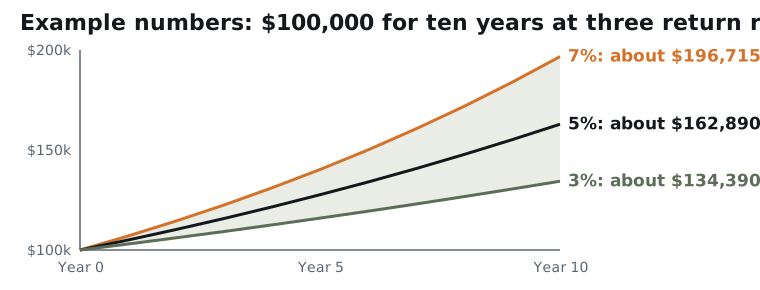
A scenario changes one assumption, keeps the others at the base case, and shows the effect. Changing one thing at a time lets the reader see what each assumption is worth.
| Scenario | Yearly return | Value after 10 years |
|---|---|---|
| Bad case | 3 percent | About $134,390 |
| Base case | 5 percent | About $162,890 |
| Good case | 7 percent | About $196,715 |
Ask for a bad-timing test as well: what if markets fall sharply just before a payment date? If the payment is still covered, the team should show why. If it is not, the team should say so.
Finally, push for a range with a stated confidence tied to the scenarios, such as "covered in every scenario we tested." Confidence is a claim the team proves with its table. The numbers and the model belong to the students; your part is checking that they can explain each one.
Part 5 of 5 Questions to Ask Your Team
- Where does each return rate come from, and what date is the source?
- Did any WInS result slip into the projection?
- What happens to the plan if this one assumption is worse?
- Which dollars is this number in, today's or future?
- How confident are we in the range, and which row of the table shows it?
Key Terms
Practice Questions
4 questions. Nothing here is recorded or scored.
- Question 1
A team's draft projection starts from the WInS ending balance. What do you ask?
- A."Can you use an even higher balance?"
- B."Would you like me to rebuild the model?"
- C.Nothing; it is their choice
- D."What do the instructions say about WInS gains in the client's projections?"
Check answerHide answer
Answer: D
- A.
- Any WInS gain is the wrong starting point.
- B.
- The model must be the team's work.
- C.
- It breaks a stated instruction, so pointing to it is your job.
- D.
- Correct. The 2026 instructions said to leave WInS gains and losses out, and the question lets the team find it.
- Question 2
A student says, "At 4 percent, $20,000 in 3 years costs $17,600 today, since we subtract 4 percent each year." What is the right correction?
- A.Multiply by 1.04 three times to get about $22,500
- B.Divide by 1.04 for each year: $20,000 divided by about 1.125 is about $17,780
- C.The student is right
- D.The answer is $20,000 because safe money does not grow
Check answerHide answer
Answer: B
- A.
- That grows the payment forward.
- B.
- Correct. Present value divides by one plus the rate for each year.
- C.
- Subtracting $800 three times is not discounting.
- D.
- Safe money earns the safe rate.
- Question 3
A team's scenario table changes the stock return, the safe rate and inflation all in the same row. What should you suggest?
- A.Use WInS results as the base case
- B.Keep it; one worst case is enough
- C.Add rows that change one assumption at a time, holding the others at the base case
- D.Remove the bad case
Check answerHide answer
Answer: C
- A.
- WInS results stay out of the projection.
- B.
- A combined case hides which assumption did the damage.
- C.
- Correct. Each row then shows what a single assumption is worth.
- D.
- Testing only good outcomes hides the risk judges want to see.
- Question 4
Which confidence statement should you push the team toward?
- A."We are very confident in our numbers."
- B."The market should go up, so the plan will work."
- C."The payment is covered in all four scenarios we tested, and the growth target is reached in two."
- D."Our WInS returns prove the plan."
Check answerHide answer
Answer: C
- A.
- It gives no evidence.
- B.
- It rests on a forecast.
- C.
- Correct. The confidence is tied to the table, so a reader can check it.
- D.
- WInS results are not evidence of a strategy's quality.