5.1 Fiscal and Monetary Policy Actions in the Short Run
How fiscal and monetary policy combine to close output gaps, and how to predict AD, output, the price level and interest rates when they act together.
Part 1 of 3 Two Policies, One Gap
Governments and central banks can act on the same output gap at the same time. Fiscal policy changes government spending and taxes. Monetary policy changes interest rates through the central bank's administered rates or open market operations. A policy mix is a combination of the two.
The imaginary country of Pellandia has a negative (recessionary) output gap: real GDP is below full-employment output and unemployment is high. Its legislature cuts income taxes. Its central bank, which runs an ample-reserves system, lowers interest on reserves. The tax cut raises consumption. The lower rates raise investment and consumption too. Both policies shift aggregate demand right.
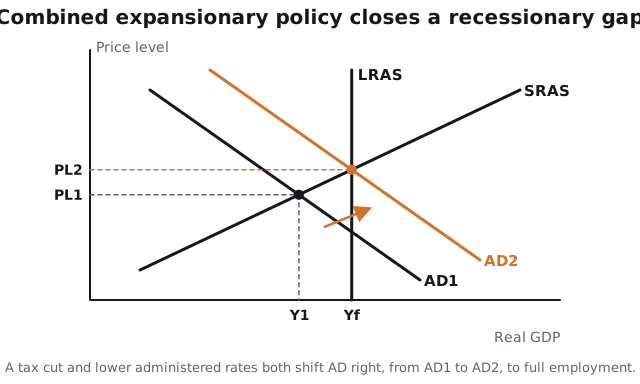
For a positive (inflationary) gap the mix runs the other way. A tax increase or a cut in government purchases, combined with higher administered rates, shifts aggregate demand left. Real output, the price level and employment fall back toward full employment.
Part 2 of 3 Reading a Policy Mix
Each policy also moves interest rates. Expansionary fiscal policy raises interest rates: more government borrowing raises the real rate in the loanable funds market, and higher income raises money demand. Expansionary monetary policy lowers interest rates. When two policies push a variable in the same direction, the result is certain. When they push in opposite directions, the result cannot be determined without knowing the sizes.
| Fiscal policy | Monetary policy | AD, real output, price level | Interest rates |
|---|---|---|---|
| Expansionary | Expansionary | All rise | Cannot be determined |
| Contractionary | Contractionary | All fall | Cannot be determined |
| Expansionary | Contractionary | Cannot be determined | Rise |
| Contractionary | Expansionary | Cannot be determined | Fall |
Part 3 of 3 Why Use Both
Pairing the policies can change the side effects. Expansionary fiscal policy alone pushes interest rates up and can reduce private investment. Adding expansionary monetary policy keeps rates from rising as much, so more of the boost to aggregate demand survives. A government that wants to shrink a budget deficit can raise taxes while the central bank lowers rates, so aggregate demand falls by less.
Two policies that push aggregate demand the same way give a certain result. Two that push against each other leave the outcome to the sizes of the changes.
Key Terms
Practice Questions
6 questions. Nothing here is recorded or scored.
- Question 1POL-1.F.1
An economy has a negative (recessionary) output gap. Which combination of fiscal and monetary policy would most effectively restore full employment?
- A.Raise income taxes and lower interest on reserves.
- B.Cut income taxes and raise interest on reserves.
- C.Cut income taxes and lower interest on reserves.
- D.Raise income taxes and raise interest on reserves.
Check answerHide answer
Answer: C
- A.
- A tax increase lowers consumption and pulls aggregate demand down, working against the lower interest rate.
- B.
- Raising interest on reserves raises rates and lowers spending, which offsets the tax cut.
- C.
- Correct. A recessionary gap calls for more aggregate demand. A tax cut raises consumption, and lower interest on reserves lowers interest rates, which raises investment and consumption. Both shift aggregate demand right.
- D.
- Both policies are contractionary and would widen the recessionary gap.
- Question 2POL-1.F.2
A government increases its purchases while the central bank lowers its administered interest rates. What are the short-run effects on real output and on interest rates?
- A.Real output rises, and interest rates rise.
- B.Real output rises, and the effect on interest rates cannot be determined.
- C.Real output rises, and interest rates fall.
- D.The effect on real output cannot be determined, and interest rates rise.
Check answerHide answer
Answer: B
- A.
- The fiscal policy alone would raise interest rates, and the monetary policy pushes them down.
- B.
- Correct. Both policies shift aggregate demand right, so real output rises. Higher government purchases push interest rates up, while lower administered rates push them down. Without the sizes, the net effect on rates is unknown.
- C.
- The monetary policy alone would lower rates, and the extra government borrowing pushes them up.
- D.
- Both policies raise aggregate demand, so the rise in real output is certain.
- Question 3POL-1.F.2
A government increases its purchases, and at the same time the central bank raises the interest rate it pays on reserves. Which of the following describes the short-run effects on interest rates and aggregate demand?
- A.Interest rates fall, and aggregate demand rises.
- B.The effect on interest rates cannot be determined, and aggregate demand rises.
- C.Interest rates rise, and aggregate demand rises.
- D.Interest rates rise, and the effect on aggregate demand cannot be determined.
Check answerHide answer
Answer: D
- A.
- Both actions raise interest rates, so rates cannot fall.
- B.
- The two policies agree on interest rates, so the rise in rates is certain. They disagree on aggregate demand.
- C.
- Higher interest rates reduce investment and consumption, which pulls against the extra government spending. The net effect on aggregate demand is uncertain.
- D.
- Correct. Both actions push interest rates up: more government borrowing and higher administered rates. For aggregate demand, the spending increase pushes up and the higher rates push down, so the net change depends on the sizes.
- Question 4POL-1.F.1
Ostmere Overheats
The imaginary country of Ostmere produces real GDP of $950 billion, while its full-employment output is $900 billion. Unemployment is below the natural rate, and inflation is rising. Ostmere's banking system has ample reserves.
Which combination of policies would best move Ostmere back to full employment?
- A.Reduce government purchases and raise interest on reserves.
- B.Increase government purchases and raise interest on reserves.
- C.Reduce government purchases and lower interest on reserves.
- D.Increase government purchases and lower interest on reserves.
Check answerHide answer
Answer: A
- A.
- Correct. Ostmere has a positive (inflationary) gap, so aggregate demand must fall. Lower government purchases reduce spending directly, and higher interest on reserves raises rates, which reduces investment and consumption.
- B.
- Higher government purchases add to aggregate demand, working against the higher interest rate.
- C.
- Lower interest on reserves raises spending, which offsets the cut in government purchases.
- D.
- Both policies are expansionary and would make the inflationary gap larger.
- Question 5POL-1.F.2
A government raises taxes to reduce its budget deficit. At the same time, the central bank lowers the interest rate it pays on reserves. Which short-run effect is certain?
- A.Aggregate demand falls.
- B.Real output rises.
- C.Interest rates fall.
- D.The price level rises.
Check answerHide answer
Answer: C
- A.
- The tax increase lowers aggregate demand, and the lower interest rates raise it. The net effect is uncertain.
- B.
- Real output follows aggregate demand, which could rise or fall here.
- C.
- Correct. A tax increase means less government borrowing, which lowers interest rates, and lower interest on reserves lowers them too. Both push rates down. The two policies pull aggregate demand in opposite directions.
- D.
- The price level also follows aggregate demand, so its direction is uncertain.
- Question 6POL-1.F.2
Ostmere Overheats
The imaginary country of Ostmere produces real GDP of $950 billion, while its full-employment output is $900 billion. Unemployment is below the natural rate, and inflation is rising. Ostmere's banking system has ample reserves.
Ostmere carries out the combination of policies that best restores full employment. What are the short-run effects on the price level and on unemployment?
- A.The price level falls, and unemployment falls.
- B.The price level falls, and unemployment rises.
- C.The price level rises, and unemployment rises.
- D.The price level rises, and unemployment falls.
Check answerHide answer
Answer: B
- A.
- Lower output means fewer jobs, so unemployment rises.
- B.
- Correct. Contractionary fiscal and monetary policy shift aggregate demand left. Real output falls toward $900 billion, so firms hire fewer workers and unemployment rises toward the natural rate. The price level falls compared with where it would have been.
- C.
- A leftward shift of aggregate demand lowers the price level.
- D.
- This is the result of expansionary policy, the opposite of what Ostmere needs.
Practice every topic in Unit 5
CED Codes
POL-1.F.1 · POL-1.F.2