5.2 The Phillips Curve
Draw the short-run and long-run Phillips curves, find long-run equilibrium, and show how demand shocks, supply shocks and the natural rate move the curves.
Part 1 of 4 The Short-Run Trade-Off
The short-run Phillips curve (SRPC) shows a short-run trade-off between inflation and unemployment. The graph puts the inflation rate on the vertical axis and the unemployment rate on the horizontal axis. The SRPC slopes downward: in the short run, lower unemployment comes with higher inflation.
The trade-off follows from the AD-AS model. When aggregate demand rises, firms produce more and hire more workers, so unemployment falls, and the price level rises faster. An economy is always operating somewhere on its SRPC.
Part 2 of 4 The Long Run: A Vertical Line
The long-run Phillips curve (LRPC) is vertical at the natural rate of unemployment. In the long run, the economy returns to the natural rate whatever the inflation rate is. The LRPC matches the vertical LRAS curve: both sit at full employment.
Long-run equilibrium is the point where the SRPC crosses the LRPC. Points to the left of long-run equilibrium, with unemployment below the natural rate, show an inflationary (positive) output gap. Points to the right, with unemployment above the natural rate, show a recessionary (negative) output gap.
| Where the economy sits | Unemployment | Output gap |
|---|---|---|
| On the LRPC | Equal to the natural rate | None: long-run equilibrium |
| Left of the LRPC | Below the natural rate | Inflationary (positive) |
| Right of the LRPC | Above the natural rate | Recessionary (negative) |
Part 3 of 4 Demand Shocks and Supply Shocks
A demand shock moves the economy along the SRPC. A supply shock shifts the SRPC itself. Suppose the imaginary country of Ostmere starts at long-run equilibrium with 5% unemployment and 2% inflation. A boom in consumer spending moves it up along the SRPC to 4% unemployment and 3% inflation.
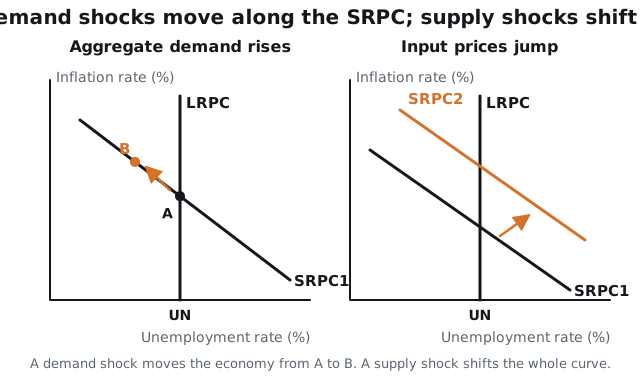
Now suppose energy prices jump. Short-run aggregate supply shifts left, and the SRPC shifts right. At every unemployment rate, inflation is higher. Ostmere can end up with higher inflation and higher unemployment at the same time.
| AD-AS change | Phillips curve change |
|---|---|
| AD increases | Move up and to the left along the SRPC |
| AD decreases | Move down and to the right along the SRPC |
| SRAS decreases (higher input prices or expected inflation) | SRPC shifts right |
| SRAS increases (lower input prices) | SRPC shifts left |
| The natural rate of unemployment changes | LRPC shifts |
Point B does not last. With unemployment below the natural rate, workers and firms come to expect 3% inflation and push wages up. Short-run aggregate supply shifts left, so the SRPC shifts right. Ostmere drifts back to 5% unemployment, on the LRPC, with inflation now near 3%. In the long run, a demand increase leaves unemployment at the natural rate and inflation higher.
Part 4 of 4 When the Natural Rate Changes
Factors that change the natural rate of unemployment shift the LRPC. A job-matching service that helps workers find openings faster lowers frictional unemployment, which lowers the natural rate and shifts the LRPC left. A change that makes workers' skills match fewer openings raises structural unemployment, which shifts the LRPC right.
Demand shocks move the economy along the short-run Phillips curve. Supply shocks shift it.
Key Terms
Practice Questions
6 questions. Nothing here is recorded or scored.
- Question 1MOD-3.A.3
Where is the long-run Phillips curve located?
- A.Vertical at an unemployment rate of zero
- B.Horizontal at the inflation rate the central bank targets
- C.At the point where the inflation rate equals the unemployment rate
- D.Vertical at the natural rate of unemployment
Check answerHide answer
Answer: D
- A.
- Some unemployment, frictional and structural, exists even at full employment, so the natural rate is above zero.
- B.
- The LRPC is vertical. A horizontal line would mean inflation never changes.
- C.
- The LRPC does not depend on inflation equaling unemployment. Its position is set by the natural rate.
- D.
- Correct. In the long run, unemployment returns to the natural rate whatever the inflation rate is, so the LRPC is a vertical line at the natural rate.
- Question 2MOD-3.B.1, MOD-3.A.1
Aggregate demand increases unexpectedly. How is this shown in the Phillips curve model in the short run?
- A.The short-run Phillips curve shifts to the right.
- B.The short-run Phillips curve shifts to the left.
- C.The economy moves up and to the left along the existing short-run Phillips curve.
- D.The long-run Phillips curve shifts to the right.
Check answerHide answer
Answer: C
- A.
- A rightward shift of the SRPC comes from a negative supply shock, such as higher input prices.
- B.
- The SRPC shifts only with supply shocks. A demand shock moves the economy along the curve.
- C.
- Correct. A demand shock moves the economy along the SRPC. Higher aggregate demand raises output, which lowers unemployment and raises inflation.
- D.
- The LRPC shifts only when the natural rate of unemployment changes.
- Question 3MOD-3.B.2
A sharp rise in the world price of oil raises production costs for most firms. What happens in the Phillips curve model?
- A.The short-run Phillips curve shifts to the right.
- B.The economy moves down and to the right along the short-run Phillips curve.
- C.The long-run Phillips curve shifts to the left.
- D.The economy moves up and to the left along the short-run Phillips curve.
Check answerHide answer
Answer: A
- A.
- Correct. Higher input prices are a negative supply shock: short-run aggregate supply shifts left, and the SRPC shifts right. Inflation is higher at every unemployment rate.
- B.
- A move along the SRPC comes from a demand shock. Oil prices affect costs, which is a supply shock.
- C.
- The oil price changes production costs, not the natural rate of unemployment.
- D.
- A move up and to the left comes from rising aggregate demand. A cost shock shifts the curve.
- Question 4MOD-3.A.5
Halvard's Phillips Curve
In the imaginary country of Halvard, the long-run Phillips curve is vertical at an unemployment rate of 5%. The economy is currently on its short-run Phillips curve at an unemployment rate of 3.5% and an inflation rate of 4%.
Which of the following describes Halvard's current situation?
- A.A negative (recessionary) output gap, with real output below full-employment output
- B.A positive (inflationary) output gap, with real output above full-employment output
- C.Long-run equilibrium, with real output at full-employment output
- D.A negative (recessionary) output gap, with real output above full-employment output
Check answerHide answer
Answer: B
- A.
- A recessionary gap sits to the right of the LRPC, with unemployment above the natural rate.
- B.
- Correct. Unemployment of 3.5% is below the natural rate of 5%, so Halvard is to the left of the LRPC. Points to the left of long-run equilibrium show an inflationary gap: output is above its full-employment level.
- C.
- Long-run equilibrium is on the LRPC at 5% unemployment. Halvard is at 3.5%.
- D.
- A recessionary gap means output is below full employment. The two halves of this choice contradict each other.
- Question 5MOD-3.B.3
A new national service matches unemployed workers with job openings much faster than before, which permanently lowers frictional unemployment. What happens in the Phillips curve model?
- A.The long-run Phillips curve shifts to the left.
- B.The long-run Phillips curve shifts to the right.
- C.The economy moves along the short-run Phillips curve, and neither curve shifts.
- D.The short-run Phillips curve shifts to the right, and the long-run curve stays put.
Check answerHide answer
Answer: A
- A.
- Correct. Lower frictional unemployment lowers the natural rate of unemployment. The LRPC is vertical at the natural rate, so it shifts left.
- B.
- A rightward shift would mean a higher natural rate. Faster job matching lowers it.
- C.
- A change in the natural rate shifts the LRPC. Movement along the SRPC comes from changes in aggregate demand.
- D.
- The change is to the natural rate, which is the position of the LRPC.
- Question 6MOD-3.A.4, MOD-3.A.2
Halvard's Phillips Curve
In the imaginary country of Halvard, the long-run Phillips curve is vertical at an unemployment rate of 5%. The economy is currently on its short-run Phillips curve at an unemployment rate of 3.5% and an inflation rate of 4%.
If Halvard's government and central bank take no action, what will happen in the long run?
- A.The long-run Phillips curve shifts left to 3.5%, and the economy stays at 3.5% unemployment.
- B.The economy moves down along the short-run Phillips curve until unemployment reaches 5% and inflation falls below 4%.
- C.The short-run Phillips curve shifts left, and unemployment stays at 3.5%.
- D.Wages and inflation expectations rise, the short-run Phillips curve shifts right, and unemployment returns to 5% at a higher inflation rate.
Check answerHide answer
Answer: D
- A.
- The LRPC moves only if the natural rate changes. An inflationary gap does not change the natural rate.
- B.
- Moving back down the same SRPC would require a fall in aggregate demand. In the self-correction, the SRPC itself shifts.
- C.
- A leftward SRPC shift would follow lower expected inflation. In an inflationary gap, expected inflation rises.
- D.
- Correct. With unemployment below the natural rate, workers and firms come to expect higher inflation, and wages rise. Short-run aggregate supply shifts left, which shifts the SRPC right. The economy ends at long-run equilibrium, where the new SRPC crosses the LRPC at 5%.
Practice every topic in Unit 5
CED Codes
MOD-3.A.1 · MOD-3.A.2 · MOD-3.A.3 · MOD-3.A.4 · MOD-3.A.5 · MOD-3.B.1 · MOD-3.B.2 · MOD-3.B.3