5.3 Money Growth and Inflation
Use the quantity theory of money and MV = PY to explain why sustained money growth causes inflation and to calculate money, velocity, prices and output.
Part 1 of 3 The Equation of Exchange
The equation of exchange links money to spending: MV = PY. M is the money supply. V is the velocity of money, the average number of times each dollar is spent on final goods and services in a year. P is the price level and Y is real output, so PY is nominal GDP.
| Find | Rearrange | Example |
|---|---|---|
| Nominal GDP | PY = MV | M = $2 trillion, V = 5: PY = $10 trillion |
| Velocity | V = PY / M | PY = $12 trillion, M = $3 trillion: V = 4 |
| Price level | P = MV / Y | M = $2 trillion, V = 5, Y = $8 trillion: P = 1.25 |
| Real output | Y = MV / P | M = $2 trillion, V = 5, P = 1.25: Y = $8 trillion |
Part 2 of 3 Money in the Long Run
The quantity theory of money adds two claims about the long run. Velocity is stable, and real output is set by the economy's resources and technology at full employment. With V and Y fixed, any change in M must show up in P.
Start an economy at full employment and add money. In the long run, real output ends where it began. Extra money first shifts aggregate demand right. As wages and other input prices adjust, output returns to its full-employment level at a higher price level.
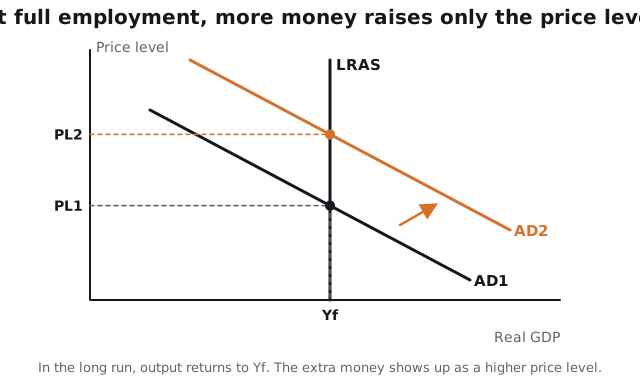
Over long periods, the growth rate of the money supply determines the inflation rate. When a central bank makes the money supply grow faster year after year, the inflation rate rises.
Part 3 of 3 Inflation as a Monetary Event
Inflation results when a central bank increases the money supply too fast for a sustained period. More dollars chase the same goods, so prices climb year after year. Deflation results when the money supply shrinks for a sustained period. A central bank that keeps money growth slow and steady keeps inflation low.
In the long run, the growth rate of the money supply sets the inflation rate.
Key Terms
Practice Questions
4 questions. Nothing here is recorded or scored.
- Question 1POL-3.A.3
In an economy, the money supply is $4 trillion and the velocity of money is 3. According to the equation of exchange, what is nominal GDP?
- A.$0.75 trillion
- B.$1.33 trillion
- C.$7 trillion
- D.$12 trillion
Check answerHide answer
Answer: D
- A.
- This divides velocity by money. The equation multiplies them.
- B.
- This divides money by velocity. Nominal GDP is money times velocity.
- C.
- This adds money and velocity. The equation multiplies them.
- D.
- Correct. MV = PY, and PY is nominal GDP. $4 trillion x 3 = $12 trillion.
- Question 2POL-3.A.3
Nominal GDP is $18 trillion and the money supply is $6 trillion. What is the velocity of money?
- A.0.33
- B.3
- C.12
- D.24
Check answerHide answer
Answer: B
- A.
- This divides money by nominal GDP, which inverts the ratio.
- B.
- Correct. Velocity is nominal GDP divided by the money supply: $18 trillion / $6 trillion = 3. Each dollar is spent on final goods and services three times a year on average.
- C.
- This subtracts money from nominal GDP. Velocity is a ratio.
- D.
- This adds the two values. Velocity is nominal GDP divided by money.
- Question 3POL-3.A.2
An economy is at full employment. The central bank makes a one-time increase in the money supply. According to the quantity theory, what is the long-run effect?
- A.Real output is unchanged, and the price level is higher.
- B.Real output is higher, and the price level is unchanged.
- C.Real output is higher, and the price level is higher.
- D.Real output is lower, and the price level is unchanged.
Check answerHide answer
Answer: A
- A.
- Correct. At full employment, output in the long run is set by resources and technology, so extra money cannot raise it. With velocity stable, more money means a higher price level.
- B.
- Output may rise for a while, and in the long run it returns to full employment. The new money ends up in prices.
- C.
- Real output rises only in the short run. In the long run, only the price level stays higher.
- D.
- More money does not reduce long-run output, and it does raise the price level.
- Question 4POL-3.A.1
Which of the following is most likely to cause inflation that continues for many years?
- A.A one-time increase in the world price of oil
- B.A central bank that increases the money supply much faster than real output grows, year after year
- C.A single large tax cut
- D.A steady rise in labor productivity
Check answerHide answer
Answer: B
- A.
- A one-time cost shock raises the price level once. Without continued money growth, it does not keep prices rising every year.
- B.
- Correct. Sustained inflation results from increasing the money supply too fast for a sustained period. Each year more money chases goods that grow more slowly.
- C.
- A single tax cut can raise aggregate demand once. Sustained inflation requires sustained money growth.
- D.
- Rising productivity raises real output, which tends to lower inflation for a given money growth rate.
Practice every topic in Unit 5
CED Codes
POL-3.A.1 · POL-3.A.2 · POL-3.A.3