5.4 Government Deficits and the National Debt
Calculate a government budget surplus or deficit, see how deficits build the national debt, and weigh the burden that interest on the debt creates.
Part 1 of 3 Surplus and Deficit
A government's budget balance for one year is its tax revenue minus its spending on purchases and transfer payments. When revenue is larger, the government runs a budget surplus. When spending is larger, it runs a budget deficit.
Suppose the imaginary country of Pellandia collects $800 billion in taxes and buys $640 billion of goods and services. It also pays $220 billion in transfer payments such as pensions and unemployment benefits. Its budget balance is $800 - ($640 + $220) = -$60 billion, a $60 billion deficit.
Part 2 of 3 How Deficits Build the Debt
A government covers a deficit by borrowing, usually by selling bonds. The national debt is the total it owes from all past borrowing. Each deficit adds to the debt; each surplus can pay part of it down.
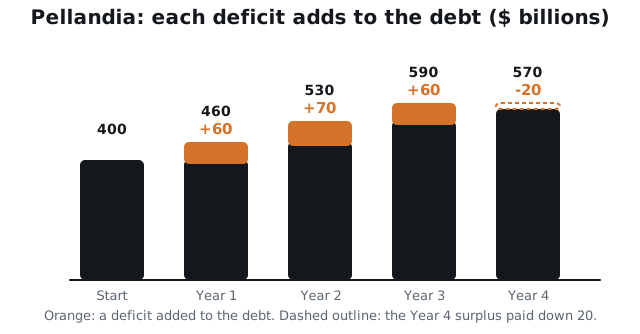
| Year | Budget balance | Debt at year end |
|---|---|---|
| Start | 400 | |
| 1 | -60 (deficit) | 400 + 60 = 460 |
| 2 | -70 (deficit) | 460 + 70 = 530 |
| 3 | -60 (deficit) | 530 + 60 = 590 |
| 4 | +20 (surplus) | 590 - 20 = 570 |
Part 3 of 3 The Cost of Carrying Debt
A government must pay interest on its accumulated debt every year. Interest payments are part of government spending, so they make a deficit larger, and a larger deficit adds still more to the debt. At a 4% interest rate, Pellandia's $570 billion debt costs about $23 billion a year in interest.
The $23 billion of interest cannot pay for schools, roads or tax cuts. The larger the debt, the more of each year's budget goes to interest and the less is left for other uses. Government borrowing can also push up interest rates for private borrowers, which topic 5.5 covers as crowding out.
A deficit is one year's shortfall. The national debt is the running total of every deficit minus every surplus.
Key Terms
Practice Questions
6 questions. Nothing here is recorded or scored.
- Question 1POL-3.B.1
A government collects $2.4 trillion in tax revenue, spends $1.9 trillion on purchases of goods and services and pays $0.8 trillion in transfer payments. What is its budget balance?
- A.A deficit of $0.3 trillion
- B.A surplus of $0.5 trillion
- C.A deficit of $1.1 trillion
- D.A surplus of $0.3 trillion
Check answerHide answer
Answer: A
- A.
- Correct. Budget balance = tax revenue - (purchases + transfers) = $2.4 - ($1.9 + $0.8) = -$0.3 trillion, a deficit.
- B.
- This leaves out transfer payments, which are government spending too.
- C.
- This subtracts the transfers from purchases instead of adding them: $1.9 - $0.8 = $1.1. Spending is the sum, $2.7 trillion.
- D.
- The size is right and the sign is wrong. Spending of $2.7 trillion exceeds revenue of $2.4 trillion.
- Question 2POL-3.B.2
Which statement correctly distinguishes a budget deficit from the national debt?
- A.A deficit is the total owed; the national debt is the shortfall in one year.
- B.A deficit is money owed to foreigners; the national debt is money owed to citizens.
- C.A deficit is the shortfall in one year; the national debt is the total owed from all past deficits minus past surpluses.
- D.A deficit and the national debt are two names for the same amount.
Check answerHide answer
Answer: C
- A.
- This reverses the two terms.
- B.
- Who holds the debt does not define either term. Both can be owed to citizens or foreigners.
- C.
- Correct. A deficit measures a single year. Each deficit adds to the national debt, which is a running total.
- D.
- They are different: the debt is the sum of many years of deficits and surpluses.
- Question 3POL-3.B.2
A government starts the year with a national debt of $5.0 trillion. It runs deficits of $0.4 trillion, $0.3 trillion and $0.2 trillion over the next three years. What is the national debt at the end of the three years?
- A.$0.9 trillion
- B.$5.0 trillion
- C.$5.2 trillion
- D.$5.9 trillion
Check answerHide answer
Answer: D
- A.
- This adds up the three deficits and forgets the $5.0 trillion already owed.
- B.
- Shrinking deficits still add to the debt. Only a surplus would lower it.
- C.
- This adds only the last year's deficit. All three deficits add to the debt.
- D.
- Correct. Each deficit adds to the debt: $5.0 + $0.4 + $0.3 + $0.2 = $5.9 trillion.
- Question 4POL-3.B.3
Why does interest on the national debt create a burden for a government?
- A.Interest payments are made only when the government runs a surplus.
- B.Interest payments use funds that could go to other purposes, and when they are paid with more borrowing, they add to the debt.
- C.Interest on the debt lowers the price level and causes deflation.
- D.Interest is paid once, when the bonds are first sold.
Check answerHide answer
Answer: B
- A.
- Interest is owed every year, whatever the budget balance.
- B.
- Correct. A government must pay interest on its accumulated debt every year. Money spent on interest cannot fund schools or tax cuts, and borrowing to pay interest makes the debt larger.
- C.
- Interest payments do not cause deflation. The burden is the money they take from other uses.
- D.
- Bonds pay interest every year until they mature.
- Question 5POL-3.B.1, POL-3.B.2
A government's budget deficit shrinks from $500 billion last year to $300 billion this year. What happens to the national debt this year?
- A.It rises by $300 billion.
- B.It falls by $200 billion.
- C.It rises by $200 billion.
- D.It does not change.
Check answerHide answer
Answer: A
- A.
- Correct. Any deficit adds to the debt. This year's deficit is $300 billion, so the debt grows by $300 billion.
- B.
- The $200 billion is the improvement in the deficit. The government still borrowed $300 billion, so the debt rose.
- C.
- The $200 billion is the change in the deficit, not the amount added to the debt.
- D.
- The debt stays the same only with a balanced budget. A $300 billion deficit adds $300 billion.
- Question 6POL-3.B.3, POL-3.B.1
Interest in Corvessa
The imaginary country of Corvessa owes a national debt of $2,000 billion at an average interest rate of 5%. This year, its tax revenue exactly equals its spending on everything except interest.
What are Corvessa's budget balance this year and its national debt at the end of the year, assuming it borrows to cover any deficit?
- A.A balanced budget, and a debt of $2,000 billion
- B.A deficit of $100 billion, and a debt of $2,000 billion
- C.A deficit of $2,100 billion, and a debt of $2,100 billion
- D.A deficit of $100 billion, and a debt of $2,100 billion
Check answerHide answer
Answer: D
- A.
- Interest is government spending. Leaving it out hides a $100 billion deficit.
- B.
- The deficit is right, and borrowing to cover it adds $100 billion to the debt.
- C.
- This treats the whole debt as this year's deficit. The deficit is one year's shortfall, $100 billion.
- D.
- Correct. Interest is 5% of $2,000 billion, or $100 billion. All other spending is covered by taxes, so the interest is the whole deficit. Borrowing $100 billion raises the debt to $2,100 billion.
Practice every topic in Unit 5
CED Codes
POL-3.B.1 · POL-3.B.2 · POL-3.B.3