5.5 Crowding Out
How government borrowing to cover a deficit raises the real interest rate, crowds out private investment, and can slow growth in the long run.
Part 1 of 3 Borrowing to Cover a Deficit
When a government runs a budget deficit, it typically borrows to cover the gap by selling bonds. The government's borrowing competes with firms and households for the same pool of saving. Crowding out is the fall in interest-sensitive private spending that happens when government borrowing raises the real interest rate.
The imaginary country of Velmora starts a large highway program and pays for it with borrowed money. Its deficit grows by $150 billion. The government must bid funds away from private borrowers.
Part 2 of 3 Crowding Out on the Graph
The loanable funds market shows the effect. A larger deficit lowers public savings, which shifts the supply of loanable funds left. (Drawing the extra borrowing as a rightward shift of demand gives the same higher real rate.) The real interest rate rises from r1 to r2.
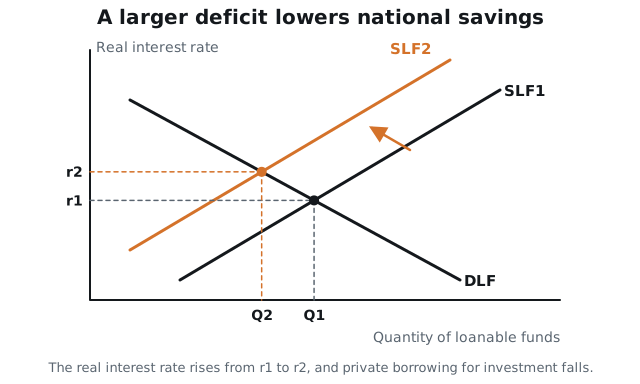
At the higher real rate, fewer private projects are worth borrowing for. A furniture maker cancels a new workshop; a family delays buying a house. Business investment and other interest-sensitive spending, such as purchases of homes and cars, fall.
| Step | What happens |
|---|---|
| 1 | The government runs a larger deficit and borrows more |
| 2 | The real interest rate rises in the loanable funds market |
| 3 | Private investment and other interest-sensitive spending fall |
| 4 | Part of the boost to aggregate demand from the fiscal policy is offset |
| 5 | Over time, a smaller capital stock means less economic growth |
Part 3 of 3 Short-Run and Long-Run Effects
In the short run, crowding out weakens expansionary fiscal policy. The highway spending raises aggregate demand, and the drop in private investment pulls part of that gain back. Aggregate demand still rises, by less than it would have without the higher interest rate.
In the long run, crowding out can lower the rate of physical capital accumulation. Firms that skip new machines and buildings today have fewer tools to work with later. Less capital per worker means slower productivity growth and less economic growth. If the borrowed money builds useful public capital, such as Velmora's highways, that capital can offset part of the loss.
Government borrowing raises the real interest rate and reduces private investment. The reduction is crowding out.
Key Terms
Practice Questions
6 questions. Nothing here is recorded or scored.
- Question 1POL-3.C.3
Which of the following best defines crowding out?
- A.Increased government borrowing raises interest rates and reduces interest-sensitive private spending.
- B.Increased government spending raises imports and reduces net exports.
- C.Higher taxes reduce the amount households save.
- D.Government purchases replace private purchases one for one because the government buys the same goods.
Check answerHide answer
Answer: A
- A.
- Correct. Crowding out is the adverse effect of government borrowing: it raises the real interest rate, so firms and households cut spending that depends on interest rates, such as investment.
- B.
- This describes a change in net exports. Crowding out works through interest rates and private investment.
- C.
- Crowding out is about government borrowing pushing up interest rates.
- D.
- Crowding out works through the interest rate, and the government does not need to buy the same goods as private buyers.
- Question 2POL-3.C.2
A government increases its budget deficit and borrows to cover it. In the loanable funds market, what happens to the real interest rate and to private investment?
- A.The real interest rate falls, and private investment rises.
- B.The real interest rate rises, and private investment rises.
- C.The real interest rate rises, and private investment falls.
- D.The real interest rate falls, and private investment falls.
Check answerHide answer
Answer: C
- A.
- More borrowing competes for the same saving, which raises the price of borrowing.
- B.
- A higher real interest rate makes fewer private projects worth funding, so investment falls.
- C.
- Correct. Government borrowing increases the demand for loanable funds (or lowers national savings and supply). Either way the real interest rate rises, and at the higher rate firms undertake fewer projects.
- D.
- Government borrowing raises the real rate. A falling rate would encourage investment.
- Question 3POL-3.C.4
What is a potential long-run effect of crowding out?
- A.A larger stock of physical capital and faster economic growth
- B.A permanent rise in the natural rate of unemployment
- C.A lower price level because the government spends more
- D.A smaller stock of physical capital and slower economic growth
Check answerHide answer
Answer: D
- A.
- Crowding out reduces private investment, which slows capital accumulation.
- B.
- Crowding out works through capital and productivity, not the natural rate of unemployment.
- C.
- More government spending raises aggregate demand and tends to raise the price level.
- D.
- Correct. When higher interest rates cut private investment year after year, firms add fewer machines and buildings. Less capital per worker means slower growth in productivity and potential output.
- Question 4POL-3.C.3
Government borrowing raises the real interest rate. Which type of private spending is most likely to fall?
- A.A government's transfer payments to retirees
- B.A firm's purchase of new factory equipment financed with a loan
- C.A household's weekly grocery purchases
- D.A household's spending on haircuts
Check answerHide answer
Answer: B
- A.
- Transfer payments are government spending, not private spending.
- B.
- Correct. Crowding out hits interest-sensitive private spending. A loan-financed equipment purchase costs more when rates rise, so some firms cancel or delay it.
- C.
- Groceries are paid from current income and rarely financed with loans, so they barely respond to interest rates.
- D.
- Haircuts are small, regular purchases paid from income. Interest rates have little effect on them.
- Question 5POL-3.C.2, POL-3.C.3
A government raises its purchases by $50 billion and borrows the full amount. Aggregate demand rises by less than the spending multiplier alone predicts. Which of the following explains the difference?
- A.The borrowing lowers the real interest rate, and private saving falls.
- B.The spending multiplier works only when the government runs a surplus.
- C.The borrowing raises the real interest rate, and the drop in private investment offsets part of the increase in aggregate demand.
- D.The added government purchases lower the price level, which reduces consumption.
Check answerHide answer
Answer: C
- A.
- Government borrowing raises the real interest rate. A lower rate would encourage spending.
- B.
- The spending multiplier applies whatever the budget balance. Crowding out is what reduces the net effect.
- C.
- Correct. Crowding out explains the gap. Higher real interest rates reduce interest-sensitive private spending, so the net increase in aggregate demand is smaller than the government purchases times the multiplier.
- D.
- More government purchases raise aggregate demand, which raises the price level.
- Question 6POL-3.C.1
When a government runs a budget deficit, how does it typically pay for the spending that tax revenue does not cover?
- A.It borrows by selling government bonds.
- B.It cuts the interest rate it pays on reserves.
- C.It lowers taxes to raise revenue.
- D.It sells foreign currency to its own citizens.
Check answerHide answer
Answer: A
- A.
- Correct. A government in deficit typically borrows to cover the gap, usually by issuing bonds. That borrowing is the source of crowding out.
- B.
- Interest on reserves is a central bank tool for steering interest rates. It does not pay for government spending.
- C.
- Lower taxes typically reduce revenue and widen the deficit.
- D.
- Governments pay for deficits by borrowing, usually by selling bonds.
Practice every topic in Unit 5
CED Codes
POL-3.C.1 · POL-3.C.2 · POL-3.C.3 · POL-3.C.4