3.5 Financial Capital
Why businesses raise outside capital, where it comes from, and how to pitch lenders and investors.
Part 1 of 4 Why a Business Goes Looking for Money
Many founders start by bootstrapping: personal savings, sometimes a personal bank loan or personal credit. Two tests say whether bootstrapping is enough. Compare personal funds with the business's initial needs, and work out break-even, the sales that cover a period's costs exactly.
If fixed costs run $9,900 a month and each drink contributes $4.50 after its own variable cost, break-even is 2,200 drinks a month, about 73 a day. An entrepreneur seeks external financial capital when personal money cannot pay the startup costs and the operating costs for long enough to reach break-even. Established businesses raise outside money too: for new products, to replace worn fixed assets, to grow sales, and to manage cash flow. Cash flow needs managing because revenue arrives unevenly while rent and payroll fall due on fixed dates.
Part 2 of 4 Two Deals: Loans and Equity
| Debt financing | Equity financing | |
|---|---|---|
| What it is | A sum borrowed and repaid on a schedule with interest; the interest is a business expense | Ownership shares issued for cash; the investors become part owners |
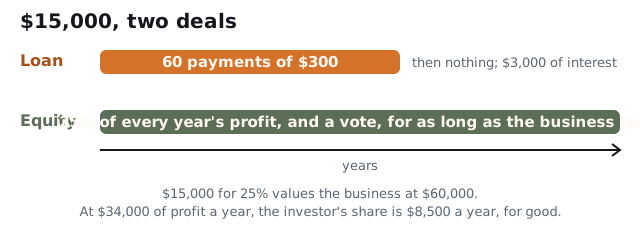
| What it costs | Higher rates and bigger loans cost more. $15,000 over 60 payments of $300 returns $18,000: $3,000 of interest (example figures; a real payment splits differently each month) | A share of future profits and a say in decisions, for as long as the business lasts |
| Who can get it | Established businesses, typically at least two years old with proven revenue and the capacity to repay, from a business bank loan; corporations also issue bonds | New businesses, from friends, family or outside investors; corporations issue stock, privately or publicly |
New businesses, usually under two years old, have no revenue record for a bank to judge, so they borrow from friends and family or sell shares. An offer of $15,000 for 25% of the business values the whole business at $60,000, because $15,000 divided by 0.25 is $60,000. The $60,000 figure is a valuation.
Part 3 of 4 What Lenders and Investors Get and Risk
Both deals hand the provider a financial asset, a loan (including a bond) or a share, that can be resold in a secondary market. A lender, also called a creditor, earns interest. An investor may earn dividends, which are a share of profits. Some corporations reinvest their profits and pay no dividends. An investor may also earn a capital gain if the asset sells for more than the investor paid. The prices of loans, bonds and shares move with business performance, investor demand and PESTEL forces. Buying a corporate bond makes a consumer a lender to that business; buying a share makes her an owner.
A $100 share that pays a $3 dividend and resells for $105 earns $8 in total, an 8% rate of return. Both providers can lose money. A lender loses when payments stop. An investor loses dividend income when profits fall, loses value when the business shrinks, and can lose the whole stake when it closes. Providers differ in risk tolerance. Some lenders and investors, both consumers and institutions, fund risky or unproven ideas. Other lenders and investors stay cautious. Every lender and investor expects a higher return for a riskier asset.
Part 4 of 4 The Pitch
Lenders and investors ask for a business plan: the value proposition, the market research behind it, the marketing strategy and the financial projections. Together those justify the size of the request, the expected return and the risk. The same plan compressed into a presentation is the pitch.
| They look for | Because |
|---|---|
| Evidence of product-market fit and a basis for every projected number | They prefer lower risk and higher projected returns |
| Financial reports, projections and industry data (established businesses) | Funders use these documents to estimate a valuation, meaning what a share is worth, and to judge whether the business can repay a loan |
| The leadership team's qualifications | Funders judge whether the leadership team can carry out the plan |
| Fit between the business's mission and the funder's goals | Funders choose by purpose as well as by return |
Funders approve a funding request because of its evidence. Any founder can show enthusiasm, so funders do not count enthusiasm as evidence.
Worked Examples
Break-even in units, and in units per day
Compute the sales volume that covers a period's costs and convert it into a daily target.
A founder projects $6,000 of monthly costs at opening. Each unit sells for $6.00 and carries $1.50 of ingredients and packaging. Find the monthly break-even volume and the daily pace it implies.
- Projected monthly costs
- $6,000
- Selling price per unit
- $6.00
- Variable cost per unit
- $1.50
- Days open per month
- about 30
1. Find what each unit contributes
Subtract the variable cost from the price. $6.00 minus $1.50 leaves $4.50 that each sale puts toward the monthly costs.
2. Divide the costs by the contribution
Break-even is the number of units whose combined contribution equals the costs. $6,000 divided by $4.50 is 1,333.3.
3. Round in the direction that actually covers the costs
A third of a unit cannot be sold, and 1,333 units falls just short, so the honest figure is 1,334.
4. Convert to a daily pace
Divide by the days the shop is open. 1,334 over 30 is about 44.5, which rounds to roughly 45 units a day.
Check answerHide answer
Answer
1,334 units a month, about 45 a day. The business must sell about 45 units a day just to stand still.
Why it matters
Break-even converts an intimidating cost total into a daily number a founder can actually watch. Pitching 60 a day against a 45-a-day floor is what makes a projection credible to a lender rather than merely optimistic.
What an equipment loan costs in total
Compute total repayment, total interest, and the split inside a single flat loan payment.
A $15,000 equipment loan is repaid over five years in sixty monthly payments of $300, structured so that every payment splits the same way. Find the cost of borrowing and the composition of one payment.
- Principal borrowed
- $15,000
- Number of payments
- 60
- Payment amount
- $300
1. Total everything repaid
Multiply the payment by the number of payments. 60 times $300 is $18,000.
2. Subtract the amount borrowed
Everything above the principal is the cost of borrowing. $18,000 minus $15,000 is $3,000 of interest.
3. Split one payment
Spread the principal evenly across the term: $15,000 over 60 payments is $250 of principal each time, so the remaining $50 of the $300 is interest.
4. Express the cost as an annual rate
The average-balance shortcut gives a rough answer. $3,000 of interest across five years is $600 a year, and on a balance averaging roughly half of $15,000 that reads as about 8%. The rate the lender would actually disclose on this payment schedule is about 7.4% a year. The gap between the two is what the shortcut costs, because the balance falls unevenly rather than sitting at exactly half the principal.
Check answerHide answer
Answer
$3,000 of interest on $15,000 borrowed. Sixty payments of $300 return $18,000 against $15,000 borrowed, so borrowing cost $3,000, and each payment is $250 of principal plus $50 of interest.
Why it matters
Only the $50 half reaches an income statement as interest expense. The $250 half retires debt and shows up on the balance sheet instead, which is why the income statement alone never tells a reader how fast a loan is disappearing.
Pricing an equity offer against a loan
Derive the valuation implied by an equity offer and compare its long-run cost against a loan.
At the end of year one an investor offers $15,000 for a 25% ownership stake. That year the business netted $18,000. The existing loan costs $50 a month in interest and ends after payment sixty. Evaluate the offer.
- Cash offered
- $15,000
- Ownership requested
- 25%
- Year one net profit
- $18,000
- Monthly loan interest
- $50
1. Back out the implied valuation
If $15,000 buys a quarter of the business, the whole business is being valued at four times that. $15,000 divided by 0.25 is $60,000.
2. Price the annual cost of the stake
The investor is entitled to a quarter of the profit. 0.25 times $18,000 is $4,500 a year, and that claim has no end date.
3. Price the annual cost of the loan
Interest of $50 a month is $600 a year, and it stops when the sixtieth payment clears.
4. Set the two side by side
Compare the recurring costs. $4,500 a year forever against $600 a year for a fixed term, plus a vote in every decision on one side and none on the other.
Check answerHide answer
Answer
Decline: the equity costs 7.5 times more per year and never ends. The offer values the whole business at $60,000 and would cost $4,500 of profit every year permanently, against $600 a year on the loan for a term that ends.
Why it matters
Equity is not repaid, which is exactly what makes it expensive. The comparison an exam wants is not which deal is cheaper this month, it is which deal has a final payment.
Computing an annual rate of return
Combine income and capital gain into a single return figure for a financial asset.
An investor pays $100 for a share. Over the following year it pays $3 in dividends, and she sells it for $105. Compute the annual rate of return.
- Purchase price
- $100
- Dividends received
- $3
- Sale price
- $105
1. Find the capital gain
Subtract what was paid from what the sale brought in. $105 minus $100 is a $5 gain.
2. Add income to the gain
Total dollars gained combines both ways an investor is paid. $3 of dividends plus $5 of capital gain is $8.
3. Divide by the price paid
The denominator is always what the asset cost. $8 over $100 is 0.08.
4. State it as a percentage
Multiply by 100 to reach 8%.
Check answerHide answer
Answer
8%. Three dollars of income and five dollars of capital gain on a $100 asset produce an 8% annual return.
Why it matters
The same formula prices a bond, a share, or a loan, which is what makes it useful. It is also why a provider of capital demanding more return is really demanding compensation for more risk.
Key Terms
Practice Questions
6 questions. Nothing here is recorded or scored.
- Question 13.5.A.1
Kicktail Boardshop
Jonah Park is three months from opening Kicktail Boardshop, a skateboard shop in a storefront two blocks from his city's busiest public skate park. His startup list totals 28,000 dollars: the counter and shelving buildout, the first order of decks, trucks, and wheels, a register system, and permits. Jonah has 10,000 dollars saved from three years of part-time work, and he plans to put all of it into the shop. That leaves 18,000 dollars to raise, and he is weighing two offers. His bank approved an 18,000-dollar five-year business loan on one condition: his uncle, who has a long credit history, signs as co-signer, because the shop has no sales record for the bank to judge. And a local investor who has watched the skate park crowds grow for years has offered 20,000 dollars in exchange for a 40 percent ownership stake in the shop.
Jonah's plan to fund part of the shop with his own 10,000 dollars of savings is best described as which of the following?
- A.Equity financing, because the savings will become Jonah's ownership stake in the shop.
- B.Bootstrapping, funding startup costs from the founder's personal savings.
- C.A business bank loan, because the shop will draw the savings from Jonah's bank.
- D.Issuing a bond, because Jonah is lending the money to his own business.
Check answerHide answer
Answer: B
- A.
- A near miss on purpose. The contribution does become Jonah's ownership stake, but equity financing means issuing ownership shares to someone else, trading a slice of control and future profits for their cash, and spending your own savings sells nothing to anyone.
- B.
- Correct. Bootstrapping is the framework's word for an entrepreneur funding startup costs with personal resources: personal savings first, and for some founders personal bank loans or personal credit. 10,000 dollars of Jonah's own saved money is the textbook case, and most founders start exactly here, because outside money is only worth its cost after the founder's own runs out.
- C.
- Which bank holds the savings changes nothing. A business bank loan is money the bank lends to the business and the business repays with interest; Jonah is spending money he already owns, borrowing nothing.
- D.
- This borrows next-door vocabulary. A bond is a loan an investor makes to a corporation; spending personal savings on your own shop lends nothing and issues nothing.
- Question 23.5.B.2, 3.5.B.3
Which of the following best explains the bank's co-signer condition?
- A.A shop with no revenue record leaves the bank no repayment history to judge.
- B.Banks are legally required to obtain co-signers on retail business loans.
- C.The uncle's signature entitles him to a share of the shop's future profits.
- D.The bank wants the uncle's assets pledged as collateral for the loan.
Check answerHide answer
Answer: A
- A.
- Correct. An established business, typically two years or more of operation with proven revenue, can borrow from a bank on its own record. A brand-new business has no record to price, so lenders look through it to someone who does; that is why new businesses so often borrow from friends and family, or, as here, put a relative's credit behind the bank's loan. The signature is a promise that if the shop cannot pay, the uncle will.
- B.
- No such law exists. The co-signer is the bank's answer to a specific risk problem, a borrower with no revenue record, not a requirement attached to retail businesses as a category.
- C.
- The co-signer-as-investor confusion. A co-signer takes on lender-sized risk and receives no ownership, no profit share, and no interest for carrying it.
- D.
- This over-applies the secured-loan logic. Collateral is a specific asset pledged so the lender can seize it on default, and nothing here is pledged; a co-signer backs the loan with a promise to repay and a credit record the bank can judge, not with a named asset.
- Question 33.5.B.1.ii
Which of the following best identifies what Jonah gives up if he accepts the investor's 20,000 dollars?
- A.He must repay the 20,000 dollars with interest across five years.
- B.He loses the 10,000 dollars of savings he has already committed.
- C.He must return the investor's money in a year the shop earns no profit.
- D.He gives up 40 percent of future profits and a voice in decisions.
Check answerHide answer
Answer: D
- A.
- The paired-concept swap. Repayment with interest is the loan's structure, and the exam loves pinning each deal's terms on the other one.
- B.
- The 10,000 dollars of savings is committed either way; accepting the investor does not take it. The question asks what the investor's 20,000 costs Jonah, and the answer is ownership, not his own contribution.
- C.
- This invents a refund. An investor's risk is exactly that bad years pay them nothing, and nobody owes the stake back.
- D.
- Correct. Equity financing trades ownership for cash: the investor becomes a part owner, collects a 40 percent share of every future profit, and gains a say in decisions, with no repayment schedule and no end date, because the money was never a loan.
- Question 43.5.B.4, 3.5.C.2
A retired teacher pays 500 dollars in the secondary market for a corporate bond issued by a national restaurant chain. Which of the following best describes the position the teacher now holds?
- A.A shareholder entitled to a share of the chain's annual profits.
- B.A part owner holding a vote on the chain's major decisions.
- C.A lender to the chain, entitled to the bond's interest payments.
- D.A co-signer responsible for the chain's other outstanding debts.
Check answerHide answer
Answer: C
- A.
- Profit shares belong to stock, the ownership asset, and a bond carries no ownership. A bondholder is a lender, not a shareholder.
- B.
- Votes belong to stock too. A bond is a loan, so it carries neither a vote nor a share of profits; both a bond and a stock are financial assets a consumer can buy secondhand, but only the stock is a piece of the company.
- C.
- Correct. A bond is a loan from an investor to a business, so whoever holds the bond holds the loan, and buying one in the secondary market makes the buyer the business's new lender, collecting the interest the bond pays.
- D.
- A co-signer promises a lender to repay a specific loan if the borrower cannot. Buying a bond creates no such promise: the teacher is owed money by the chain, and is responsible for none of the chain's other debts.
- Question 53.5.B.1.i, 3.5.B.1.ii, 3.5.C.7
Kicktail Financing Comparison
Jonah lines the two offers up side by side, and the table shows the numbers. Jonah's projected net profit for a typical year is 20,000 dollars.
Item | Co-signed bank loan | Investor offer Cash received | $18,000 | $20,000 Repayment | 60 monthly payments of $360 | None Claim on profits | None | 40% of net profit every year Voice in decisions | None | Vote on major decisions Which conclusion is supported by the table?
- A.In one typical year the investor's profit share exceeds five years of loan interest.
- B.The loan is the cheaper capital because 18,000 dollars is less than 20,000.
- C.Accepting the investor's offer guarantees the shop a 20,000-dollar profit each year.
- D.The loan costs Jonah nothing because payments come out of the shop's revenue.
Check answerHide answer
Answer: A
- A.
- Correct. Price the loan first: 60 payments of 360 dollars is 21,600 repaid on 18,000 borrowed, so the loan's full cost is 3,600 dollars of interest across five years. Price the equity the same way: 40 percent of a 20,000-dollar net profit is 8,000 dollars handed over in one typical year, again the next year, with no final payment ever scheduled. 8,000 in one year beats 3,600 across five, and the gap is the price of risk: an owner gets paid only when profits exist and can lose the whole stake, so investors demand a bigger return than lenders do.
- B.
- This prices the loan by its principal. The 18,000 goes back to the bank either way, and a loan's cost is its interest, never the size of the check.
- C.
- This reads a projection as a promise. The table projects 20,000 dollars of profit, and no financing choice can guarantee a projection comes true.
- D.
- Payments coming out of revenue does not make them free; every dollar of the 21,600 repaid leaves the shop, and 3,600 of it is interest the business would otherwise keep. A cost does not disappear by being routed through the register.
- Question 63.5.C.5
An investor buys one share of stock in a public shipping company for 50 dollars. During the year the share pays a 2-dollar dividend, and at the end of the year the investor sells it for 54 dollars. Which of the following is the investment's annual rate of return?
- A.4 percent.
- B.8 percent.
- C.11.1 percent.
- D.12 percent.
Check answerHide answer
Answer: D
- A.
- Half the answer: this counts only the dividend, 2 on 50. Numbers that split cleanly into income and gain are the exam writers inviting you to forget one.
- B.
- The other half: this counts only the capital gain, 4 on 50, and forgets the dividend income.
- C.
- This divides the 6 dollars gained by the 54-dollar sale price. The base of a rate of return is the price paid for the asset, the 50 dollars, never the price the sale returned.
- D.
- Correct. The annual rate of return divides total dollars gained by the price paid for the asset, and total dollars gained adds income to capital gain. The income is the 2-dollar dividend; the capital gain is 54 minus 50, 4 dollars earned by selling the share for more than it cost. 6 dollars gained on a 50-dollar price is 12 percent.
In a class? These questions are not recorded.
Take the same questions as a scored quiz and your teacher will see that you have finished this section.
Take the scored quiz →8 Common Mistakes on 3.5
The wrong moves students actually make on these questions, why each one is wrong, and what to do instead. Part of the practice tier.
See what is includedCED Codes
3.5.A.1 · 3.5.A.2 · 3.5.A.3 · 3.5.A.4 · 3.5.A.5 · 3.5.B.1 · 3.5.B.1.i · 3.5.B.1.ii · 3.5.B.2 · 3.5.B.3 · 3.5.B.4 · 3.5.C.1 · 3.5.C.2 · 3.5.C.3 · 3.5.C.4 · 3.5.C.5 · 3.5.C.6 · 3.5.C.7 · 3.5.D.1 · 3.5.D.2 · 3.5.D.3 · 3.5.D.4